Week - 2 - Explicit and Implicit Analysis
EXPLICIT ANALYSIS: The explicit analysis needs very small step to be stable, i.e., time step to be less than the courant_friedrichs-levy-criterion. This explicit method calculates the state of the system for the later time from the current time. This kind of analysis is used in different applications like crash analysis, drop test, blast, etc., It is less accurate.
Sum of all the forces = mass * acceleration.
IMPLICIT ANALYSIS: Implicit analysis are used when the analysis conducted is very slow and the effect of strain rates are minimal. If the growth of the stress as a function of strain is established then we can consider for implicit analysis. This method calculates the state of system by involving the current and later state of the system. Implicit analysis takes larger time steps so it is unconditionally stable. It is much more accurate than the explicit analysis.
Sum of all the forces = 0.
EXPLICIT METHOD:
Given f(u)= `u^3`+`9*u^2`+4*u;
k(u)= `3*u^2+18*u+4`;
let us assume
step-1
u0=0;
'Detla'F=0;
k(u1)=3*(0)^3+18*(0)+4;
k(u1)=4;
'Delta'u1='Delta'F/k(u0);
'Delta'u1=1/4=0.25;
u1=u0+'Delta'u1;
u1=0+0.25;
Fext=1;
fint=(0.25)^3+9*(0.25)^2+4*(0.25);
fint=1.578;
R0=(fint)1-(Fext)1=1.578-1;
R0=0.578;
step-2
u1=0.25;
k(u1)=3*(0.25)^3+18*(0.25)+4;
k(u1)=8.625;
'Delta'u2='Delta'F/k(u1)=1/8.625=0.11594;
u2=u1+'Delta'u2=0.25+0.11594=0.36594;
Fext=2;
fint=(0.36594)^3+9*(0.36594)^2+4*(0.36594)=2.707;
R1=(fint)2-(Fext)2=2.707-2=0.707;
step-3
u2=0.36594;
k(u2)=3*(0.36594)^3+18*(0.36594)+4=10.988;
'Delta'u3='Delta'F/k(u2)=1/10.988=0.0910;
u3=u2+'Delta'u3=0.36594+0.0910=0.45694;
Fext=3;
fint=(0.45694)^3+9*(0.45694)^2+4*(0.45694)=3.792;
R1=(fint)2-(Fext)2=3.792-3=0.792;
Table for the explicit method:
| steps | 'Delta'f | 'Delta'ui |
ui |
Fext | fint | R=fint-Fext |
| 1 | 1 | 0.25 | 0.25 | 1 | 1.578 | 0.578 |
| 2 | 1 | 0.11594 | 0.36594 | 2 | 2.707 | 0.707 |
| 3 | 1 | 0.0910 | 0.45921 | 3 | 3.792 | 0.792 |
IMPLICIT METHOD:
This method is same as the explicit method but to achieve the equlibrium we need to do the newton raphson iterations before going to next step these iterations are continued till we achieve the tolerance value of 10^-3.
Given f(u)= `u^3`+`9*u^2`+4*u;
k(u)= `3*u^2+18*u+4`;
let us assume
step-1
u0=0;
'Detla'F=0;
k(u1)=3*(0)^3+18*(0)+4;
k(u1)=4;
'Delta'u1='Delta'F/k(u0);
'Delta'u1=1/4=0.25;
u1=u0+'Delta'u1;
u1=0+0.25;
Fext=1;
fint=(0.25)^3+9*(0.25)^2+4*(0.25);
fint=1.578;
R0=(fint)1-(Fext)1=1.578-1;
R0=0.578>0.001;
u10=u1=0.25;
1st iteration
'delta'u11=-([k(u10)]^-1)*R0;
'delta'u11=-([3*(0.25)^3+18*(0.25)+4]^-1)*R0=-0.066;
u11='delta'u11+u10;
u11=-0.066+0.25;
u11=0.184;
f(u11)=(0.184)^3+9*(0.184)^2+4*(0.184);
f(u11)=1.046;
Fext=1;
R1=f(u11)-Fext=1.046-1=0.046>0.001
2nd iteration
'delta'u12='delta'u11-([k(u11)]^-1)*R1;
'delta'u12=-0.066-([3*(0.184)^3+18*(0.184)+4]^-1)*0.046=-0.072;
u12='delta'u12+u10=-0.072+0.25=0.178;
f(u12)=(0.178)^3+9*(0.178)^2+4*(0.178)=1.002;
R2=f(u12)-Fext=1.002-1=0.002>0.001;
3rd iteration
'delta'u13='delta'u12-([k(u12)]^-1)*R2;
'delta'u13=-0.072-([3*(0.178)^3+18*(0.178)+4]^-1)*0.002=-0.07227;
u13='delta'u13+u10=-0.07227+0.25=0.1777;
f(u13)=(0.1777)^3+9*(0.1777)^2+4*(0.1777)=1.0006068;
R2=f(u13)-Fext=1.0006068-1=0.000606<0.001; we can stop the iteration as the tolerance is achieved.
step-2
let us assume u1=u13
u1=0.1777;
k(u1)=3*(0.1777)^3+18*(0.1777)+4=7.29333;
'Delta'u2='Delta'F/k(u1)=1/7.2933=0.13711;
u2='Delta'u2+u1=0.13711+0.1777=0.3148;
f(u2)=(0.3148)^3+9*(0.3148)^2+4*(0.3148)=2.18229;
Fext=2;
R0=2.18229-2=0.18229;
u20=u2;
1st iteration
'delta'u21=-([3*(0.25)^3+18*(0.25)+4]^-1)*0.18229=-0.01829;
u21='delta'u21+u20=-0.01829+0.3148=0.29650;
f(u21)=(0.29650)^3+9*(0.29650)^2+4*(0.29650)=2.0032762;
Fext=2;
R1=f(u21)-Fext=2.0032762-2=0.0032762>0.001;
2nd iteration
'delta'u22='delta'u21-([k(u21)]^-1)*R1=-0.01829--([3*(0.2965)^3+18*(0.2965)+4]^-1)*0.003276=-0.01863122;
u22='delta'u21+u20=-0.01863+0.3148=0.29616;
f(u22)=(0.29616)^3+9*(0.29616)^2+4*(0.29616)=2.00001312;
Fext=2;
R2=2.00001312-2=0.00001312<0.001; we can stop the iterations as the tolerance is achieved
step-3
u2=u22=0.29616;
k(u2)=3*(0.29616)^3+18*(0.29616)+4=9.5940;
'Delta'u3='Delta'F/k(u22)=1/9.5940;
u3='Delta'u3+u22=0.10423+0.29616=0.40039;
f(u3)=(0.40039)^3+9*(0.40039)^2+4*(0.40039)=3.10855;
Fext=3;
R0=3.10855-3=0.10855;
1st iteration
'delta'u31=-([k(u3)]^-1)*R0=-([3*(0.40039)^3+18*(0.40039)+4]^-1)*0.10855=-0.009287;
u32='delta'u31+u3=-0.009287+0.40039=0.3911;
f(u32)=(0.3911)^3+9*(0.3911)^2+4*(0.3911)=3.00092;
Fext=3;
R1=f(u32)-Fext=3.00092-3=0.00092<0.001 we can stop the iterations as the tolerance is achieved
Table for the implicit method:
| steps | 'Delta'f | ui |
Fext | fint | R=fint-Fext |
| 1 | 1 | 0.1777 | 1 | 1.00060689 | 0.00060689 |
| 2 | 1 | 0.29616 | 2 | 2.00001312 | 0.00001312 |
| 3 | 1 | 0.3911 | 3 | 3.00092 | 0.00092 |
Exact values are evaluated by solving the equation u^3+9*u^2+4*u=Fext
Table for comparison of explicit and implicit values with exact values:
| steps | Fext | explicit ui |
implicit ui |
exact ui |
| 1 | 1 | 0.25 | 0.1777 | 0.177 |
| 2 | 2 | 0.36594 | 0.29616 | 0.296 |
| 3 | 3 | 0.45921 | 0.3911 | 0.391 |
GRAPH:
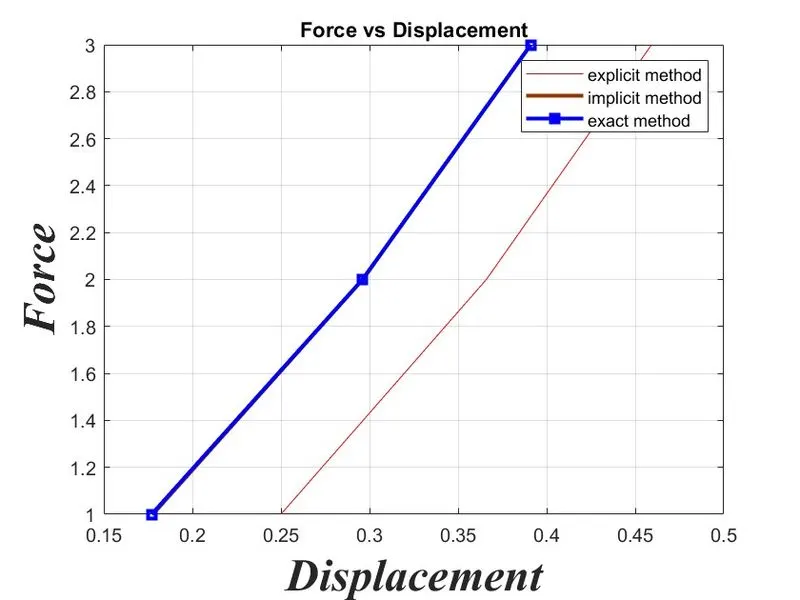
CONCLUSIONS:
The explaination for explicit and implicit analysis is done and the problem is solved based on the two methods and it is observed that the implicit analysis is giving accurate results when compared to explicit method but the time to solve the problem is high.