Week - 2 - Explicit and Implicit Analysis
Aim: To Solve the mathematical equation using Explicit and Implicit Method.
f = (u)ᶟ +9(u)² + 4(u)
Time interval problem solving can be broadly classify in two categories
1) Implicit 2) Explicit
The selection of the type of analysis depends on various factor like:
- Computational Characteristics
- Stability
- Accuracy
- Time interval
Implicit Analysis:
In Implicit the solution, will be find by solving an equation that includes current and later stage of the system. In other words, implicit will find the solution of later stage and by add it with present stage we will get the solution of the iteration.
The equation used in Implicit method is

This method is used to find solution for dynamic equation using matrix inversion method. This method is mostly recommended to find the displacement of the system. Even though we can use this method for dynamic method, but it is recommended for static and quais static analysis
This method is inverse of explicit method
Let us consider displacement is zero at force 1
K(u) = 3u² + 18u + 4 will be K(0) = 3(0)² + 18(0) + 4
K(0) = 4
ΔF = K ΔU
ΔU = ΔF/ K
ΔU = 1/4
ΔU = 0.25
U1 = u + ΔU
= 0 + 0.25
= 0.25
External force = F = 1
Internal Force = f = (u)ᶟ +9(u)² + 4(u)
= (0.25)ᶟ +9(0.25)² + 4(0.25)
= 1.5781
Residual force = 1.5781-1
Residual Force = 0.5781
R is greater than 0.001
Therefore we have to use Newton Raphson Method
U1 = U
∂U = [-K(U)]ˆ-1 x R
K(U) = 3u² + 18u + 4
=3(0.25)² + 18(0.25) + 4
= 8.6875
∂U = [-8.6575] ˆ-1 x 0.5781
∂U = -0.0665
Therefore U1 Becomes
U1 = U + ∂U
= 0.25 - 0.0665
= 0.1834
Therefore Internal force will be
Fi = (0.1834)ᶟ +9(0.1834)² + 4(0.1834)
= 1.04
Residual force = 1.04-1
Residual Force = 0.04
R is greater than 0.001
Therefore we have to use Newton Raphson Method
U1 = U
∂U = [-K(U)]ˆ-1 x R
K(U) = 3u² + 18u + 4
=3(0.1834)² + 18(0.1834) + 4
= 7.4021
∂U = [-7.4021] ˆ-1 x 0.04
∂U = -0.0054
Therefore U1 Becomes
U1 = U + ∂U
= 0.1834 – 0.0054
= 0.1779
Therefore Internal force will be
Fi = (0.1779)ᶟ +9(0.1779)² + 4(0.1779)
= 1.0020
Residual force = 1.0020-1
Residual Force = 0.002
R is greater than 0.001
Therefore we have to use Newton Raphson Method
U1 = U
∂U = [-K(U)]ˆ-1 x R
K(U) = 3u² + 18u + 4
=3(0.1779)² + 18(0.1779) + 4
= 7.2971
∂U = [-7.2971] ˆ-1 x 0.002
∂U = -0.0002
Therefore U1 Becomes
U1 = U + ∂U
= 0.1779 – 0.0002
= 0.1776
Therefore Internal force will be
Fi = (0.1776)ᶟ +9(0.1776)² + 4(0.1776)
= 0.9998
Residual force = 0.9998-1
Residual Force = - 0.0001
R is Smaller than 0.001
Therefore For iteration 1
U1 = 0.1776
Iteration 2
U = U1
K(U) = 3u² + 18u + 4
=3(0.1776)² + 18(0.1776) + 4
= 7.2914
ΔF = K ΔU
ΔU = ΔF/ K
ΔU = 1/7.4806
ΔU = 0.13714
U1 = u + ΔU
= 0.1776 + 0.1336
= 0.3147
External Force = F ext = 2
Internal Force = Fi = (u)ᶟ +9(u)² + 4(u)
= (0.3112)ᶟ +9(0.3112)² + 4(0.3112)
= 2.1812
Residual force = 2.1812 -2
Residual Force = 0.1812
R is greater than 0.001
Therefore we have to use Newton Raphson Method
U1 = U
∂U = [-K(U)]ˆ-1 x R
K(U) = 3u² + 18u + 4
=3(0.3112)² + 18(0.3112) + 4
= 9.9617
∂U = [-9.9617] ˆ-1 x 0.1812
∂U = -0.01818
Therefore U1 Becomes
U1 = U + ∂U
= 0.3112 – 0.01818
= 0.2965
Therefore Internal force will be
Fi = (0.2965)ᶟ +9(0.2965)² + 4(0.2965)
= 2.0003
Residual force = 2.003 -2
Residual Force = 0.003
R is greater than 0.001
Therefore we have to use Newton Raphson Method
U1 = U
∂U = [-K(U)]ˆ-1 x R
K(U) = 3u² + 18u + 4
=3(0.2965)² + 18(0.2965) + 4
= 9.6007
∂U = [-9.6007] ˆ-1 x 0.003
∂U = -0.00031
Therefore U1 Becomes
U1 = U + ∂U
= 0.2965 – 0.00031
= 0.2961
Therefore Internal force will be
Fi = (0.2961)ᶟ +9(0.2961)² + 4(0.2961)
= 1.9994
Residual force = 1.9994 -2
Residual Force = -0.0006
R is less than 0.001
Therefore, for iteration 2
U2 = 0.2961
Iteration 3:
U2 = U3
U3 = 0.2961
K(U) = 3u² + 18u + 4
=3(0.2961)² + 18(0.2961) + 4
= 9.5928
ΔF = K ΔU
ΔU = ΔF/ K
ΔU = 1/9.5928
ΔU = 0.104
U1 = u + ΔU
= 0.2961 + 0.104
= 0.4003
External Force = F ext = 3
Internal Force = Fi = (u)ᶟ +9(u)² + 4(u)
= (0.4003)ᶟ +9(0.4003)² + 4(0.4003)
= 3.107
Residual force = 3.107 - 3
Residual Force = 0.107
Fi = (0.4003)ᶟ +9(0.4003)² + 4(4.003)
= 3.107
Residual force = 3.107-3
Residual Force = 0.107
R is greater than 0.001
Therefore we have to use Newton Raphson Method
U1 = U
∂U = [-K(U)]ˆ-1 x R
K(U) = 3u² + 18u + 4
=3(4.003)² + 18(4.003) + 4
= 11.6861
∂U = [-11.6861] ˆ-1 x 0.107
∂U = -0.0091
Therefore U1 Becomes
U1 = U + ∂U
= 0.4003 – 0.0091
= 0.3912
Fi = (0.3912)ᶟ +9(0.3912)² + 4(0.3912)
= 3.002
Residual force = 3.002-3
Residual Force = 0.002
R is less than 0.001
Therefore, for iteration 3
U3 = 0.3912
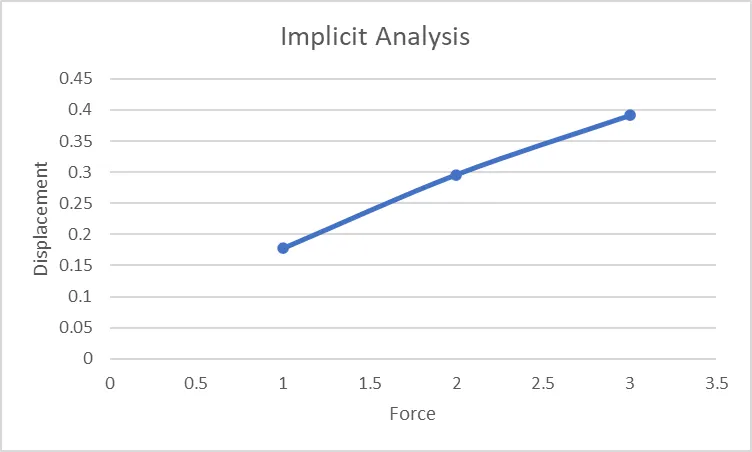
| Iteration | ΔF | ΔU | U | F | f | R = F - f |
| 1 | 1 | 0.1776 | 0.1776 | 1 | 1.0001 | 0.0001 |
| 2 | 1 | 0.1185 | 0.2961 | 2 | 2.0006 | 0.0006 |
| 3 | 1 | 0.2727 | 0.3912 | 3 | 3.002 | 0.002 |
2) Explicit Analysis:
In Explicit method the solution, will be obtained by direct solution at different time interval. one of the advantages of explicit over implicit is that, explicit does not to converge after every iteration. This method is mostly used to find the acceleration of the system. This method is mostly recommended for velocity more than 10 meter per second.
ƒ(u)= uᶟ + 9u² = 4u ……….(1)
Stiffness matrix
K(u) = dF(u) ÷ d(u)
= 3u² + 18u + 4 ………..(2)
From equation 1 and 2 we get
ΔF = K ΔU .…….(3)
Iteration 1:
Let use consider
ΔF = 1
u(0) = 0
To find the value of stiffness put initial condition in equation 2
K = 3(0)² + 18(0) + 4
K = 4
To find deflection put value of K=4 in equation 3
ΔF = K ΔU
1 = 4 ΔU
ΔU = 1/4
ΔU = 0.25
U1 = u + ΔU
= 0 + 0.25
U1 = 0.25
Iteration (2) :
Considering value of u = u1
Then stiffness matrix will be
K(u) = 3u² + 18u + 4
K = 3(0.25)² + 18(0.25) + 4
K = 8.6875
To find deflection put value of K = 8.6875 in equation 3
ΔF = K ΔU
1 = 8.6875 ΔU
ΔU =1/8.6875
ΔU = 0.1151
U2 = u + ΔU
= 0.25 + 0.1151
U2 = 0.3651
Iteration 3 :
Considering value of u = u1
Then stiffness matrix will be
K(u) = 3u² + 18u + 4
K = 3(0.3651)² + 18(0.3651) + 4
K = 10.9716
To find deflection put value of K = 10.9716 in equation 3
ΔF = K ΔU
1 = 10.9716 ΔU
ΔU =1/10.9716
ΔU = 0.09114
U3 = u + ΔU
= 0.3651 + 0.09114
U3 = 0.4562
Iteration 4 :
Considering value of u = u1
Then stiffness matrix will be
K(u) = 3u² + 18u + 4
K = 3(0.4562)² + 18(0.4562) + 4
K = 12.8359
To find deflection put value of K = 12.8359 in equation 3
ΔF = K ΔU
1 = 12.8359 ΔU
ΔU =1/12.8359
ΔU = 0.07790
U4 = u + ΔU
= 0.4562+ 0.07790
U4 = 0.5341
Iteration 5 :
Considering value of u = u1
Then stiffness matrix will be
K(u) = 3u² + 18u + 4
K = 3(0.5341)² + 18(0.5341) + 4
K = 14.4695
To find deflection put value of K = 14.4695 in equation 3
ΔF = K ΔU
1 = 14.4695 ΔU
ΔU =1/14.4695
ΔU = 0.06911
U5 = u + ΔU
= 0.5341+ 0.06911
U5 = 0.6032
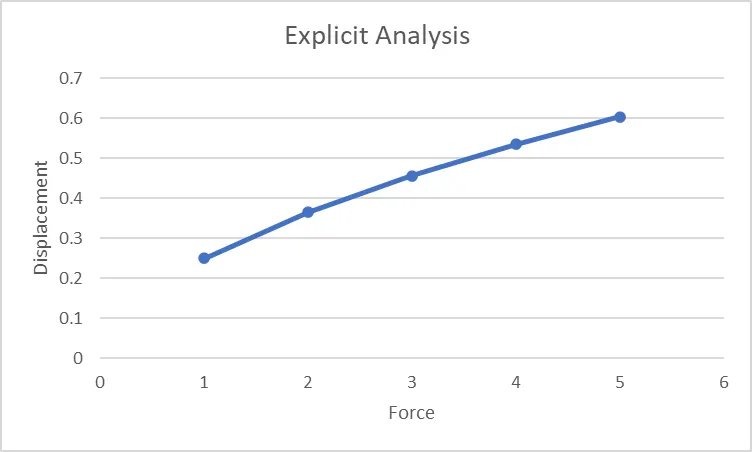
| Iteration | ΔF | ΔU | U | F |
| 1 | 1 | 0.25 | 0.25 | 1 |
| 2 | 1 | 0.1151 | 0.3651 | 2 |
| 3 | 1 | 0.3411 | 0.4562 | 3 |
| 4 | 1 | 0.193 | 0.5341 | 4 |
| 5 | 1 | 0.4102 | 0.6032 | 5 |
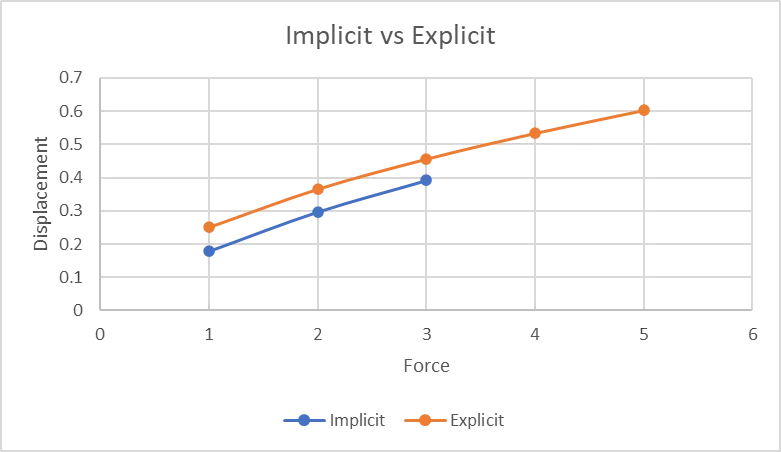
Comparison between implicit and explicit methods:
Which Method is better?
- Both solvers have their own areas of advantages.
- Implicit method helps us to select bi time interval, while explicit does restrict the time interval depending upon size, mesh quality and computational capability of the computer used.
- Implicit method is complicated and slow, while explicit is direct and fast method.
- Implicit will given accurate result with small interval of time.
Conclusion:
- Got to know different method to solve dynamic equation.
- Learned the process that occurs at the back end of the system by solving different mathematical equation.
- Got to know major difference between implicit and explicit, and how it affects the solution and when to use it.