Week - 2 - Explicit and Implicit Analysis
AIM:
To solve the equation F(u) = u^3 + 9u^2 + 4u by using both Explicit and Implicit methods and compare the results with the analytical solution.
EXPLANATION:
Generally, in most of the real life situation engineering problems analytical solutions are not possible. So different numerical methods were used to approximate the solution. Based on the type of load acting, the Structural systems can be classified as static and dynamic systems. In this report structural analysis of a simple non linear static bar is done by using Explicit and Implicit numerical methods.
EXPLICIT METHOD -
- Explicit method is one of the numerical method for approximating the solution. In this method, the parameters of the current time step depends only on the previous time step parameters. For eg - v(n+1) = f(u(n),v(n)), here in this function velocity in n+1 time step depend on displacement and velocity in the nth time step.
- Explicit method uses incremental steps to attain the solution. In order to define the time step, the time interval has to satisfy some conditions hence this method is conditionally stable one.
- Equilibrium of forces is not maintained in Explicit solvers, so they are mostly used in dynamic analysis.
- The time interval in Explicit method are small, so the computational time for explicit method is less than Implicit method.
- Explict method are mainly used in the systems where final solution as well as intermediate time step solution are important. It means final process or solution depends on intermediate time step process or solution. For example in crash analysis and metal forming process the final result depends on the intermediate result.
IMPLICIT METHOD -
- Implicit method is one of the numerical method for approximating the solution. In this method, the parameters of the current time step depends o the current as well as previous time step parameters. For eg - v(n+1) = f(u(n),v(n+1)), here in this function velocity in n+1 time step depend on n+1 , nth time step parameters.
- Implicit method uses Iterative and incremental steps to attain the solution. In order to define the time step, the time interval don't need to satisfy conditions hence this method is unconditionally stable one.
- Equilibrium of forces is maintained in Implicit solvers, so they are mostly used in static analysis.
- The time interval in Implicit method is large, so the computational time for Implicit method is less than Explicit method.
- Implicit method are mainly used in the systems where final solution is important. For example in cantilevar beam, final step deflection is considered for analysis.
MODEL SETUP -
Consider a simple structural bar subjected to external force as shown in the fig 1. Due to the application of external force, internal resistance force is developed in the bar which is given by the equation F(u) = u^3 + 9u^2 + 4u ---------------(1)
where u - elongation of the bar, F(u) - Internal force developed due to elongation. Since the force is not linearly proportional to the elongation, the given system is considered as a nonlinear static structure.
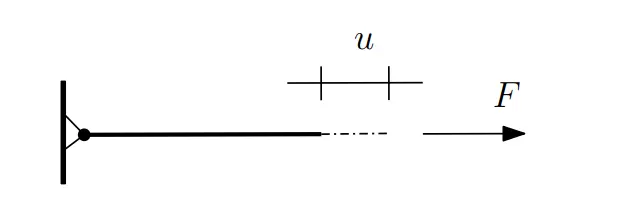
FIG 1: Structural Bar subjected to tension force
The stiffness of the bar is given by k = ∂F / ∂u = 3u^2 + 18u + 4 -----------------------------------------------------------(2)
Case 1 - Explicit method
This method uses incremental steps to obtain the solution. The model is divided into 3 time steps and a load increment of ΔF = 1 is applied on each step.
ΔF = k Δu -------------------------------------------------------------------------------------------------------------(3)
is used in this analysis.
Step 1 -
Since, initially the bar is not subjected to any external force so elongation in the bar is zero i.e; u0 = 0
ΔF = 1
From eq(2), k(u0) = 3u0^2 + 18u0 + 4 = 4
From eq(3), Δu = ΔF/k(u0) = 1/4 = 0.25
u1 = u0 + Δu = 0 + 0.25 = 0.25
The internal resistance force developed due to elongation u1 is F(u1) = u1^3 + 9u1^2 + 4u1 = 1.5781
Step 2 -
u1 = 0.25
ΔF = 1
From eq(2), k(u1) = 3u1^2 + 18u1 + 4 = 8.6875
From eq(3), Δu = ΔF/k(u1) = 1/8.6875 = 0.1151
u2 = u1 + Δu = 0.25 + 0.1151 = 0.3651
F(u2) = u2^3 + 9u2^2 + 4u2 = 2.7087
Step 3 -
u2 = 0.3651
ΔF = 1
From eq(2), k(u2) = 3u2^2 + 18u2 + 4 = 10.971
From eq(3), Δu = ΔF/k(u2) = 1/10.971 = 0.0911
u3 = u2 + Δu = 0.3651+ 0.0911 = 0.4562
F(u3) = u3^3 + 9u3^2 + 4u3 = 3.7928
| STEP | Δui | ui | (Fext)i | (fint)i | R = fint - Fext |
| 1 | 0.25 | 0.25 | 1 | 1.5781 | 0.5781 |
| 2 | 0.1151 | 0.3651 | 2 | 2.7087 | 0.7087 |
| 3 | 0.0911 | 0.4562 | 3 | 3.7928 | 0.7928 |
TABLE 1: Parameters in each step of the explicit method
In the Explicit method as force equilibrium is not followed, it is observed from Table 1 that the residue in each step > 0.001
Case 2 - Implicit method
This method uses iterative and incremental steps to obtain the solution. The model is divided into 3 incremental steps and a load increment of ΔF = 1 is applied on each step. Since the Implicit method follows force equilibrium, NEWTON RAPHSON iteration method is used to obtain force equilibrium in each step.
ΔF = k Δu -------------------------------------------------------------------------------------------------------------(4)
is used in this analysis.
Step 1 -
Since, initially the bar is not subjected to any external force so elongation in the bar is zero i.e; u0 = 0
ΔF = 1
From eq(2), k(u0) = 3u0^2 + 18u0 + 4 = 4
From eq(4), Δu = ΔF/k(u0) = 1/4 = 0.25
u1 = u0 + Δu = 0 + 0.25 = 0.25
The internal resistance force developed due to elongation u1 is F(u1) = u1^3 + 9u1^2 + 4u1 = 1.5781
Residue = fint - Fext = 1.5781 - 1 = 0.5781
ll R1(0) ll > 0.001, so Newton Raphson iteration is used to obtain equilibrium.
δu(j+1) = -[k(u(j))]^-1 * Rj --------------------------------------------------------------------------------------------(5)
Iteration 1 in Step1 :
From eq(5), δu(1) = -(8.6875)^-1 * 0.5781 = -0.0665
u1(1) = u1(0) + δu(1) = 0.25 - 0.0665 = 0.1835
fint1(1) =u1(1)^3 + 9u1(1)^2 + 4u1(1) = 1.0432
R1(1) = fint1(1) - Fext1 = 1.0432 - 1 = 0.0432
ll R1(1) ll > 0.001, so again Newton Raphson iteration is used to obtain equilibrium.
Iteration 2 in Step1 :
The stifnness in the bar due to elongation u1(1) is k(u1(1)) = 3u1(1)^2 + 18u1(1) + 4 = 7.404
From eq(5), δu(2) = -(7.404)^-1 * 0.0432 = -0.005834
u1(2) = u1(1) + δu(2) = 0.1835- 0.0058 = 0.1777
fint1(2) =u1(2)^3 + 9u1(2)^2 + 4u1(2) = 1.0006
R1(2) = fint1(2) - Fext1 = 1.0006 - 1 = 0.0006
ll R1(2) ll < 0.001, therefore force equilibrium is obtained in step 1.
Step 2 -
u1 = 0.1777
ΔF = 1
From eq(2), k(u1) = 3u1^2 + 18u1 + 4 = 7.2933
From eq(4), Δu = ΔF/k(u1) = 1/7.2933 = 0.1371
u2 = u1 + Δu = 0.1777 + 0.1371 = 0.3148
The internal resistance force developed due to elongation u2 is F(u2) = u2^3 + 9u2^2 + 4u2 = 2.18722
Residue = fint - Fext = 2.1822 - 2 = 0.1822
ll R2(0) ll > 0.001, so Newton Raphson iteration is used to obtain equilibrium.
Iteration 1 in Step2 :
The stiffness in the bar due to elongation u2(0) is k(u2(0)) = 3u2(0)^2 + 18u2(0) + 4 = 9.9636
From eq(5), δu(1) = -(9.9636)^-1 * 0.1822 = -0.0182
u2(1) = u2(0) + δu(1) = 0.3148 - 0.0182 = 0.2966
fint2(1) =u2(1)^3 + 9u2(1)^2 + 4u2(1) = 2.0042
R2(1) = fint2(1) - Fext2 = 2.0042 - 2 = 0.0042
ll R2(1) ll > 0.001, so again Newton Raphson iteration is used to obtain equilibrium.
Iteration 2 in Step2 :
The stifnness in the bar due to elongation u2(1) is k(u2(1)) = 3u2(1)^2 + 18u2(1) + 4 = 9.6027
From eq(5), δu(2) = -(9.6027)^-1 * 0.0042 = -0.0004
u2(2) = u2(1) + δu(2) = 0.2966 - 0.0004 = 0.2962
fint2(2) =u2(2)^3 + 9u2(2)^2 + 4u2(2) = 2.0003
R2(2) = fint2(2) - Fext2 = 2.0003 - 2 = 0.0003
ll R2(2) ll < 0.001, therefore force equilibrium is obtained in step 2.
Step 3 -
u2 = 0.2962
ΔF = 1
From eq(2), k(u2) = 3u2^2 + 18u2 + 4 = 9.5948
From eq(4), Δu = ΔF/k(u2) = 1/9.5948 = 0.1042
u3 = u2 + Δu = 0.2962 + 0.1042 = 0.4004
The internal resistance force developed due to elongation u3 is F(u3) = u3^3 + 9u3^2 + 4u3 = 3.1086
Residue = fint - Fext = 3.1086 - 3 = 0.1086
ll R3(0) ll > 0.001, so Newton Raphson iteration is used to obtain equilibrium.
Iteration 1 in Step3 :
The stiffness in the bar due to elongation u3(0) is k(u3(0)) = 3(u3(0))^2 + 18(u3(0)) + 4 = 11.6881
From eq(5), δu(1) = -(11.6881)^-1 * 0.1086 = -0.0093
u3(1) = u3(0) + δu(1) = 0.4004 - 0.0093 = 0.3911
fint3(1) =u3(1)^3 + 9u3(1)^2 + 4u3(1) = 3.0008
R3(1) = fint3(1) - Fext3 = 3.0008 - 3 = 0.0008
ll R3(1) ll < 0.001, therefore force equilibrium is obtained in step 3.
| STEP | ΔFi | ui | (Fext)i | (fint)i | R = fint - Fext |
| 1 | 1 | 0.1777 | 1 | 1.0006 | 0.0006 |
| 2 | 1 | 0.2962 | 2 | 2.0003 | 0.0003 |
| 3 | 1 | 0.3911 | 3 | 3.0008 | 0.0008 |
TABLE 2: Parameters in each step of the Implicit method
COMPARISION -
The fig 2 shows the graphs for the solutions obtained by Actual, Explicit and Implicit methods. Since the Implicit method follows force equlibrium, it is clearly observed that Explicit method shows more deviation compared to Implicit method with the actual solution.
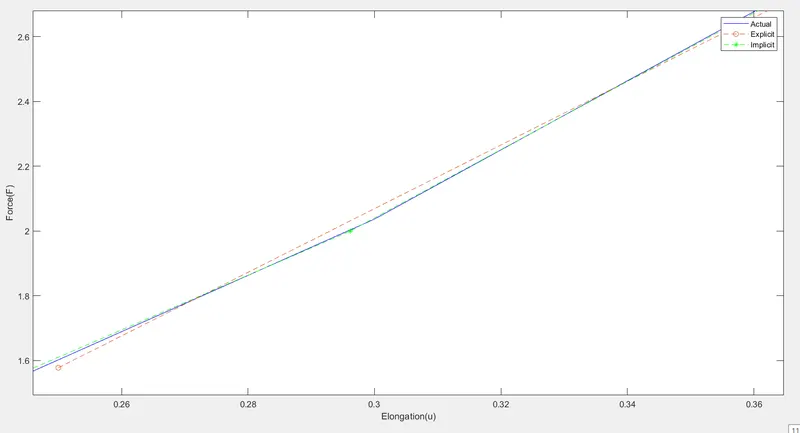
FIG 2: Comparision of graphs
CONCLUSION:
The solutions for the equation F(u) = u^3 + 9u^2 + 4u are obtained by using both Explicit and Implicit methods and comparision was done. For static analysis, Implicit method is preferred and for dynamic analysis, Explicit method is preferred. Since analysis done for non linear static system, Implicit method shows accurate results.