Week - 2 - Explicit and Implicit Analysis
Aim
To solve the given equation using implicit and explicit method and plot force vs displacement curve.
Given equation:`f(u)=u^3+9u^2+4u`
Indroduction
Explicit and implicit method are mainly used to slove non-linear Transient Dynamic problem with the governing equation `M{ddotu}+C{dotu}+k{u}=f{t}`
| Implicit Method | Explicit method |
| In this method, Accleration is assumed to be vary linearlly over timestep | In this method, Accleration is assumed to be constant over timestep |
|
In this scheme, unknown X find by inversion of stiffness matrix[K] |
In explicit scheme, the unknown X can be found by inversion of Mass matrix[M] |
| for any initial assumption of `triangle t` solution converges, hence uses large time step | we need to take of critical time step value `triangle t` so, small time step is uses |
| Newmark-`beta` method is used | Central difference method is used |
| It is unconditionally stable | It is conditionally stable |
| More accurate | Less accurate |
| Implicit method required much more computer storage | Less storage required than an implicit method |
|
Application Good choice for structural dynamic type problem for which load rates are slow such as low- frequency response, Vibration, Oscillation |
Application Best suited for wave propagation type of problem with high strain rates such as Car crash Analysis, Drop test, Impact, Blast, etc |
Explicit Analysis
`f(u)=u^3+9u^2+4u`
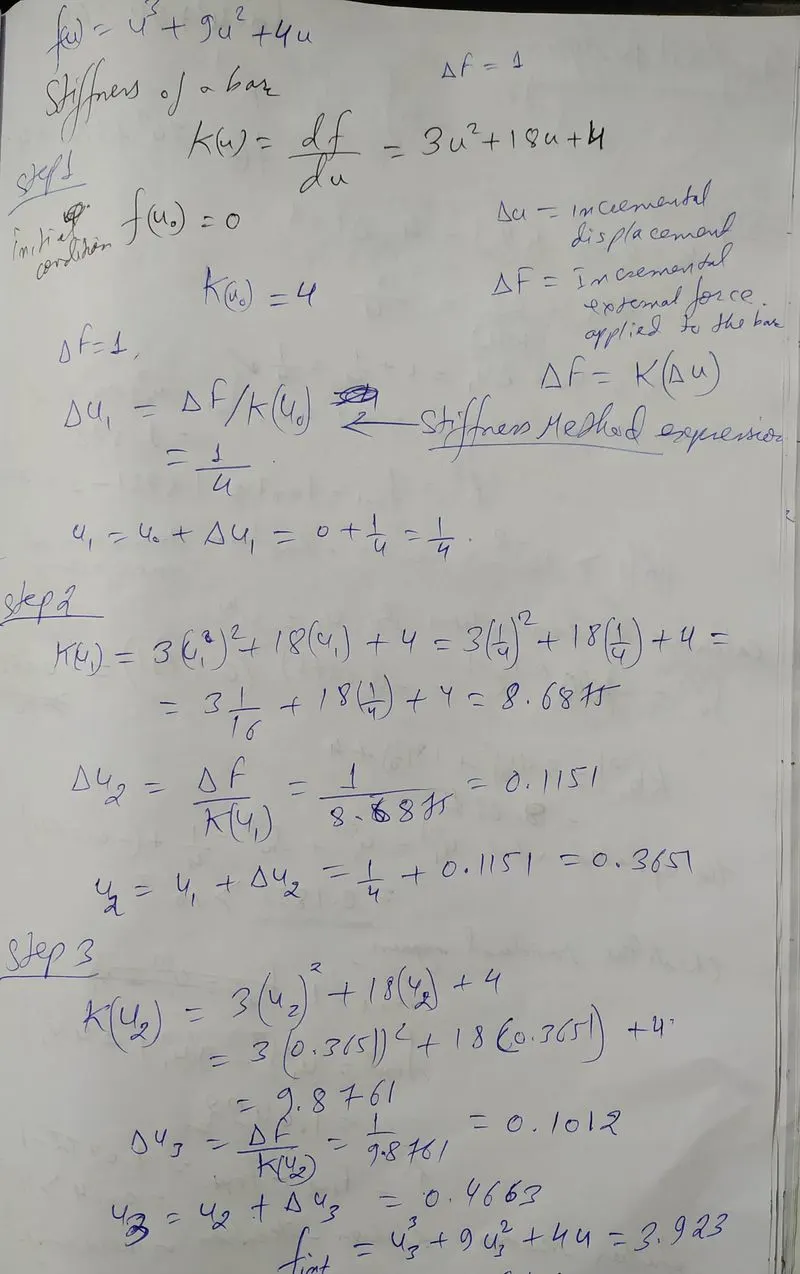
finally, from the 3 steps the following result are obtained.
`Fext = triangleF+triangleF+triangle F`
=1+1+1=3
`fInt = triangleu_3^3+9triangleu_3^2+4triangleu_3`
`=(0.4663)^3+9(0.4663)^2+4(0.4663)`
`=3.923`
It is evident from the result that external and internal force are not in equilibrium because `Fext ne fInt`. Table below summarizes the main result of explicit analysis.
| Step i | `triangleF_i` | `triangleu_i` | `u_i` | `(Fext)_i` | `(fInt)_i` | `R=fInt-Fext` |
| 1 | 1 | 1/4 | 1/4 | 1 | 1.578 | 0.578 |
| 2 | 1 | 0.1151 | 0.3651 | 2 | 2.708 | 0.708 |
| 3 | 1 | 0.1012 | 0.4663 | 3 | 3.923 | 0.928 |
Implicit Analysis
`f(u)=u^3+9u^2 +4u`
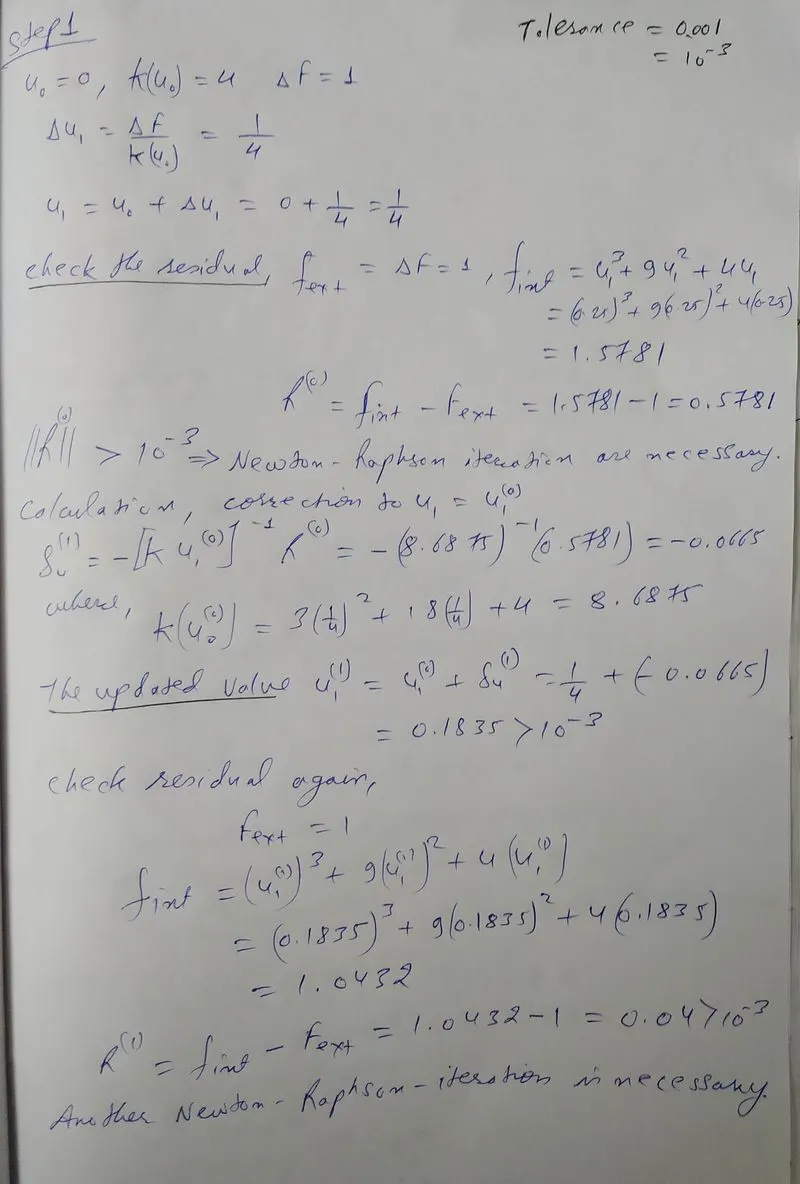
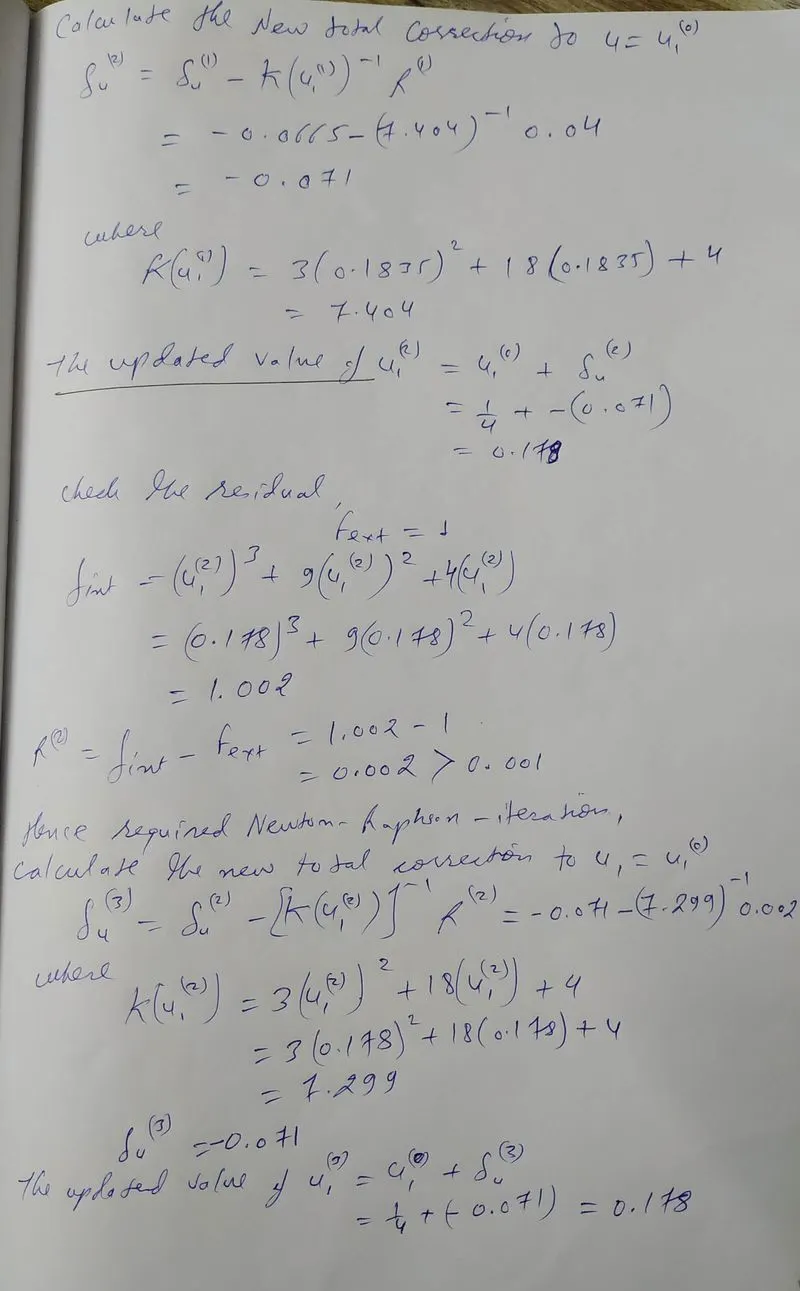
Since the value are coming same, Hence it conversed `u_1 =0.178`
Similarly, `u_2 and u_3` are calculated as shown below in Table.
| Step i | `triangleF_i` | `triangleu_i` | `u_i` | `(Fext)_i` | `(fInt)_i` | `R=fInt-Fext` |
| 1 | 1 | 1/4 | 0.178 | 1 | 1.002 | 0.00 |
| 2 | 1 | 0.134 | 0.296 | 2 | 2.004 | 0.004 |
| 3 | 1 | 0.104 | 0.391 | 3 | 3.0006 | 0.0006 |
Exact Solution
`f(u)=u^3+9u^2+4u=1` `=>` `u=0.1776`
`f(u)=u^3+9u^2+4u=2` `=>` `u=0.2961`
`f(u)=u^3+9u^2+4u=3` `=>` `u=0.3910`
Force vs Displacement
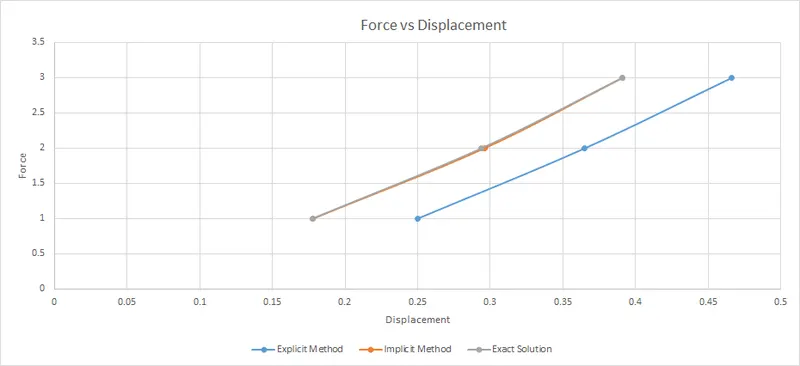
From the graph we can see that implicit method and exact solution curve are exactly maching with each other.
The Newton-Raphson iterations correct the incremental steps so that they land on the exact solution to the specified tolerance. Excellent agreement is acheived with just 3 increment and in each step only two Newton-Raphson iteration are required.
Discussion
we can use both implicit and explicit solver to solve the same type of problems. the only difference is in approach to time increment.
The speed of computing is exactly the differnce between implicit and explicit. of course the size of the explicit step depent on the model and computing times depends on the system hardware.
Conclusion
Thus, nonlinear analysis illustrated using an incremental explicit and implicit procedure. The results are plotted for comparision.