Surface Meshing on a Pressure valve
Aim:- To mesh a pressure valve using three different mesh sizes and find out the optimal mesh size.
Introduction :
ANSA :
- ANSA is a Computer-aided engineering tool for Finite Element Analysis and CFD Analysis widely used in the automotive industry. It is developed by BETA CAE Systems. The software is distributed world wide by a number of BETA CAE Systems subsidiaries and business agents.
- ANSA maintains the association between CAD geometry and the FE mesh. This means that the FE meshes are better representations of their geometric parents. Also it is easy to maintain and update any changes in the geometry by simply reworking the updated area instead of recreating the FE from scratch.
- It carries several proprietary algorithms for meshing suitable for both CFD and structural models. ANSA was initially standing for 'Automatic net generation for structural analysis', but the software has gone beyond that very quickly. ANSA has broadly six menus which are used to do various activities those are: TOPO MESH, VMESH ,DECK-SOLVER, MORPH ,HBLOCK.
Different type of modules in ANSA :
- TOPO - Set of tools for Geometry clean-up and for setting up of PIDs.
- MESH - Tools to generate Surface Mesh or 2D Mesh.
- VOLUME MESH - To generate solid or 3D Mesh.
- SOLVER DECKS - Tools based on different solvers such as ABAQUS, RADIOSS ,ANSYS etc.
- MORPH - Advanced tool to capture geometry more accurately while meshing.
Solution procedure :
For solving we follow the below procedure
- Import the CAD model.
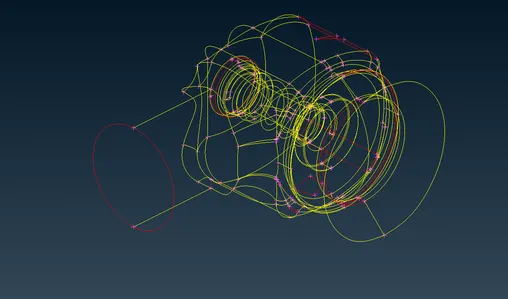
- Geometry check-up.
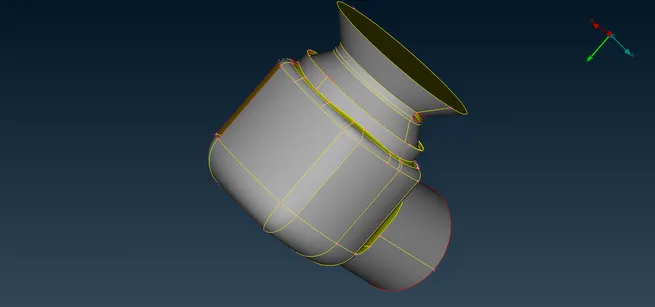
- Topo/Geometry cleanup.
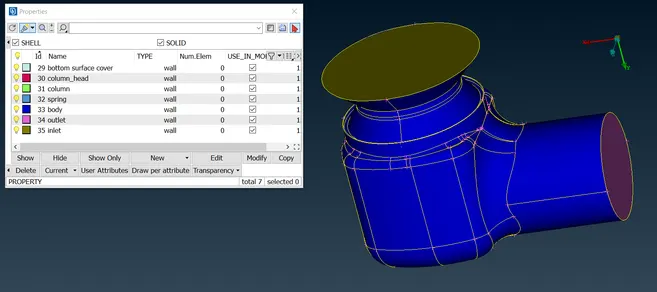
- Setting-up of relevant PIDs.
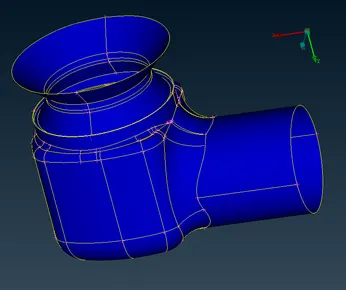
- Defining the element size or length.
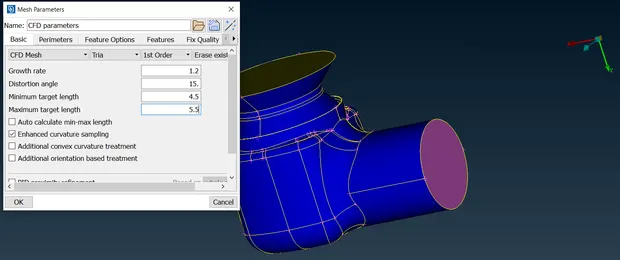
- Selection of Meshing type.
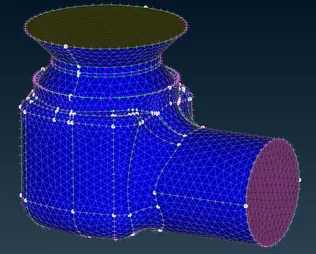
- Generating Mesh
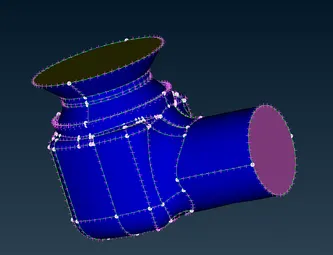
Target length = 3 mm :
- Everything is same as above case but the only change here is ,the target length changes to 3mm .
- Then you can see the geometry after giving the mesh length.
- For meshing also we follow the same process as in the previous case.
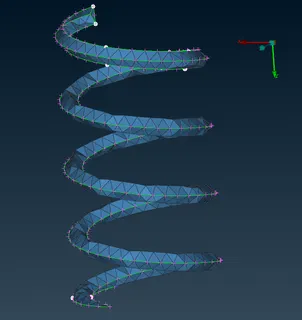
Target length = 5 mm :
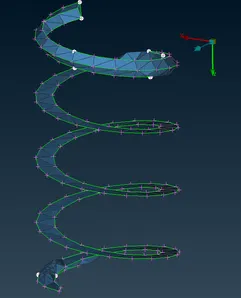
- Everything is same as above case but the only change here is ,the target length changes to 5 mm .
- Then you can see the geometry after giving the mesh length in the below image.
Target length = 1 mm :
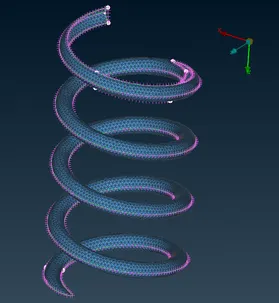
We can see that the surface of the spring is very much better than the 5 mm and 3 mm mesh,
So we can see that the size of the total length of the mesh decreases with better approximate result.
Result:-
The meshing of 1 mm, 3 mm and 5 mm mesh has been done and the results have been found.
Conclusion:-
The meshes seems to be much better with decrease in the total length of the mesh, hence we can find the 1 mm mesh with better approximate result and spring surface than the 3 mm and 5mm.