Week 2 Challenge
Question 1:
Different types of fuel cells:
Fuel Cells are among the potential sources of energy that can help tackle the upcoming energy crisis, powering the future world. They use electrochemical reactions to convert the chemical energy of the fuel into electricity. They are similar to batteries in operation; however, the fuel cell can replenish the chemical reactants when running low. Different types of fuel cells are as follows:
1) Proton Exchange Membrane Fuel cell
2) Solid Oxide fuel cell
3) Alkaline Fuel cell
4) Direct Methanol fuel cell.
| FUEL CELL TYPE | COMMON ELECTROLYTE | OPERATING TEMPERATURE | TYPICAL STACK SIZE | ELECTRICAL EFFICIENCY (LHV) | ADVANTAGES | APPLICATIONS | CHALLENGES |
| Polymer electrolyte membrane (PEM) | Perfluorosulfonic acid | <120> | <1> | 60% direct H2; a 40% reformed fuel b |
|
|
|
| Direct Methonol Fule Cell (DMFC) | Nafion | 70 -130°C |
1-100W |
20-30% |
|
|
|
| Alkaline (AFC) | Aqueous potassium hydroxide soaked in a porous matrix, or alkaline polymer membrane | <100> | 1–100 kW | 60% |
|
|
|
| Solid oxide (SOFC) | Yttria stabilized zirconia | 500°–1,000°C | 1 kW–2 MW | 60% |
|
|
|
Question 2:
Plot with energy density and power density for various battery types:
Energy density:Energy density is the amount of energy stored in a given system or region of space per unit volume or per weight. It is sometimes confused with energy per unit mass which is properly called specific energy or gravimetric energy density.
Energy density is generally expressed in two ways, although the first is more common:
- Volumetric energy density - how much energy a system contains in comparison to its volume; typically expressed in watt-hours per litre (Wh/L) or Megajoules per liter (MJ/L).
- Gravimetric energy density- how much energy a system contains in comparison to its mass; typically expressed in watt-hours per kilogram (Wh/kg), or Megajoules per kilogram (MJ/kg).Gravimetric energy density can also be referred to as specific energy.
Power density:Power density is the amount of power (time rate of energy transfer) per unit volume.
In energy transformer including batteries, fuel cells, motors, power supply units etc., power density refers to a volume, where it is often called volume power density, expressed as W/m3.
Energy density vs Power density:
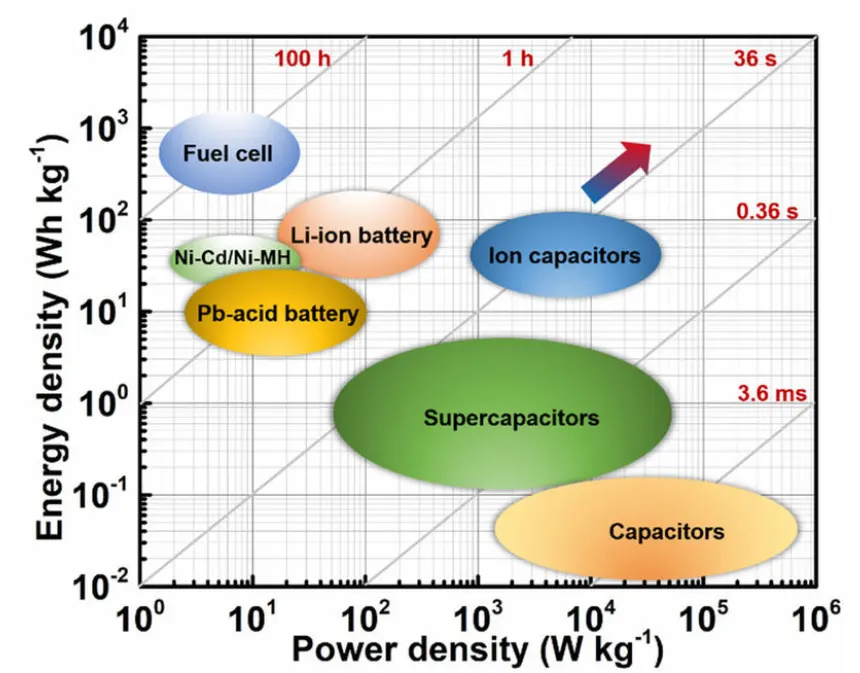
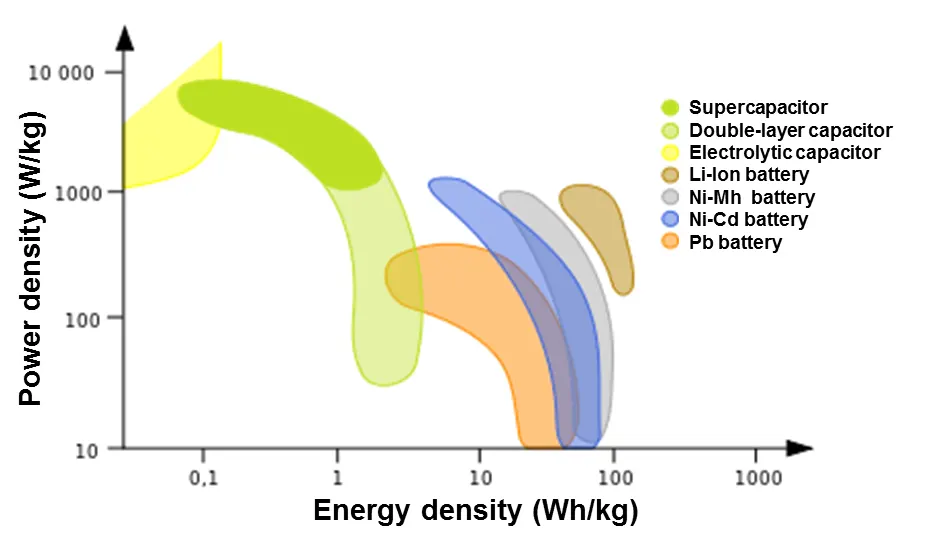
Fuel cell: Fuel cells work like batteries, but they do not run down or need recharging. They produce electricity and heat as long as fuel is supplied. A fuel cell consists of two electrodes—a negative electrode (or anode) and a positive electrode (or cathode)—sandwiched around an electrolyte.
The Fuel cells are having high energy density but the power density is very less when compared to other types of batteries.As they produce the electrical energy based on their fuel supply, its reaction time given as 100Hrs.Here shown the energy density as 1000Wh/Kg where as its power density produced given as nearlly 10W/Kg.They requires boost converters to match load requirements.
Li- ion batteries:A lithium-ion or Li-ion battery is a type of rechargable batteries which uses the reversible reduction of lithium ions to store energy. The negative electrode of a conventional lithium-ion cell is typically graphite, a form of cathode. This negative electrode is sometimes called the anode as it acts as an anode during discharge. The positive electrode is typically a metal oxide and is sometimes called the cathode as it acts as a cathode during discharge. Positive and negative electrodes remain positive and negative in normal use whether charging or discharging and therefore are clearer terms than anode and cathode, which are reversed during charging
The Lithium ion batteries having high energy density and also its power density matching its load requirements with out boost converters.Here shown for 100Wh/Kg energy density,the power density is given as nearly 100W/Kg.They are in equal ratio.
Lead acid batteries:The lead–acid battery is a type of rechargable batteriesfirst invented in 1859.It is the first type of rechargeable battery ever created. Compared to modern rechargeable batteries, lead–acid batteries have relatively low energy density. Despite this, they are able to supply high surge currents. These features, along with their low cost, make them attractive for use in motor vehicles to provide the high current required by starter motors. Lead-acid batteries suffer from relatively short cycle lifespan (usually less than 500 deep cycles) and overall lifespan (due to the "double sulfation" in the discharged state), as well as slow or long charging time.
Nickel cadmium batteries: It’s a device that produces, DC voltage based on the chemical reaction between the substances involved. In a nickel-cadmium battery, the redox material is used as a base, and around it, the layer of nickel and a separator are used. The nickel-cadmium cell voltage is around 1.2 V. When connected in series generally 3 to 4 cells are packed together to get an output of 3.6 to 4.8 V
For Ni-cd batteries the energy density are quite high as same as Li-ion and Lead acid battery types. But its specific power is less when compared with other batteries. Here given the energy density as 50Wh/Kg but its power density is only near 9W/kg. Thus they are used in less power consuming devices
Ultra capacitors:An ultracapacitor is a type of electrochemical device, no chemical reactions are involved in the storing of its electrical energy. This means that the ultra-capacitor remains effectively an electrostatic device storing its electrical energy in the form of an electric field between its two conducting electrodes Then ultra-capacitors make excellent energy storage devices because of their high values of capacitance up into the hundreds of farads, due to the very small distance d or separation of their plates and the electrodes high surface area A for the formation on the surface of a layer of electrolytic ions forming a double layer.
Ultracapacitors are having less energy density but they will produce high power in short duration of time. Here shown supercapacitors as having nearly 1 Wh/Kg of energy density produces nearly 5KW/kg of specific power or said to be its power density. Thus they are used in certain applications needs high power requirement in short duration of time.Its reaction time is given as 0.36 seaconds.