Week 2 Challenge
Question 1:
Compare four different types of fuel cells and state their applications.
Answer:
Fuel Cells:
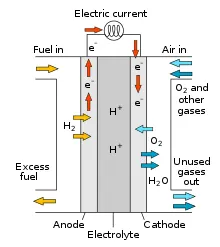
Fuel Cell was invented in 1838 but was used commercially much later by NASA. Typically, they used it
in their satellites and other devices for their research to supply power. Today, you will find these being
used in commercial and residential premises and industries. It can be used both as a primary or as a
secondary source of power.
A fuel cell is a tiny device that has two electrodes namely, a cathode and an anode. These electrodes
result in an electrochemical reaction inside the cell.
However, a fuel cell needs to have two important components to perform this reaction. These are:
1. An oxidizing agent and
2. Supply of fuel or an electrolyte.
When these two are cut off, the cell will stop generating electric power. The electrolyte is very
important because it supports the movements of ions, to and from the electrodes.
Working Process of Fuel Cells:
A fuel cell generates electricity via a chemical reaction by simply completing an electric circuit. The
entire process is completed in a few steps which are as follows:
A] At the anode, Hydrogen atoms are introduced. These atoms are known to carry a positive electric
charge. However, these atoms are stripped of their electrons at this stage. These negatively charged
electrons move and create a current through the wires.
B] At the cathode, Oxygen atoms are introduced. These atoms combine with the leftover electrons of
the hydrogen atoms. It can combine with it after it passes through the anode or at this stage itself. It
all depends on the type of cell.
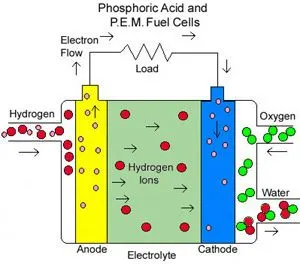
The different reactions that take place involve:
A] At Cathode: O2 + 2H2O + 4e- → 4OH-
B] At Anode: 2H2 + 4OH- → 4H2O + 4e-
The net result of these two reactions is 2 H2 + O2 → 2H2O.
Sometimes, however, the reaction can be too slow and in such a situation a catalyst is used. Usually,
platinum or palladium is used to expedite the reaction.
Types of Fuel Cells:
There are different types of fuel cells available in the market, though the working process is pretty
similar in all. The various types of the fuel cell are:
1. PEM or Polymer Electrolyte Membrane Fuel Cells, which are also known as Proton Exchange
Membrane Fuel Cells, have an operating temperature of 50 to 100 degrees Centigrade while
conducting protons. These cells consist of electrodes, bipolar plates, a polymer membrane, and a
catalyst.
2. Phosphoric Acid Fuel Cells contain phosphoric acid as their electrolyte. The operating
temperature of these fuel cells is typically between 150 to 200 degrees Centigrade while they carry the
positively charged Hydrogen ions. It is the non-conductive nature of this electrolyte that forces the
electrons to pass through the cathode by completing an external circuit. However, the acidic nature
corrodes the electrodes and oxidizes during the process.
3. Solid Acid Fuel Cells work on either Cesium Hydrogen Sulfate, CsHSO4, or Cesium Dihydrogen
Phosphate, CsH2PO4. The molecular structure of the solid acid material works in a specific order at a
lower temperature. However, at a high temperature, conductivity can increase significantly due to the
phase transition.
4. Alkaline Fuel Cells use an aqueous alkaline solution. This solution helps to saturate the permeable
milieu and helps in separating the electrodes. These cells operate at a temperature of 90 degrees
Centigrade and are very efficient in producing heat and water apart from electric power.
5. Solid Oxide Fuel Cells come with a solid oxide or a ceramic electrolyte like the Yttria-stabilized
Zirconia. These low-cost cells are also very efficient. However, it operates at a very high temperature.
The standard operating temperature of these cells can be 600°C and 1000°C at the two extremes of
the temperature scale.
6. Molten Carbonate Fuel Cells are powered by natural gas or biogas and use Lithium Potassium
Carbonate salt as its electrolyte. It turns liquid at high temperatures to help the carbonate ions move.
These cells also have a very high operating temperature of more than 650°C. However, the electrolyte
corrodes the anode and cathode of the cells for its high operating temperature.
Applications:
Fuel cell technology is very useful and has a wide and varied range of applications. A few of them
include but are not limited to:
i. Electric and eco-friendly vehicles
ii. Spaceships and space expeditions
iii. Electronic devices and
iv. Military applications.
The byproducts of the fuel cells, in the form of heat and water, are also very useful. Also, in remote
areas, fuel cells are used as a primary electrical source or as a backup. It can also be used to power up
cell phones, other appliances, and even households.
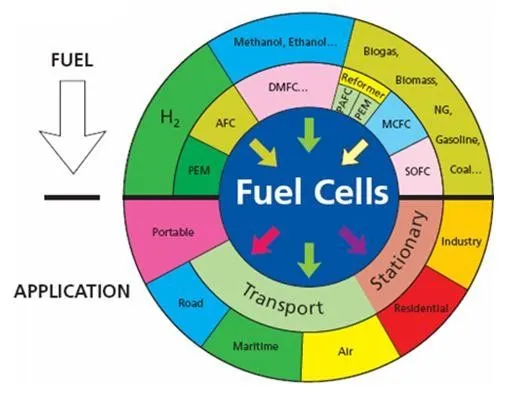
Fig. Applications of Fuel Cells
Advantages:
There are lots of different advantages of using fuel cells. A few of them are:
1. These are more efficient in comparison to any regular combustion engine since they do not undergo
a double conversion process.
2. These cells save wasteful emissions of greenhouse gases. It not only conserves energy but creates
heat and water as its byproducts.
3. These cells are consistent and more stable, reliable, and convenient to use because the parts in
them or around them need minimal or no movement.
4. The working process involves atom separation and is very clean, ergonomic, and is very useful for
preserving natural resources.
5. These cells are very easy to combine with other technologies such as solar panels and turbines.
6. Most importantly, the fuel cells are considered to be extremely scalable in comparison to a
traditional cell. Depending on the need, these cells can generate electric power from a few watts to
several megawatts.
The advantages and applications of the fuel cells may vary with their type.
Comparison of different types of Fuel cells in Tabular Format:
| FUEL CELL TYPE | COMMON ELECTROLYTE | OPERATING TEMPERATURE | TYPICAL STACK SIZE | ELECTRICAL EFFICIENCY (LHV) | APPLICATIONS | ADVANTAGES | CHALLENGES |
|---|---|---|---|---|---|---|---|
| Polymer electrolyte membrane (PEM) | Perfluorosulfonic acid | <120°C | <1 kW–100 kW | 60% direct H2; a 40% reformed fuel b |
Backup power Portable power Distributed generation Transportation Specialty vehicles |
Solid electrolyte reduces corrosion and electrolyte management problems Low temperature Quick start-up and load following |
Expensive catalysts Sensitive to fuel impurities |
| Alkaline (AFC) | Aqueous potassium hydroxide soaked in a porous matrix, or alkaline polymer membrane | <100°C | 1–100 kW | 60% c |
Military Space Backup power Transportation |
Wider range of stable materials allows lower cost components Low temperature Quick start-up |
Sensitive to CO2 in fuel and air Electrolyte management (aqueous) Electrolyte conductivity (polymer) |
| Phosphoric acid (PAFC) | Phosphoric acid soaked in a porous matrix or imbibed in a polymer membrane | 150°–200°C |
5–400 kW, 100 kW module (liquid PAFC) <10 kW (polymer membrane) |
40% d | Distributed generation |
Suitable for CHP Increased tolerance to fuel impurities |
Expensive catalysts Long start-up time Sulfur sensitivity |
| Molten carbonate (MCFC) | Molten lithium, sodium, and/or potassium carbonates, soaked in a porous matrix | 600°–700°C | 300 kW–3 MW, 300 kW module |
50% e |
Electric utility Distributed generation |
High efficiency Fuel flexibility Suitable for CHP Hybrid/gas turbine cycle |
High temperature corrosion and breakdown of cell components Long start-up time Low power density |
| Solid oxide (SOFC) | Yttria stabilized zirconia | 500°–1,000°C | 1 kW–2 MW | 60% f |
Auxiliary power Electric utility Distributed generation |
High efficiency Fuel flexibility Solid electrolyte Suitable for CHP Hybrid/gas turbine cycle |
High temperature corrosion and breakdown of cell components Long start-up time Limited number of shutdowns |
Question 2:
Using a plot with energy density and power density on the X and Y axis, arrange various
battery types like lithium ion, lead acid, Nickel Cadmium, Ultracapacitor, fuel cell.
Answer:
Types of Batteries:
1. Lithium ion
A lithium-ion battery or Li-ion battery (abbreviated as LIB) is a type of rechargeable battery in
which lithium ions move from the negative electrode to the positive electrode during discharge and
back when charging.
2. Lead acid
The lead–acid battery is a type of rechargeable battery first invented in 1859 by French
physicist Gaston plante. It is the first type of rechargeable battery ever created. Compared to
modern rechargeable batteries, lead–acid batteries have relatively low energy density. Despite this,
their ability to supply high surge currents means that the cells have a relatively large power-to-
weight ratio. These features, along with their low cost, make them attractive for use in motor
vehicles to provide the high current required by starter motors.
3. Nickel Cadmium
A nickel-cadmium battery (NiCd or NiCad) is a rechargeable battery used for portable computers,
drills, camcorders and other small battery-operated devices requiring an even power discharge.
NiCds use electrodes made of nickel oxide hydroxide, metallic cadmium and an alkaline electrolyte
of potassium hydroxide.
4. Ultracapacitor
Ultracapacitors are bigger capacitors that are inherently better energy storage devices that are
able to store large amount of electrical charge than chemical batteries. Compared to similar size
batteries, ultracapacitors have higher power density, quick charge/discharge rate and a longer
lifecycle.
5. Fuel cell
Fuel cells require a continuous input of fuel and an oxidizing agent (generally oxygen) in order to
sustain the reactions that generate the electricity. Therefore, these cells can constantly generate
electricity until the supply of fuel and oxygen is cut off.
Despite being invented in the year 1838, fuel cells began commercial use only a century later when
they were used by NASA to power space capsules and satellites. Today, these devices are used as
the primary or secondary source of power for many facilities including industries, commercial
buildings, and residential buildings.
A fuel cell is similar to electrochemical cells, which consists of a cathode, an anode, and an
electrolyte. In these cells, the electrolyte enables the movement of the protons.
Energy density vs Power density:
Energy density is the amount of energy in a given mass (or volume) and power density is the
amount of power in a given mass. The distinction between the two is similar to the difference
between Energy and power. Batteries have a higher energy density than Capacitors, but a capacitor
has a higher power density than a battery. This difference comes from batteries being able to store
more energy, but capacitors can give off energy more quickly.
Energy density describes how much energy the device can store for a given mass/volume. Therefore
a device with a higher energy density can supply an electronic load for longer than one with a low
energy density and the same mass/volume.
Energy density:-
If a system has a high energy density then it is able to store a lot of energy in a small amount of
mass. A high energy density does not necessarily mean a high power density. An object with a high
energy density, but low power density can perform work for a relatively long period of time. An
example of this type of energy storage is a mobile phone. Its power will last most of the day, but to
recharge the device, it must be connected to another power source for an hour or more.
Power density:-
If a system has a high power density, than it can output large amounts of energy based on its mass.
For example, a tiny capacitor may have the same power output as a large battery. However, since
the capacitor is so much smaller, it has a higher power density. Since they release their energy
quickly, high power density systems can also recharge quickly. An example application of this type of
energy storage is a camera flash. It has to be small enough to fit inside the camera (or cell phone)
but have a high enough power output to light up the subject of your photo. this makes a system with
a high power density ideal.
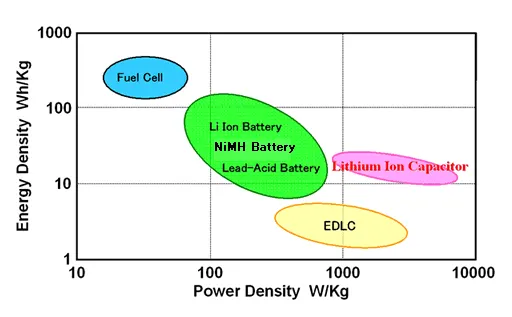
Figure 2
Fig. 2 , This demonstrates the relationship between energy density and power density.
For example, Fuel cells will have very high energy densities, with relatively low power densities.