Week 2 Challenge
Question 1 :
Aim : To Compare four different types of fuel cells and state their applications.
Answer:
- Here mainly the Fuel cells are primarily classified by the kind of electrolyte they employ.They are
- The kind of electrochemistry reactions that take over in the cells
- The kind of catalyst required
- The fuel required and other factors
- And aslo These characteristics affect the applications for which these cells are more suitable.
- so There are several types of fuel cells currently under develompet each with its own advantages and limitations and applications.
The major four types of fuel cells in present are:-
- Polymer Electrolyte Membrane Fuel cells
- Alkaline Fuel cells
- Solid Oxide Fuel cells
- Direct Methanol fuel cells
| Type of fuel cell | Electrolyte | Operating temperature | size of Stack | Efficiency | Applications |
| Solid Oxide (SOFC) | Ceramic solid oxide zirconia | 500-1000c | 1kw to 2Mw | 60% | Auxilary power Electric utility Distributed generation |
| Polymer Electrolyte Membrane (PEM) | Perfluorasulphonic acid incorporated into solid memprane | <120 degree c | <1Kw to 100kw | 60% in using direct H2 40% in using reformed fuel | Distributed generation Backup Power Portable power Transportation Special vehicles. |
| Direct Methanol(DMFC) | Here Sulphonic acid incorporated into solid membrane or sulphuric acid solution. | 30 to 130 c | 1w to 100w | 97% | Portable Electronic equipments like charging laptops cell phones etc |
| Alkaline (AFC) | Aqueous potassium hydroxide soaked in porous matrix or alkaline polimer membrane | <100 degree c | 1kw to 1000kw | 60% | military space transportation |
Advantages of Polymer Electrolyte Membrane(PEMFC):
- The Solid electrolyte reduces corrosion and electrolyte management problems
- It Operating in low temperatures
- It has Quick start-up and load following
Challenges of Polymer Electrolyte Membrane(PEMFC):
- It is Expensive catalyst i.e platinum used as catalyst
- Its Sensitive to fuel impurities.
Advantages of Alkaline(AFC):
- It has Wide range of stable materials allows lower cost components
- It Operate in low temperatures
- It as Quick start-ups
Challenges of Alkaline(AFC):
- It is Sensitive to CO2 in fuel and air
- Its Aqueous challenges in electrolyte management system
- The Conductivity of electrolyyte as due polymer
Advantages of Solid Oxide(SOFC)
- It as High efficiency.
- It as Fuel flexibility.
- There is No aqeuous challenges as the usage solid electrolyte
Challenges of Solid Oxide(SOFC)
- It as High temperature corrosion
- The Breakdown of cell components
- It as Low start-up time
- The Limited number of shutdowns
Advantages of Direct methanol(DMFC)
- Its Methanol is much easier to store than hydrogen
- It doesnot need high temperature or pressure
Challenges of Direct methanol(DMFC)
- The Methanol is more toxic and highly flammable
- The Methanol is made of non-renewable fossile fuels
- The Poduction of CO2
- It has Low efficiency as it passes through the membrane material
Question 2:
Aim : By Using a plot with energy density and power density on the X and Y axis, arrange various battery types like lithium ion, lead acid, Nickel Cadmium, Ultracapacitor, fuel cell.
Answer :
- Here we mainly discuss about the Comparison of Power density and Energy density.
- Here we will discuss about the characteristics of various energy supplying and storing devices based on its energy densities and power densities.
- Here Power density refers to how quickly a device can discharge its energy
- Where as energy density refers to how much energy a device contains
The componets are
- Lithium ion batteries.
- Lead acid batteries.
- Nickel cadmium batteries.
- Ultracapacitors.
- Fuel cells.
1) Li-ion batteries:
- Here lithium-ion battery is a type of rechargeable battery which is charged and discharged by lithium ions moving between the negative anode and positive cathode electrodes.
- This is Because lithium-ion batteries are suitable for storing high-capacity power they are used in a wide range of applications which includes consumer electronics such as smartphones and PC industrial robots production equipment and automobiles.
2) Lead acid batteries:
- The lead acid battery consists of a negative electrode made of spongy or porous lead
- The lead is porous to facilitate the formation and dissolution of lead
- The positive electrode consists of lead oxide
- Here Both electrodes are immersed in a electrolytic solution of sulfuric acid and water
- If In case the electrodes come into contact with each other through physical movement of the battery or through changes in thickness of the electrodes an electrically insulating but chemically permeable membrane separates the two electrodes.
- This membrane also prevents electrical shorting through the electrolyte.
- These are employed in emergency lightening to provide power for sump pumps.
- Used in electric motors
- Submarines
- Nuclear submarines
3)Ni-cadmium batteries:
- Here The nickel-cadmium battery is the same as lead acid-based batteries.
- It consists of three fundamental layers
- The first one is a nickel layer then the separator layer and the cadmium layer.
- The nickel acts as a positive electrode collector and the cadmium layer acts as a negative layer collector.
- Here The separator layer between the two layers is made up of KOH or NaOH.
- Its purpose is to provide OH ions.
- It also consists of a safety valve sealing plate insulation ring insulation gasket and an outer case.
- The purpose of the insulator ring is to provide insulation between the two layers.
- The insulator gasket is the place where the insulation ring is kept nearby.
- The separator layer is connected to this ring.
- It has various applications like toys small DC motors calculators fans computers etc.
3) Ultra capacitors:
- Here the Supercapacitors Ultracapacitors or EDL as they are also called look very much like batteries.
- They have double layer construction consisting of two carbon electrodes immersed in an organic electrolyte.
-
When During charging the electrically charged ions in the electrolyte migrate towards the electrodes of opposite polariity due to the electric field between the charged electrodes created by the applied voltage.
-
Thus two separate charged layers are produced. Although similar to a battery the double layer capacitor depends on electrostatic action.
-
Since no chemical action is involved the effect is easily reversible and the typical cycle life is hundreds of thousands of cycles.
-
They are majorly used in all EV's to initiate high torque requirements and many other low/high power equipments
4) Fuel cell:
- Here a Fuel cells work like batteries but they do not run down or need recharging.
- They produce electricity and heat as long as fuel is supplied.
- A fuel cell consists of two electrodes—a negative electrode or anode and a positive electrode or cathode sandwiched around an electrolyte.
- A fuel such as hydrogen is fed to the anode, and air is fed to the cathode.
- The electrons go through an external circuit creating a flow of electricity.
- The protons migrate through the electrolyte to the cathode where they unite with oxygen and the electrons to produce water and heat.
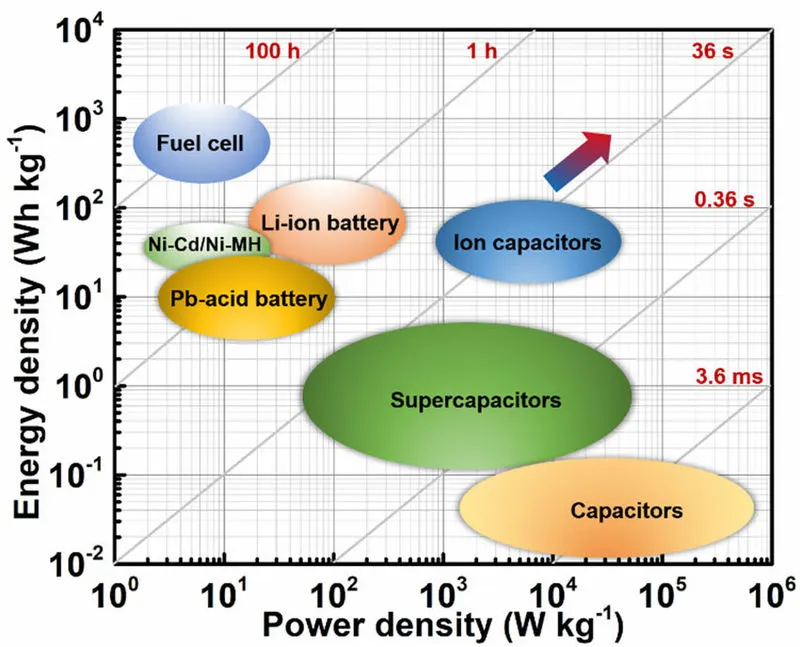
Conculsion from the above plot:
- Here The Fuel cells are having high energy density but the power density is very less when compared to other types of batteries.
- Because they produce the electrical energy based on their fuel supply its reaction time given as 100Hrs.
- Here shown the energy density as 1000Wh/Kg where as its power density produced given as nearlly 10W/Kg.
- They requires boost converters to match load requirements.
- Lithium ion batteries having high energy density and also its power density matching its load requirements with out boost converters.
- Here shown for 100Wh/Kg energy density the power density is given as nearly 100W/Kg.They are in equal ratio.
- For lead acid batteries the energy density and power density are nearly in equal ration.
- Here given for energy density of 10Wh/Kg the power density is also 10W/Kg.
- so increase in energy density also increases the power density in equal ratio as Li-ion batteries.
- Here For the Ni-cd batteries the energy density are quite high as same as Li-ion and Lead acid battery types.
- But its specific power is less when compared with other batteries.
- Here given the energy density as 50Wh/Kg but its power density is only near 9W/kg.
- Thus they are used in less power consuming devices.
- Ultracapacitors or Supercapacitors are having less energy density but they will produce high power in short duration of time.
- Here as shown supercapacitors as having nearly 1 Wh/Kg of energy density produces nearly 5KW/kg of specific power or said to be its power density.
- Thus they are used in certain applications needs high power requirement in short duration of time.Its reaction time is given as 0.36 seaconds.
- Capacitors are normally using in most of the electronic devices to produce high power balancing regions. Thus they are having nearly 0.05Wh/Kg as energy density but power output as extremely higher.Its reaction time as given 3.6 micro seconds.