Week 2:- BiW Fixture Basics Challenge
BIW FIXTURE BASICS
QUE:-1 .WHAT ARE PROCESS OF PROJECT EXECUTION ACTIVITY?
ANS:- There are following step for the project execution activity
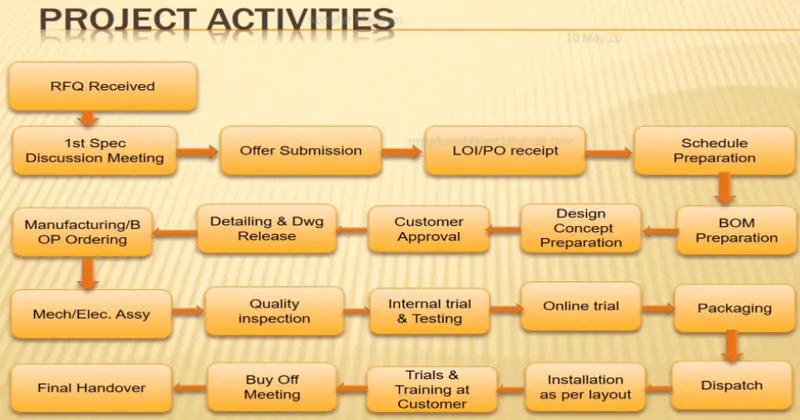
REQUEST FOR QUATATION (RFQ):-
In BIW fixture design project begains . it starts with basic requirement or RFQ that we receive from customer .RFQ means request where in customer gives his requirement specification etc . in form some document or data to study or to work on information include such as technical offer . commercial offer . timeline of project based on that we have processing to execute project.
1st specifications dicussion meeting & offer submission:
In this the document related technical offer , commercial offer , project execution timeline required to complete the project are prepared . the time required to 3d design analysis of design drawing & detailing manufacturing , assembly & commissioning etc. is considered . then cost of all operation is considered . by considering these kind of things the offer is prepared & submitted to customer . Below fig show document that how technical offer is made .
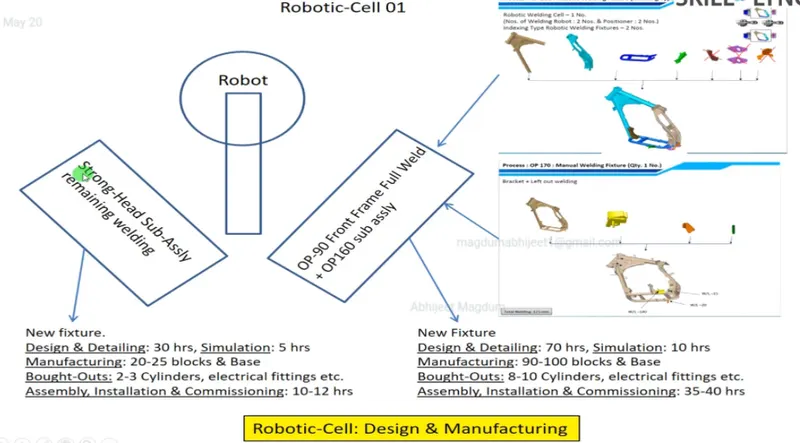
These are technical offer based on this commercial offer will be placed .
PO/LOI:Once we submitted offer cuatomer will study the offer at same time he will get offer from different supplier & vendor.
He compares these techincal offer & based on cost which ever suit best for his requirement . Then he will release LOI or PO
with it term & conditions as earlier.
Schedule preparation : In project each activity depands on previous activity . so if previous activity has not completed on time it will cause delay in next activity date is fixed so that it will moves further . each acitvity has assigned specific time . when acitvity is starting & when ot is ending ?so have some back plan so that the fianl date come to close final delivery date. there need prepare scheduling to be done to complete project in time " On time delivery "is one of the major requirement from customer side also cutomer want commitment must be follow in respect of time.
BOM preparation :-bom prepation is a listing down of part list which include brought out part , vendor parts and consumable items with qty of each item . through Bom prepation material budget will be fixed .B/O parts include all machined. fabricated parts etc where consumable include like oil, gaease , glue loctite etc
Design concept prepation :-Further step is to design a concept . A concept is bassed on all specification received data from customer as 3d data of car panel drawing . drawing std . design std , manufacturing std. after studying all data design concept is build .
Customer approvel :-As design concept ready then it is send to customer for its approval it is also known as ddesign approval process (DAP) or customer approval process . in that customer will check that all his specification consider or not in specifications. wheather it is as per technical offer submitted these changes are updated to design team by project team . design team again work on it some modification or changes are necessary to improve design like clamping need to be improved or this mechanism will work fine . sensor should be this make . these changes are updated to customer . Once He final approval we will moves further for detailing & dwg. release.
Detailing & Dwg.release: In detailing all assemblies broken down into its child parts. Parts of assemblyare segregated into std. As well as manufactured. For std. parts own data sheet or specification sheet prepared to purchase it from catalogue. e.g motor power,motor current rating, torque produced,shaft rpm which suit for our application.For vendor parts all detail should be provide on dwg. Like all dimension of part with tolerance,surface finish,surface treatment,hardness,welding note all should be mention on dwg. These dwgs are checked & released for manufacturing.
Manufacturing & B/O ordering: Manufacturing department will receive all dwg to start manufacturing of items like mylar,blade,riser,base frame.Also purchase team will place order for B/O parts like motor,gearbox,cylinder & valves.As material get ready. QC team should inspect all part received is as per specification or not otherwise it will create issue later whicj will waste our time.
Mechanical & Electrical Assembly: After QC check, parts are available for assembly.A station is integration of all mechanical as well as electrical assembly. Assembly team will do all assembly as per dwg. All station are build as per layout.Then again QC team shuld be involved for checking assemblyas per final dwg., all coordinate dimension should be ok as per design data.
Internal trial & testing:After successful of trial next step is online training.In online training has two mode manual & automated.In online trial systems is run through control panel.All sensor,actuator,motor current & temperature,noise,all alarm,also safety should be tested.All process must be executed as per sequence also cycle time meet.In online training system run for certain cycle & actual production taken to ensure system run successfully.
Packaging: After trial get successful,customer give approval to dispatch system.To dispatch whole system needs to be disassemble station wise & pack properly.Delicate material should be packed properly otherwise there is chance of damage aesthetically or functionally during transportation.During packaging labeling,special handling instruction should be pasted on particular parts to convey message of taking care during handling & transportation.
Dispatch: All material transported customer site through trucks,container and ships or by air.
Installations:All system is assembled & installed at customer end as per layout approved initially in DAP.All station,robots,conveyor mounted as per distance specified in layout.Robot arm should be reachable to station,pick & drop point.It should not foul with other equipment.Also some adjustment should be provided for leveling purpose at robot conveyor base,station base frame like leveling stud to align with other equipment.Layout is always specified at the time of initial design stage & it has to be approved by customer.
Trail & Training at customer end:Once installation is done trial start at customer end.So there will be production trial,online trial.Production trial is necessary because at the time of designing fixture, it also committed no.of unit that will be manufactured from that fixture also whether it is meeting quality,benchmark or not.Also in technical offer it is committed that there will be 100 units per 8 hrs shift will manufactured from that fixture with weld qualty.So during production trail fixture capability will be ensured.Once this goal is achieved then there will be training to operator,staff member,engineers to let them to understand how process is working?
Buy off meeting:Once training is completed there is buy off meeting betwwen customer & project team with discussion on if there other things need to be incorporated,anything missing that described in LOI/PO or offer submission.Then customer will raise point or sometimes customer wants modification that will lead to extra quotation, extra costing according work is done as per buy of meeting.
Final handover:Once all points raised by customer will be closed then all will go for final handover.All data, technical manual,soft hard documents will submit to customer.These are main project activity.
QUE-2.WHAT ARE TYPE OF JOINING PROCESS?
Answer: There are many joining processes used in BIW like welding,gluing.
The durability and performance of any structure is largerly depends on quality & design of components joints.Whole structure can't be made in one piece.Two fundamental option for joining material & components.
1.Metallurgical joining
2.Mechanical joining
1.Metallurgical joining: In welding two or more parts are heated & melted or forced together,causing the joined parts to function as one.In some welding method filler material is added to make the marging of materials easier.
a.Welding:
Welding is process of permanently joining material welding joins different metal/alloys with a number of processes in which heat is supplied either electrically or by means of torch. Welding is done by application of heat or both heat & pressure. Pressure may be employed,but this is not in many processes essential.The welding process involves applying heat to the workpiece.The heat applied should be such that the workpiece
should melt ,i.e the temperature at which welding is done , should be more then the melting point of the workpiece to be welded . welding is a febrication or sculptural process that join material .
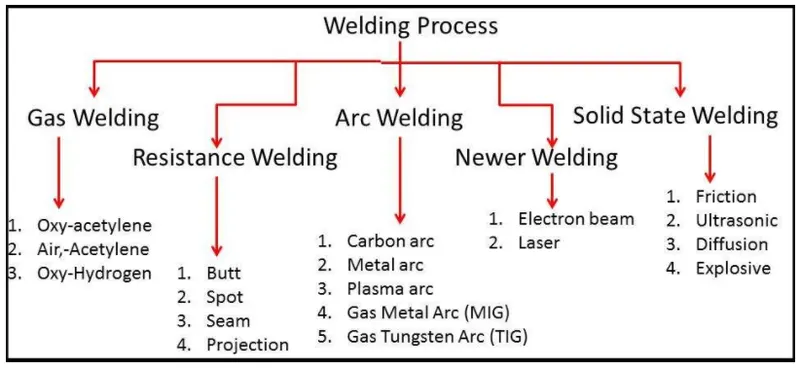
There are many different type of welding operation , such as the various arc welding resistance welding and oxyfuel gas welding methods. Below fig illustrate different type of welding process.
b.Brazing: During brazing process a filler metal is melted & distributed in between multiple soild metal components after they have been heated to proper temperature
The filler metal must have been melting point that is above 840. Brazing is metal- joining process in which two or more metal items are joined together by melting and flowing a filler metal into the joint , the filler metal having la lower melting point than the adjoining metal.
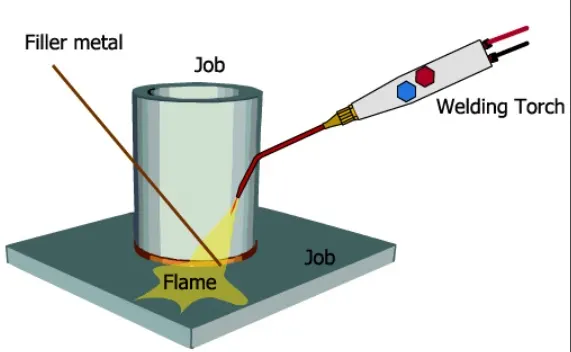
Brazing differ welding in that it does not involve melting the work piece and from soldering in using higher temperature for a similar process , while also required much more closely fitted parts by capillary action . the filler metal is brought slightly above its melting (liquidus) temperature while protected by suitsble atmosphere, usually a flux.It then flows over the base metal(in a process known as wetting) and is then cooled to join the same or different metals with considerable strength.Below fig show brazing process.
c.Soldering: Soldering is a process in which two or more items are joined together by melting and putting a filler metal (solder) into the joint, the filler metal having a lower melting than the adjoining metal.Unlike welding,soldering does not involve melting the work pieces.In brazing,the workpiece metal also does not melt, but the filler metal is one that melts at a higher temperature than in soldering.In the past,nearly all solders containe lead,but environmental and health concerns have increasingly dictated use of lead-free alloys for electronics and plumbing purposes.Soldering is used in plumbing,electronics and metalwork from flashing to jewellery and musical instruments.Below fig shown as an additional inforamtion.
d.Adhesive bonding: Adhesive bonding(also referred to as gluing or glue bonding) describes a wafer bonding technique with applying an intermediate layer to connect substrates of different types of materials. Those connections produced can be soluble or insoluble.The commercially available adhesive can be organic or inorganic and is deposited on one or both subtrate surfaces.Adhesives, especially the well- established SU-8, and benzocyclobutene (BCB), are specialized for MEMS or electronic component production.The procedure enables bonding temperatures from 1000 C down to room temperature.The most important process parameters for achieving a high bonding strength are adhesive material, coating thickness, bonding temperature,processing time,chamber process,tool pressure.
Adhesive bonding has the advantage of relatively low bonding temparature as well as the absence of electric voltage and current.Based on the fact that the wafers are not in direct contact,this procedure enables the use of different substrates , e.g silicon, glass,metals and other semiconductor materials.A drawback is that small structures become wider during patterning which hampers the production of an accurate intermediate layer with tight dimension control.Further,the possibility of corrosion due to out-gassed products,thermal instability and penetration of moisture limits the reliability of the bonding process. Another disadvantage is the missing possibility of hermitically sealed encapsulation due to higher permeability of gas and water molecules while using organic adhesives.Below fig shown for an additional inforamtion.
e.Diffusion Bonding:Diffusion bonding or diffusion welding is a solid-state welding technique used in metalworking,capable of joining similar and dissimilar metals.It operates on the principle of solid-state diffusion,wherein the atoms of two solid,metallic surfaces intersperse themselves over time.This is typically accomplished at an elevated temperature, approximately 50-70% of the absolute melting temparature of the materials.Diffusion bonding is usually implemented by applying high pressure,in conjunction with necessarily high temperature,to the materials to be welded;the technique is most commonly used to weld "sandwiches" of alternating layers of thin metal foil,and metal wires or filaments.Currently, the diffusion bonding method is widely used in the joining of high-strength and refractory metals within the aerospace and nuclear industries.
2.Mechanical Joining:Mechanical joining is a process for joining parts through clamping or fastening using screws,bolts or rivets.Advantages of machanical joining include versatility, ease of use,and the option to disamntle the product in cases where regular maintenance requires it.The ability to join dissimilar materials is another benefit.A drawback of using mechanical joining is the lack of a continuous connection between parts,because the joint is achieved through discrete points.Also,holes created for joining are vulnerable to fractures and corrosion.
Mechanical joining-also called joining by forming -has become interseting for the automotive industry due to the request to reduce fuel consumption and thereby emissions.In order to reduce weight on the car body,the usage of lightweight materials in the body-in-weight application has increased.This includes aluminium, high-strength steel alloys,polymers,and composited.Here the different type of mechanical joining techniques.One general benefit for all mechanical joining methods is the mobility of the material after joining.At the same time mechanical joining offers an impressive strength.
a)Mechanicla Fastening: The joining of material combinations which cannot be easily welded usch as pre-painted steel or very dissimialr metal.Ex.Al application in autobody makes use of mechanical fastening to overcome the poor inherent weld ability of Al.
The joining of materials in application where high fatigue life is critical compared to static strength.
The joining of materials where high tool life is of relative importance
E.g screw,bolts etc
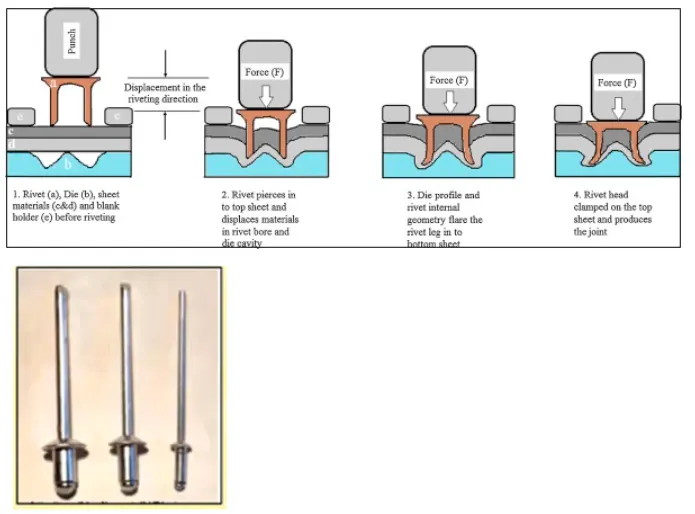
b)Self piercing riveting: Self piercing riveting is high speed mechanical fastening for point joining sheet material,typical steel & aluminium alloys.It is single step technique generally using a semi tubular rivet to clinch the sheet in mechanical joint.There is also process variant which utilizes solid rivets.
As name suggest pre drilled hole are not required,allowing joint to be made rapidly in one operation. The process cycle is shown below
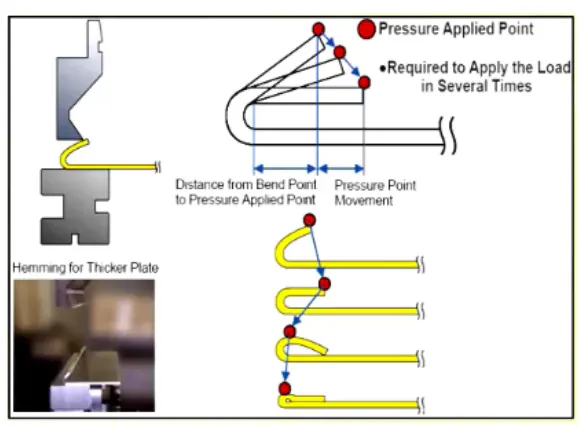
C.Hemmingn &seaming process:
Hemming & seaming are two similar metal working process in where a sheet metal edge is rolled over on to itself. Hemming is process in which edge is rolled flush to itslef, while seam join edge of two material. hems are commonly used to reinforcementt an edge, hide burrs and rough edges, and improve appearance.
QUE3.WHAT IS RESISTANCE WELDING & ITS APPLICATION SECTOR?
The most common type of welding used in the BIW joining processes is resistance welding.The types of resistance welding are
1.Resistance Spot Welding
2.Resistance Projection Welding
3.Resistance Seam Welding
Resistance welding is made by conduction a strong current through the metal combination to heat up and finally melt at localised points predetermined by the position of the electrodes and workpieces to be welded.
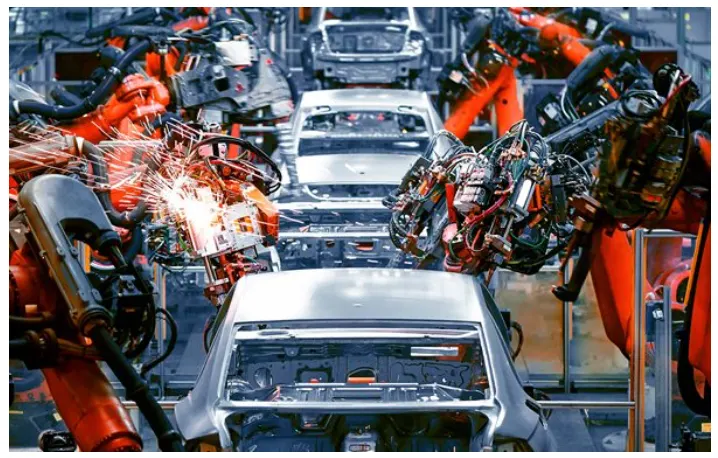
Spot welding which can be automated combined with robots and manupulation systems is the most common joining process especially in high volume manufacturing lines and has in particular been the main joining process in BIW panels.
Resistance spot welding:
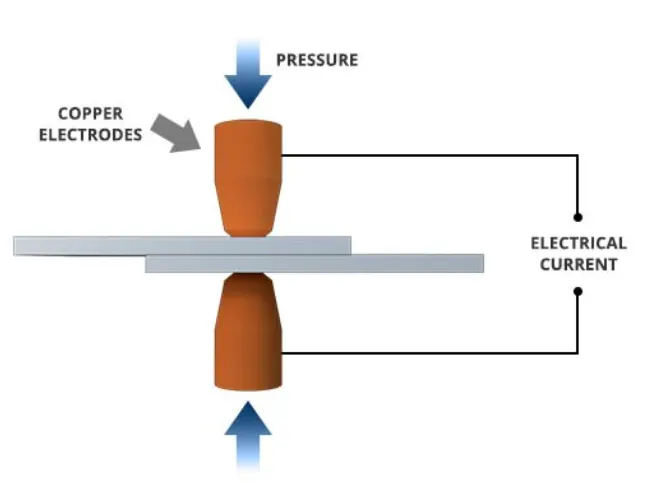
Resistance Spot Welding process:-
The process involves applying pressure and heat to the weld area using shaped alloy copper electrodes which convey an electrical current through the weld pieces.
The welding heat is generated by the electric current, which is transferred to the workpiece through copper alloy electrodes.
Copper is used for the electrodes as it has a high thermal conductivity and low electrical resistance compared to most other metals,ensuring that the heat is generated preferentially in the work pieces rather than the electrodes.
Application
Resistance Spot Welding which is a pressure welding process is cost effective technology used in joining Automative BIW parts, reinforcement structutres, frames.
The weld quality is better which can be simulated with required parameters.
Effective in joining thinner materials with high production rate.
Resistance projection welding
Resistance Projection welding is a slight modification of Spot Welding where the current applied through two falt electrodes are much stronger and therefore used for joining Thicker materials.
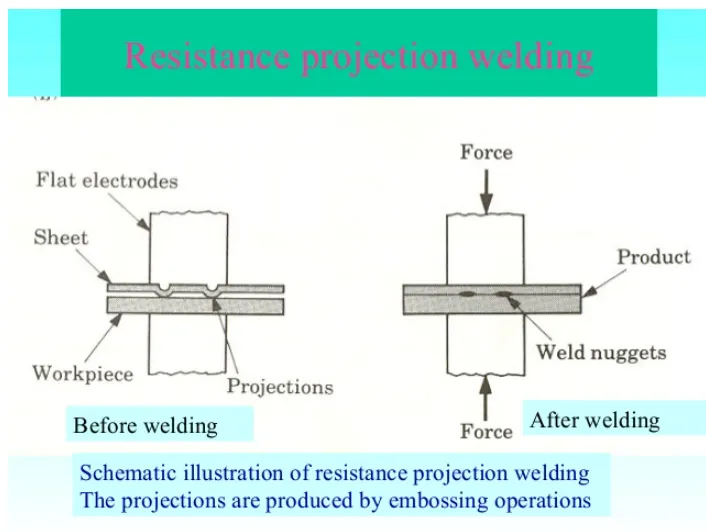
APPLICATION:
The strength of the weld quality is better hence used in joining thicker materials
Eg.Weld Nuts
RESISTANCE SEAM WELDING
In seam welding of overlapping nuggets is produced,usually buy replacing the conventional spot welding electrodes by wheels that turn as the parts to be welded are fed between them.The process thus produces a continuous leak-tight seam.
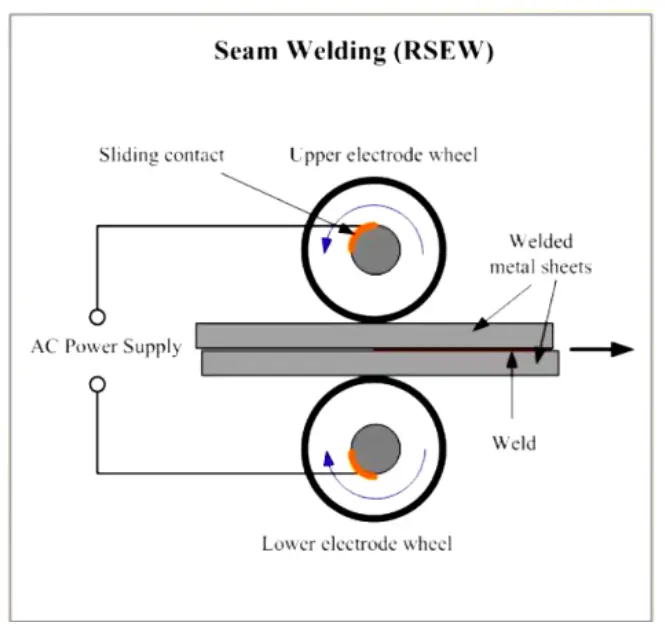
APPLICATIONS
Seam Welding is mostly applied in manufacturing of conatiners,radiatord and heat exchangers.
QUE.4-WHAT IS FUSION WELDING AND ITS TYPE FUSION WELDING WITH ITS APPLICATION OF AUTOMOTIVE SECTOR
Fusion Welding is a type of welding where joining is acheived through heat by fusing the two materials through an elctrode.
External application of pressure is not required,
The types of fusion welding process are
1.Arc Welding
2.Resistance Welding
3.Gas Welding
4.High Energy Welding
Arc welding
ARC Welding process involeves either consumable elctrodes or non consumable electrodes.
Arc is produced between the tip of electrode and workpiece by use of AC or DC power
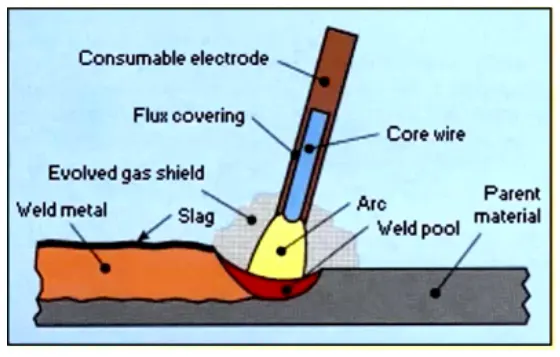
TYPES OF ARC WELDING
Manual metal arc welding?
It is also known as Shielded metal arc welding is a stick welding process where both the electrode rod and workpiece metal fuses to created to weld
METAL INERT GAS WELDING
In MIG welding process a stream of inert gas passed to the arc welding
TUNGSTEN INERT GAS WELDING
TIG Welding uses a non consumable tungsten electrod along with an inert gas with the aid of filler rod and weld head .
QUE.5-WHAT IS THE 3-2-1 PRINCIPLE?
- 3-2-1 Principle or taylor principle is way of arresting the degree of freedom to completely fix the component with respect to the primary , secondry and tertiary datum planes.
- fixture design process involves accurate and correct orientation of workpiece with respect to the cutting tool or inspection device with regid clamping and fixation of workpiece.
- A workpiece in free space has 12 degree of freedom
- 6 Translational (positive and negative direction of X,Y,Z)
- Thus a fixture uses 3-2-1 principle to constrain the motion of the workpiece by suitable holding device during various operations.
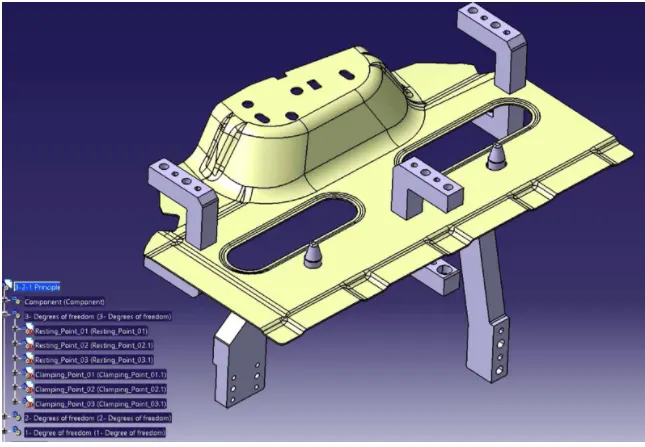
QUE- 6.DEFINE THE BODY CONSTRAINATE SYSYTEM ?
- It is a coordinate system consisting of set lines and surface used to deifne the position of point in space in either two or three dimensions.
- it is also called as car line and body line
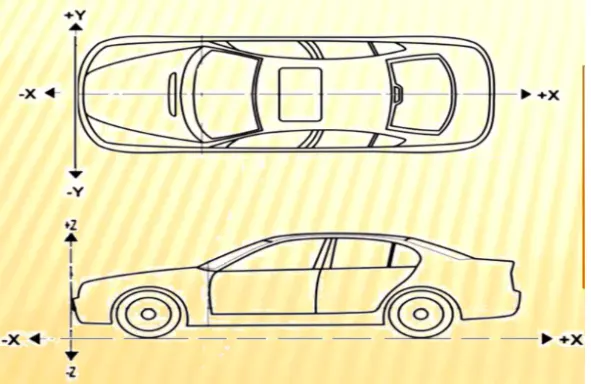
Body coordinate system is used in automotive industry for drawing of body parts, product and process design .
QUE.7:ELABORATE BODY PLANE SYSYTEM AND ITS ESSENTIALS
The body planes are the reference planes used to define the GD & T all the car parts in an automotive domain.
Thus the measurement from the body planes to the parts are called as body line dimensions .
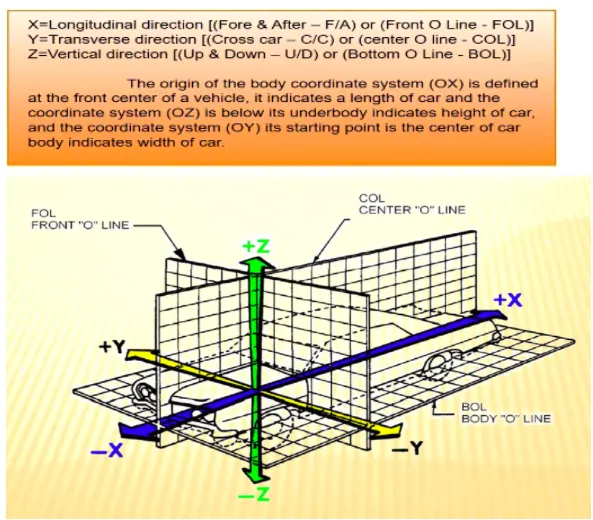
APPLICATIONS
The application of body line dimensions are
- it define the extract position of each vehicle body parts with respect to fixed origin
- it ensure a flawless design for assembly
- it assists in quality checks and in easy location of different parts
While designing all the design are carried out relative to the body line (fixture , turn tables ) and helps in creating a standardised systems
CONCLUSION:-
While designing all the designs are carried out relative to body lines (fixture , turn tables )and helps in creating a standardized systems.