Week 2:- BiW Fixture Basics Challenge
1. What is the process of project execution activity?
- PROJECT LIFECYCLE: This is the lifecycle of the overall project from customer’s RFQ (Initiation of project) to project completion & handover.
No.
Activity
Description
1
RFQ Received
Receiving customer's request for quote.
2
1st Spec Discussion Meeting
Initial discussion with customer on fixture specification.
3
Offer Submission
Submitting offer to customer.
4
LOI/PO receipt
Receiving purchase order from customer. This officially starts the project.
5
Schedule Preparation
Prepare schedule (gantt chart) for the project.
6
BOM Preparation
Prepare bill of material considering the standard parts from customer.
7
Design Concept Preparation
Prepare fixture design, see below for “Design Process” in detail.
8
Customer Approval
Getting customer’s approval.
9
Detailing & Dwg Release
Once the design is approved, detailing and GD&T will be done to specify the dimensions and tolerances required.
10
Mfg/BOP Ordering
Put in order for materials needed as per design.
11
Mech/Elec. Assy
Assembly of fixture.
12
Quality Inspection
Quality check on the positioning & tolerance.
13
Internal Trial & Testing
Internal test for fixture feasibility.
14
Online Trial
Trial on the production line.
15
Packaging
Package the fixture & prepare for dispatch to customer.
16
Dispatch
17
Installation as per layout
Installation on customer’s site.
18
Trials & Training at customer
Trial on the site and provide training to use the fixture.
19
Buy Off Meeting
Final review of the fixture, and discuss if any adjustment is needed.
20
Final Handover
Handover of the fixture and relevant documents to customer, e.g. BOM, Keysheet, Layout sheet, etc.
DESIGN PROCESS: This is the process involved in the design stage (Step 7 – 20). This is an iterative process where the results will be validated along each step.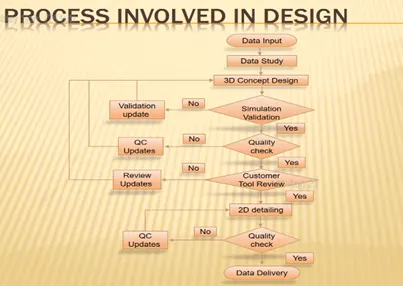
2. What are the types of joining processes?
-
Joining Type
Metallurgical Joining
(joining process that will change the material composition of the welded material)Mechanical Joining
(used in material that cannot be easily welded, e.g. pre-painted steels or very dissimilar metals or Aluminium that has low weldability)Chemical
(mainly used on cosmetic part in a car, e.g. windshield)Examples
Resistance Welding
· Spot Welding
· Seam Welding
· Projection Welding
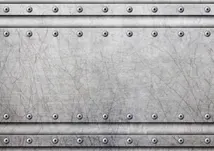
Riveting
Adhesive Bonding

Fusion Welding
· Arc Welding
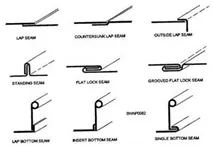
Hemming & Seaming
3. What is Resistance Welding & its application in the automotive sector?
Resistance Welding a widely used welding technology in the automotive sector for joining metal sheets and components. It works by conducting a current thru two pieces of metal, thus melting the metal at a localized point and joining the pieces. To confine the contact area of the weld interface, force is applied during welding.
-
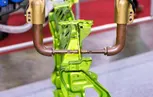
Spot Welding
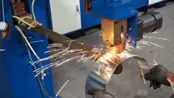
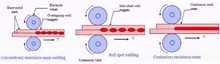
Seam Welding
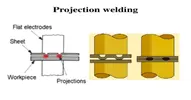
Projection Welding
Commonly used in BIW welding. The process is relatively fast, takes only 1-2 sec / spot and there are approx. 5000 spot/BIW.
Used in leak-proof part as it joins metal sheets in a continuous fashion. Example of seam welded parts include Container, Radiator, Heat Exchanger
Form of welding where the size and shape of the welds are determined by the projections (profile) on the metals to be joined. used for mechanical fixing of autobody structure eg weld nuts.
4. What is fusion welding & types of fusion welding with its application in the automotive sector?
Fusion welding joins the material by heating the metal workpiece to a molten state then allowing it to be solidified. Arc welding is a type of fusion welding where an arc is created between the electrode and the base material to melt the metal at the point of contact. It is commonly used during automotive repair work.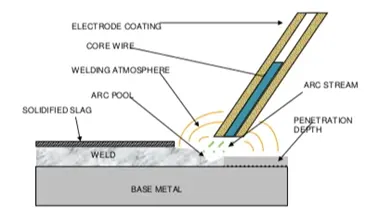
5What is the 3-2-1 principle?
3-2-1 is the main principle used in the design of fixture, where the number means fixing 3, 2 and 1 degree of freedom respectively in both positive and negative direction.
First, the workpiece must be located with three rest & clamp for stability while fixing 3 d.f. (translational Z, rotation X & rotation Y)
Next, using the first pin, 2 d.f. is arrested (translational X, translational Y)
Lastly, using the second pin, 1 d.f is arrested (rotational Z)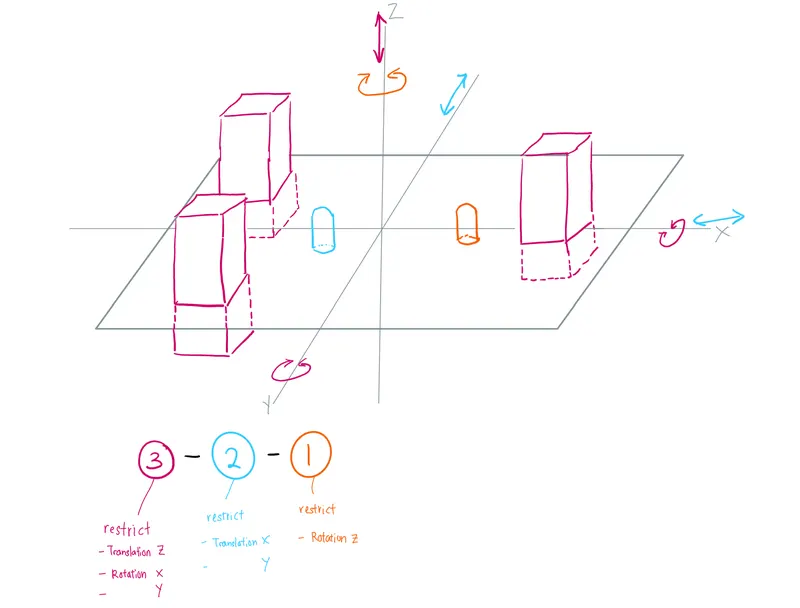
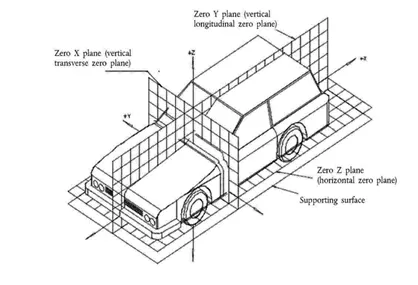
6. Define Body coordinate system?
BCS also know as Car line & Body line is a reference system used to specify the location of different parts in a car in 2D/3D plane. Difference car maker have different BCS standards. 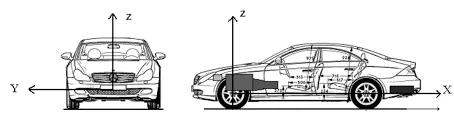
7. Elaborate Body plane system & its essentials.
It is the reference plane in an automotive car, used to define the GD&T of all car parts with respect to the automotive domain.
-
- To define the exact position of each part in the car w.r.t fixed origin
- To ensure easy location of parts.
- To ensure parts can be perfectly assemblied.
- To ensure ease of designing as all designs are prepared relative to the bodyline/fixture/turntable
- To aid in QC