Week 1:- Introduction to BiW and Fixtures Challenge
What is BIW & define its parts?
BIW (Body in White):
- The overall structure of a car formed by welded sheet metal components, in which the other components will be married later in the process, i.e. engine, chassis, exterior and interior trim.
- Also refers to the stage in automotive manufacturing in which the car body sheet metal components are being assembled by welding and other joining process.
- BIW parts includes: Body side, Underbody, Closure, Roof, Fenders
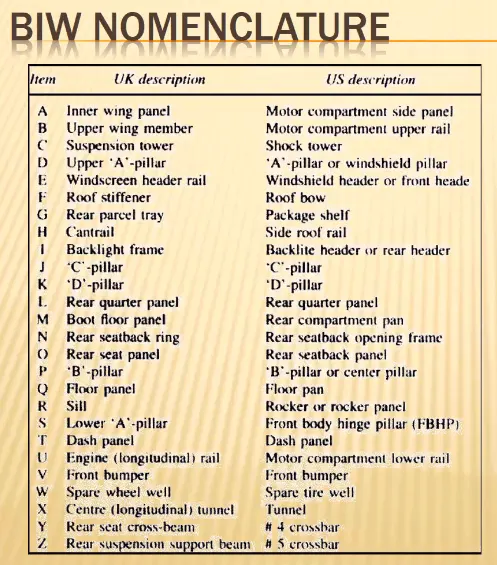
What do you understand by BIW nomenclature?
It is the standardized naming structure for the BIW parts. There are some differences between some namings from the UK & US.
What is fixture & its types?
- A fixture is a device which holds the work piece to be processed (welded), by using 3-2-1 principle. In general, welding fixture (aka. tool) consists of a number of different units mounted on a base unit together to hold the car panel (work piece),
- The goal is to support the workpiece in proper location and to prevent distortion in workpieces during welding. Hence, the placement of locating elements will be important to achieve this, in which the clamping has to be tight but firm, placement of clamping elements has to be clear of the welding area and the fixture has to be quite stable and rigid to withstand the welding stresses.
- Types:
- Production Fixture - mass production purpose
- Pre production opetation fixtures (PPO) - For initial batch production to study the feasibility.
- Checking Fixture - For car panel geometric inspection purpose.
What is the basic principle of fixture design?
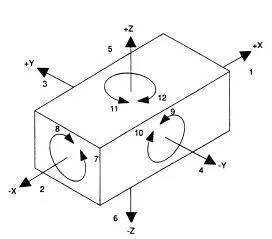
To achieve zero degree of freedom by fixing all the 12 degree of freedom in order to locate the work piece in the fixture. The 12 df consist of 6 translational df & 6 rotational df.
Elaborate types of BIW Stations?
- Geo-station: Using geo tool where the geometry of the panels welded together is defined accurately. Geo pin has a (-0.15) closer tolerance in general.
- Respot station: Fixture in which the remaining weld spots not achieved in geo-tool are welded, on the pre-welded panel from the geo tool. Respot pin tolerance (-0.28).
- Hemming (Marriage) station: Ficture in which the inner panel assembly and the outer panel assembly are joined together.
- Checking Station: Fixture used to check the automotive parts or assemblies. To ensure all coordinates, relative dimensions & positions are as per the tolerances. A checking station can be a gauge type, fixed type and automated checking fixture type.
Other tools used
- - Gripper: Fixture to hold the car panel, fixed to the manipulating end of robot or an end effector. Aka EOAT - End of Arm Tooling
- Stands
What are the basic terminologies used in the BIW fixture?
- NC/Mylar/Fingers - The part attached to the end of a clamp arm, directly contacting the car panel (workpiece)
- PLP - Principle Locating Point, Holes that need to precisely placed, where the position of other parts will be taken with respect to the PLP.
- Blade - Connects the rest mylar with the riser.
- Risers - Raise the unit to an overall height that is ergonomically friendly.
- Rough locators / Guide - Small metal plate/rod to guide the workpiece onto the fixture.
- Hardware - Screws, bolts and nuts.
- CMM - A machine used to precisely measure the part/assembly.
- Units - The subassembly of an overall fixture, eg. Base unit, Pin unit, Clamp unit
- Number plate - Embossing to recognize different units with unit number
- Coordinate plate - to cover coordinate hole to check for CMM machine
- Name Plate - Information plate to containing basic information of the fixture (ie. fixture name, company name etc)
- Clamp Arm - Assembly that moves to open/closed position
- Pivot - Point/Axis where the clamp arm rotates on.
- Class 'A' surface / Skin Surface - Outer face of the car, visible to users. Thus need to use softer material for clamping to prevent distortion to the surface.
- Reed Switches - Attached to side of the clamping cylinder to detect the position of the rod.
- Sensors - Detect the position of the car panel to prevent error in the welding process.
- Shims - Thin metal plates added in X and Y direction to adjust for manufacturing tolerances.