Week 2 : Basic Calibration of Single cylinder SI-Engine
AIM:
1.Run the case at 1800 rpm and list down important parameters
- air flow rate
- BMEP
- BSFC
- In-cylinder pressure
2. Increase the power output at 3600 rpm by 10% of this 1cylSi-final.gtm
This the aim of the challenge for this week ,to make a basic callibration of SI engine.
INTRODUCTION:
SI ENGINE:
A spark-ignition engine (SI engine) is an internal combustion engine, generally a petrol engine, where the combustion process of the air-fuel mixture is ignited by a spark from a spark plug.
Spark-ignition engines are commonly referred to as "gasoline engines".
The working cycle of both spark-ignition and compression-ignition engines may be either two-stroke or four-stroke.
A four-stroke spark-ignition engine is an Otto cycle engine. It consists of following four strokes: suction or intake stroke, compression stroke, expansion or power stroke, exhaust stroke. Each stroke consists of 180 degree rotation of crankshaft rotation and hence a four-stroke cycle is completed through 720 degree of crank rotation.
SOLUTION:
1.Run the case at 1800 rpm and list down important parameters
- air flow rate
- BMEP
- BSFC
- In-cylinder pressure
AIR FLOW RATE:
air flow rate is if you want to calculate the conveying air velocity. You can do this by multiplying the cross-sectional area (i.e. the area of the circular end of the pipe) by the air flow velocity. As with air speed calculations, you should determine the air flow rate under different conditions (the beginning or end of the conveying line) in order to account for the pressure gradient.
You can also calculate the air flow rate if you already know what the air velocity and pipe diameter are. With this information, you can use the following formula to determine the air flow rate: Qair = uair * π.D2/4.
AIR FLOW RATE is the mass ratio of air to a solid, liquid, or gaseous fuel present in a combustion process.
BMEP:
Brake mean effective pressure (BMEP) - Mean effective pressure calculated from measured brake torque. Gross indicated mean effective pressure (IMEPg) - Mean effective pressure calculated from in-cylinder pressure over compression and expansion portion of engine cycle (360° in a four-stroke, 180° in a two-stroke).
BMEP can be thought of as a 'Torque ratio' for the engine. An interesting way to think of BMEP is that it tells you how efficiently the engine uses its size (displacement) to produce torque. It is a tool that can help you during the generator system design.
Brake Mean Effective Pressure (BMEP) is essentially the average pressure forcing the pistons inside your engine down that provides the measured torque output.
BSFC:
BSFC is the measurement of efficiency of fuel by the engine that combusts the fuel air mixture and produces the rotational motion of the crankshaft. This is used for comparing the efficiency of the engine. BSFC is the ratio of the rate of fuel consumption and the effective power produced from the engine.
The BSFC calculation (in metric units)
Commonly BSFC is expressed in units of grams per kilowatt-hour (g/(kW⋅h)). The conversion factor is as follows: BSFC [g/(kW⋅h)] = BSFC [g/J] × (3.6 × 10⁶) The conversion between metric and imperial units is: BSFC [g/(kW⋅h)] = BSFC [lb/(hp⋅h)] × 608.277.
In-cylinder pressure:
Cylinder Pressure is the pressure in the engine cylinder during the 4 strokes of engine operation (intake, compression, combustion and expansion, and exhaust). You could argue that pressure during expansion is the most important, because that is the cylinder pressure pushing on the piston to produce power.
The pressure (P) the gas exerts on the piston is equal to the force (F) with which it pushes up on the piston divided by the surface area (A) of the piston. Thus, the force exerted by the gas is equal to the product of its pressure times the surface area of the piston.
Cylinder pressure measurement is mostly performed with piezoelectric high-temperature pressure sensors that are installed through a mounting bore which has to be drilled in the cylinder head for this specific purpose. Measuring spark plugs with an integrated high-temperature pressure sensor are also used.
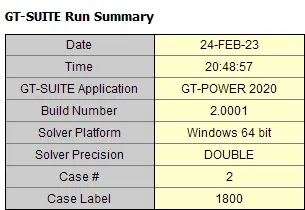
THE GT-SUITE RUN SUMMARY FOR RPM-1800:
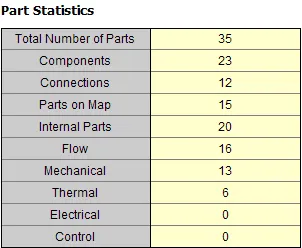
PART STATISTICS:
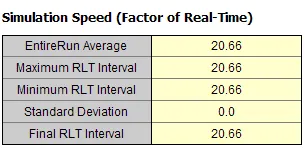
SIMULATION SPEED :
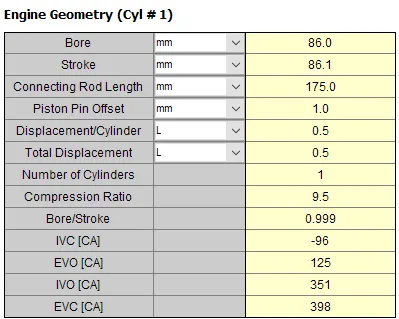
ENGINE GEOMETRY:
ENGINE PERFORMANCE PREDICTIONS:
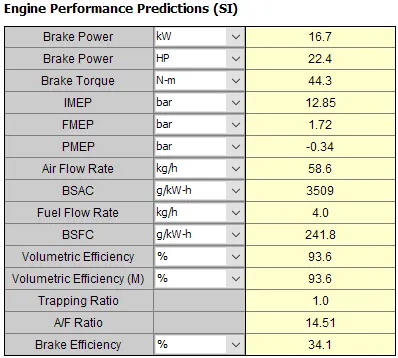
ENGINE PERFORMANCE:
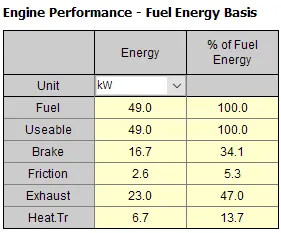
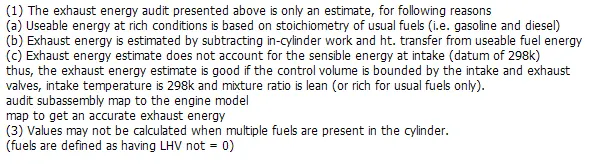
KEY CYLINDER PREDICTIONS:
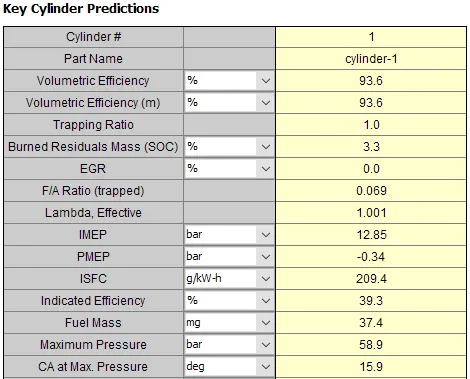
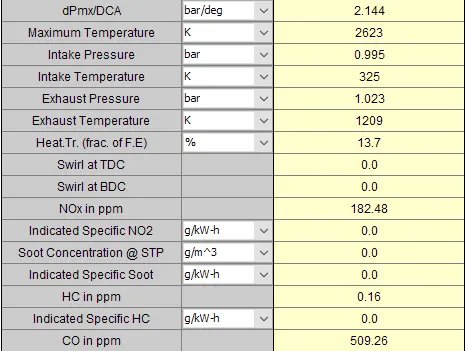
THE RESULTS FOR RUN RPM-1800 IS :
- air flow rate-58.6 Kg/h
- BMEP-3509 g/kwh
- BSFC-241.8 g/kwh
- In-cylinder pressure-1.023 bar
2. Increase the power output at 3600 rpm by 10%
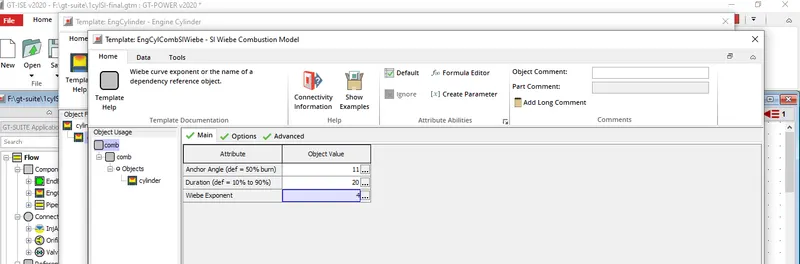
Increase the power output at 3600 rpm by 10% there are several ways present to increase the power output such as,
increase the bore ,increase the stroke, the increase of the compression ratio all the increase o the parameters change the pressuee output. the chages and the results are added in the file.
the results are attached in the file given below.
CONCLUSION:
In this challenge the basic callibration of the SI ENGINE is carried and the knowledge about is obtained.
the detail information how the si engine wors and the process all was clearly understood by this challenge.