Week 2 Air standard Cycle
ENGINE-KINEMATICS CHALLENGE
Aim:
- Write a python code such that it generates PV diagram for Otto-cycle.
- Also give an output for the thermal efficiency for the same cycle.
Problem Statement:
Otto cycle generally gives us an idea of how an SI engine works. It is a detailed thermodynamic study of SI engine and helps us calculate various efficiencies associated with the engine. Thus, writing a code to produce such a PV diagram from raw inputs from user will make the further studies in the field much easier.
Theory:
- Process 1–2 is an adiabatic (isentropic) compression of the charge as the piston moves from bottom dead centre (BDC) to top dead centre (TDC).
- Process 2–3 is a constant-volume heat transfer to the working gas from an external source while the piston is at top dead centre. This process is intended to represent the ignition of the fuel-air mixture and the subsequent rapid burning.
- Process 3–4 is an adiabatic (isentropic) expansion (power stroke).
- Process 4–1 completes the cycle by a constant-volume process in which heat is rejected from the air while the piston is at bottom dead centre.
Relation between crank angle(ᵠ) and static volume(V);
V/Vc = 1 + (1/2)*(rc – 1)*[ R + 1 - cosᵠ - (R2 – sin2ᵠ)1/2]
rc => compression ratio
R = con_rod length/crank pin radius
Program:
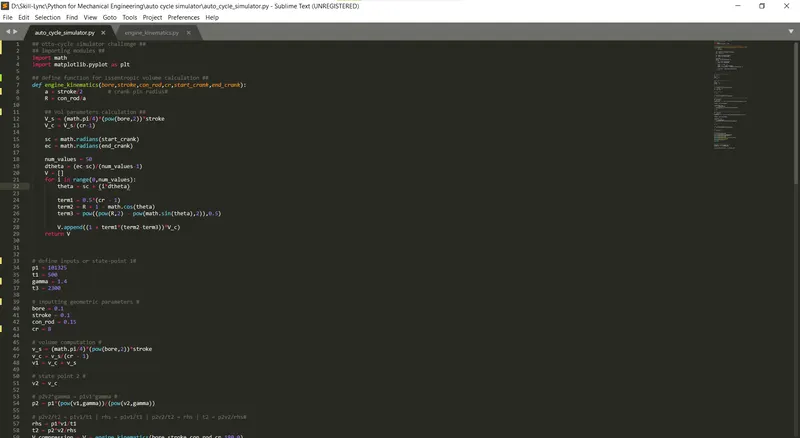
## otto-cycle simulator challenge ##
## importing modules ##
import math
import matplotlib.pyplot as plt

## define function for issentropic volume calculation ##
def engine_kinematics(bore,stroke,con_rod,cr,start_crank,end_crank):
	a = stroke/2 		# crank pin radius#
	R = con_rod/a

	## vol parameters calculation ##
	V_s = (math.pi/4)*(pow(bore,2))*stroke
	V_c = V_s/(cr-1)

	sc = math.radians(start_crank)
	ec = math.radians(end_crank)

	num_values = 50
	dtheta = (ec-sc)/(num_values-1)
	V = []
	for i in range(0,num_values):
		theta = sc + (i*dtheta)

		term1 = 0.5*(cr - 1)
		term2 = R + 1 - math.cos(theta)
		term3 = pow((pow(R,2) - pow(math.sin(theta),2)),0.5)

		V.append((1 + term1*(term2-term3))*V_c)
	return V


# define inputs or state-point 1#
p1 = 101325
t1 = 500
gamma = 1.4
t3 = 2300

# inputting geometric parameters #
bore = 0.1
stroke = 0.1
con_rod = 0.15
cr = 8

# volume computation #
v_s = (math.pi/4)*(pow(bore,2))*stroke
v_c = v_s/(cr - 1)
v1 = v_c + v_s

# state point 2 #
v2 = v_c

# p2v2^gamma = p1v1^gamma #
p2 = p1*(pow(v1,gamma))/(pow(v2,gamma))

# p2v2/t2 = p1v1/t1 | rhs = p1v1/t1 | p2v2/t2 = rhs | t2 = p2v2/rhs#
rhs = p1*v1/t1
t2 = p2*v2/rhs
V_compression = V = engine_kinematics(bore,stroke,con_rod,cr,180,0)

constant = p1*pow(v1,gamma)

P_compression = []
for v in V_compression:
	P_compression.append(constant/(pow(v,gamma)))
# state point 3 #
v3 = v2

#p3v3/t3 = p2v2/t2 | rhs = p2v2/t2 | p3 = rhs*t3/v3 #
rhs = p2*v2/t2
p3 = rhs*t3/v3
V_expansion = V = engine_kinematics(bore,stroke,con_rod,cr,0,180)

constant = p3*pow(v3,gamma)

P_expansion = []
for v in V_expansion:
	P_expansion.append(constant/(pow(v,gamma)))

#state point 4 #
v4 = v1

# p4v4^gamma = p3v3^gamma #
p4 = p3*(pow(v3,gamma))/(pow(v4,gamma))

#p4v4/t4 = rhs #
t4 = p4*v4/rhs

#plotting #
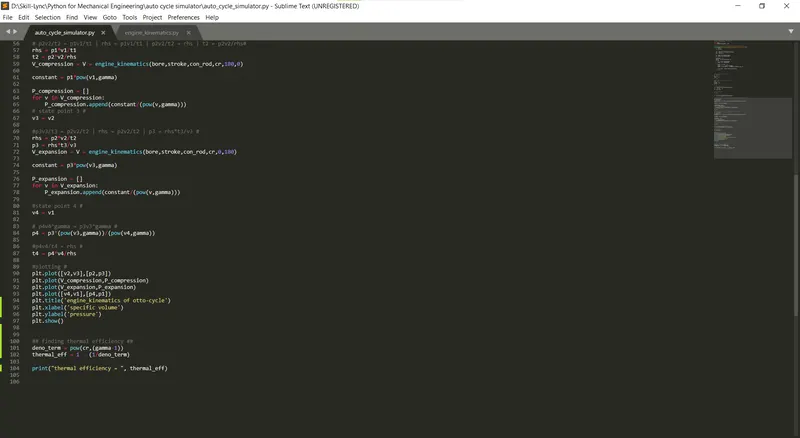
plt.plot([v2,v3],[p2,p3])
plt.plot(V_compression,P_compression)
plt.plot(V_expansion,P_expansion)
plt.plot([v4,v1],[p4,p1])
plt.title('engine_kinematics of otto-cycle')
plt.xlabel('specific volume')
plt.ylabel('pressure')
plt.show()


## finding thermal efficiency ##
deno_term = pow(cr,(gamma-1))
thermal_eff = 1 - (1/deno_term)

print("thermal efficiency = ", thermal_eff)
Results:
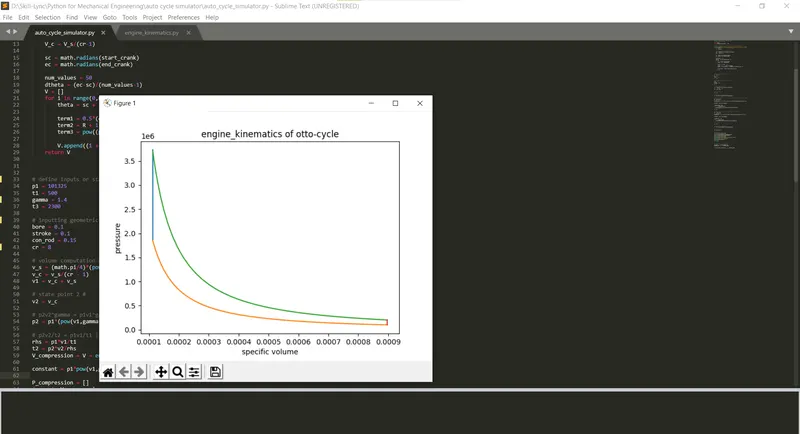
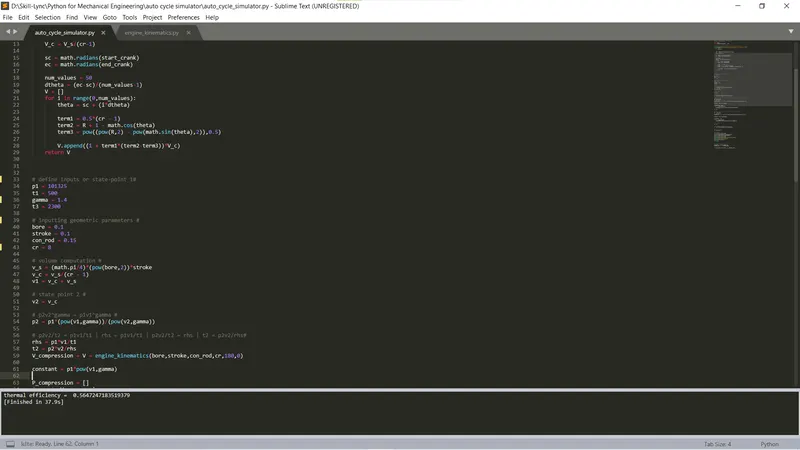
Thermal efficency = 56.47%
Disscussion:
1. P-V diagram for otto-cyle was achieved with python coding
2. Thermal efficiency was also calculted with the code