Week -2
Doorbell using solenoid block in Mat lab
SOLENOID : solenoid is an electro mechanical device which takes electrical input and produces mechanical output. Construction wise solenoid is an electromagnet which is used in many applications like door bell and solenoid valve when we require a mechanical output we place some metals near to the solenoid. so, when this solenoid is energised by electrical input the metals near to the solenoid gets attracted towards it and released when the solenoid is de energised after the electrical input is withdrawn. Here a motion or movement is observed by the metals because of the solenoid .so, this working principle is used in different applications.
APPLICATION : One of the important application of solenoid in many ships where solenoid valve in connection with hydraulic system is used to open the sea chest valves which are positioned at the bottom of the ships . Solenoid valves are simple and effective electrically operated valves to control liquid, gas or steam. Solenoid valves have many uses, from controlling compressed air to operate pneumatic equipment, controlling high-pressure oil to operate hydraulic equipment.
The coil is connected to the switch, battery and an electrical reference i.e an earthing.
The switch is connected to the pulse generator that provide the desired pulse to turn on and off the switch.
There is a scope block connected to the output of the pulse generator to observe the type of pulse and its time.
Here the Pulse produced is of the amplitude ‘1’ and with a period of 4 sec with a width of 50% meaning the pulse will be of amplitude 1 for 2 sec and 0 the other 2 sec.
2) Thermistor to sense the temperature of a heater & turn on or turn off the fan as per the below conditions:
EXPLAINATION
Here we are making an arrangement that will sense the temperature and will turn on and off the fan for the desired temperature condition.
For this project we have to turn on the fan when the temperature goes above 25 degree Celsius.
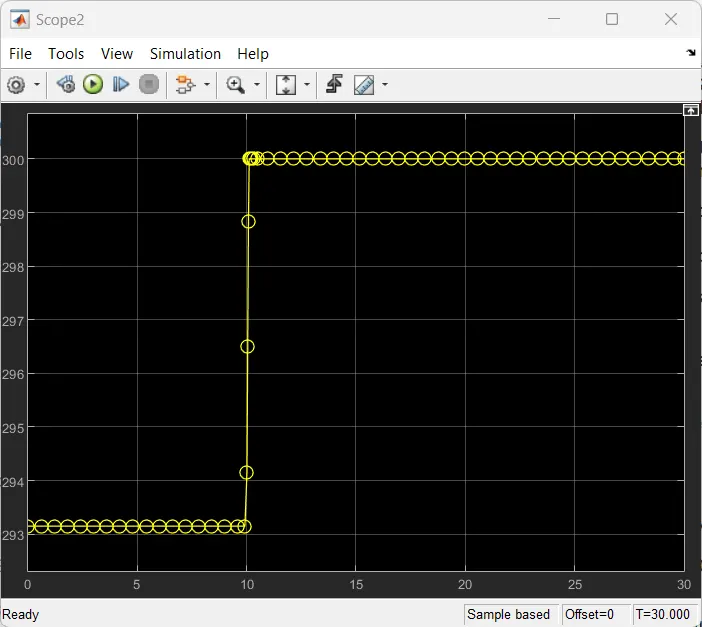
In the given project the temperature and time are related as following
From 0-10 sec the temperature will be 20 degrees.
From 10-30 sec the temperature will be 27 degrees.
From 30-50 sec the temperature will be 23 degree.
According to this the fan should be switched on from 10-30 sec and switch of for the rest of the time.
We will use a ‘controlled temperature source’ block which gives the desired output no matter the amount of Heat generated. For providing the input to the ‘Controlled Temperature Source’ we will use a signal builder block which will generate the above given conditions. We can see this int the graph provided above.
ABOUT THERMISTORS:- There are 2 types of thermistors mainly the one which increases the resistance with increase in temperatures and the one which decreases the resistance with increase in temperature
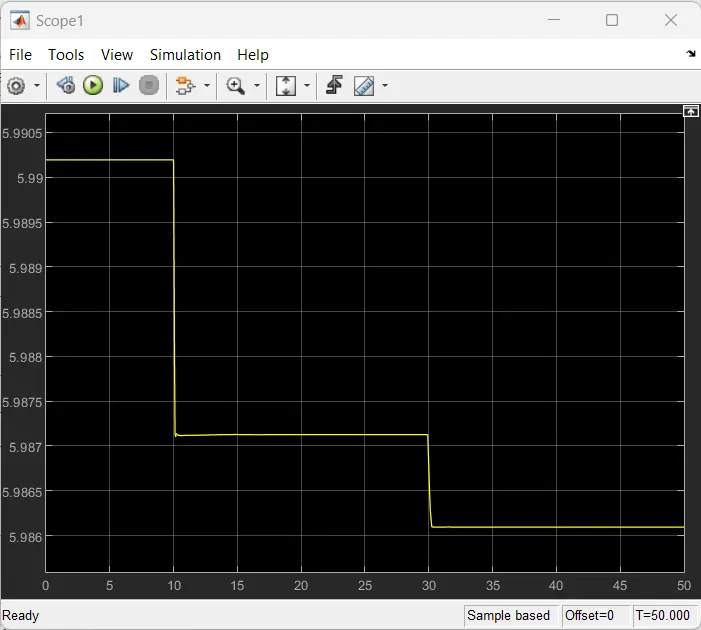
The thermistor will detect the temperature and its resistance will increase or decrease with respect to temperature. For different types of Temperatures the thermistor will give different readings, Which we will measure by attaching the voltmeter block across the resistance and will take a look in the scope block.
Under the scope block attached to the voltmeter we observe that when the temperature is 20 degrees the line is in between 0.01-0.0095.
When the temperature is 27 degrees the voltage value - 5.9863 and when the temperature is 23 degrees the line is 5.99
As I have found out that when the temperature is 25 degrees the line is almost equal to 5.987
The output of the voltmeter is connected to the switch.
The switch has three input and one output, among that the first and the third input are the conditions which we will give and the second input will be connected to the output of the voltmeter.
i have assign the 5.9863 is constant and have used the greater than & equal block
If the value of the output of the voltmeter value 5.9863 i the greater than & equal block the signal will be given as ‘1’ which will in turn give the signal to switch on the fan and if the output value is less than the ‘voltage value then the signal will be given as ‘0’ and a signal will be send to switch off the fan.
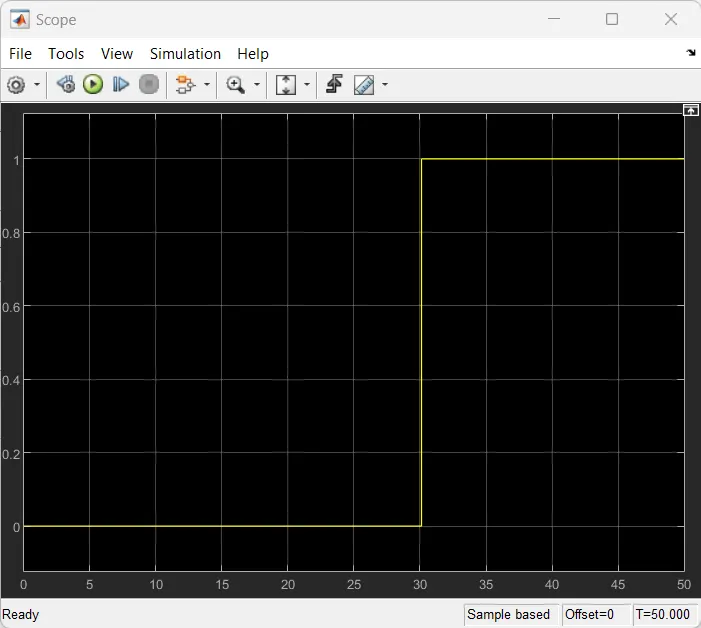
We can observe the scope block attached to the switch block. The value is ‘1’ between 10-30 sec as the temperature is beyond 25 degrees and for the rest of the time the value is ‘0’.
CONCLUSION
Hence the above two experiment are done successfully.
Kelvin Values
Various Voltage levels
ON/OFF STATUS