Week -2
1. MAKING A SIMULINK MODEL OF A DOREBELL USING A SOLENOID BLOCK :
- Door bell model
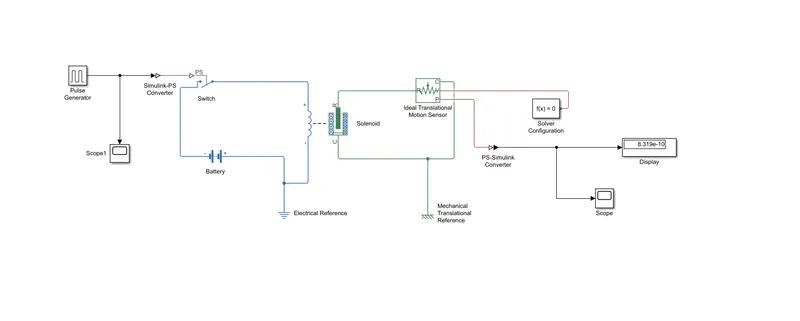
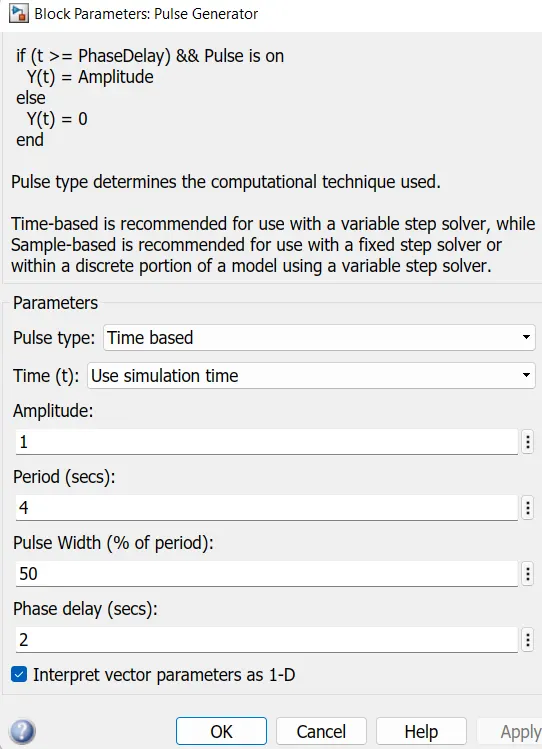
1. Pulse generator : The pulse generator is used to creat square wave pulses at regular time intervals. The block waveform parameters ampitude, pulse width, period and phase delay, determine the shape of the output waveform.
2. Switch : The switch block is controlled by the external physical signal. If the external signal is greater than the threshold parameters then the switch is closed, otherwise switch is open.
3. Battery : The battery block is used in the doorbell model for electrical energy transmission. One end of the battery is connected to the switch and another end is connected to solenoid.
4. Solenoid : The solenoid block is connected with the switch and battery and we will get a complete electrical circuit. Another end of the solenide is connected to ideal translation motion sensor and lower end of the solenoid is connected to c port of the ideal translation motion sensor.
5.Electrical reference : Electrical reference is used due to the formation of electrical circuit.
6. Ideal translational motion sensor : Ideal translational motion sensor is connected to solenoid for sensing the signals from the solenoid. Therefore a mechanical circuite is formed.
7. Mechanical translational reference : A mechanical translation reference is used due to the formation of mechanical circuit.
8. PS : Simulink converter is used for converting the signals.
9. Solver configuration : A solver configuration is used for getting the equation of the model.
10. Scope : A scope displays the plot of the model after running the model.
11. Display : A display block shows the output value of the model.
Plot of pulse generator :
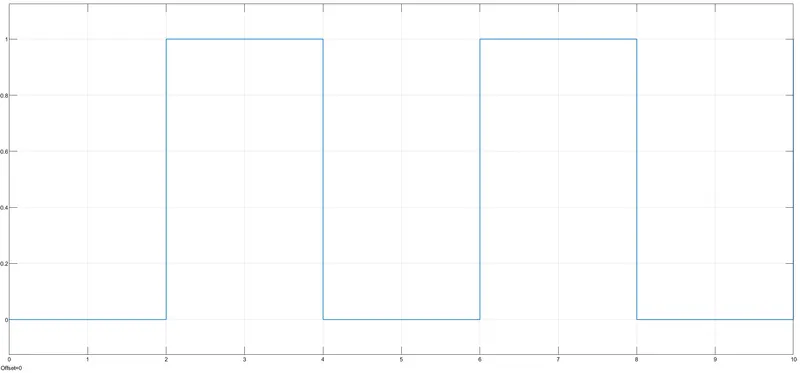
Time period given is 2 seconds to the pulse generator to open and close the switch. When the switch is closed the selenoid block recieves electrical power from the battery and plunger moves from port R to C to hit the bell and produces sound.
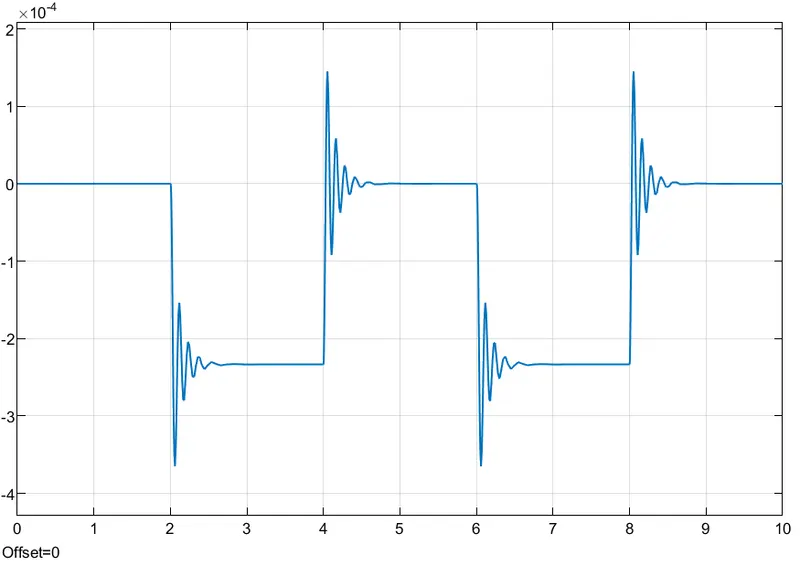
Plot of PS_Simulink convertor :
2. Use a thermistor to sensor the temperature of a heater and turn on or off the fan as per the given below conditions :
THERMISTOR MODEL :
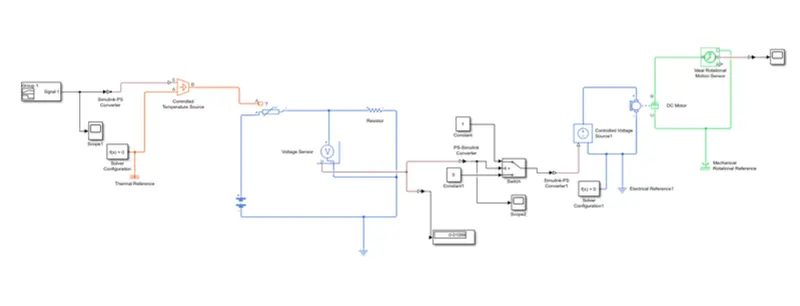
Temperature source : 20 degrees celsius from 0 to 10 seconds, 27 degrees celsius from 10 to 30 seconds, 23 degrees celsius from 30 to 50 seconds.
Fan condition : ON if the temperature above 25 degrees celsius, OFF otherwise.
Thermistor : A thermistor is a semi conductor that has a resistance capacity more than a conducting material and less than a insulating material.
It's electrical resistance varies with the change in the temperature or thermally sensitive resistor. They are namely two types of thermistors they are
- Negative temperature coefficient (NTC).
- Positive temperature coefficient (PTC).
Thermistors relation with temperature also depends on the material in which it is made. A NTC thermistor will decrease it's resistence value when temperature increases. Where as a PTC will increase it's resistance when it's temperature increases.
Thermistors have high sensitivity which can be upto 10 percent change per degree celsius and their typical responce time is 0.5 to 5sec with an operating range from -50 to -300 degree celsius.
BLOCKS USED :
1. Signal builder : To generate the signal according to the input conditions given.
2. PS-Simulink converter : This block converts the simulink signals to the respective physical signals.
3. Controlled temperature source (CTC) : Provides a temperature physical output based on conditions given to port s.
4. Thermal reference : This block provides the required initial conditions to the connected thermal block of the solver.
5. Thermistor : Uses NTC thermistor relation between temperature and resistance.
6. Battery : It is a storage device that provides the required voltage based on the parameter given.
7. Resistor : Resistor which provides the opposing nature of current in a circuit.
8. Voltage sensor : It is used to measure the voltage or potential difference across any electrical component and it should connect in parallel only.
9. Electrical reference : These blocks provide the required initial conditions to the connected thermal block solver.
10. Solver configuration : This block specifies the solver parameters that your model needs bofore you can begin simulation and this is mandatory for all simscape models.
11. PS-Simulink converter : Converts physical signal to the respective simulink signals.
12. Constant : It provides a constant output value.
13. Switch : It has three inputs namely port 1, port 2, port 3 is a control input where the signal given to port 2 is satisfied with the condition and threshhold of the switch block then it passes port 1 as output and it is not satisfied then it will pass to port 3 as output.
14. Scope : This block provides the output plot.
15. DC motor : This block represents the electrical and torque characteristics of a DC motor.
16. Mechanical rotational reference : It gives as a reference to the ideal rotational motor sensor.
PLOT IN SIGNAL BUILDER ASA INPUT SIGNAL :
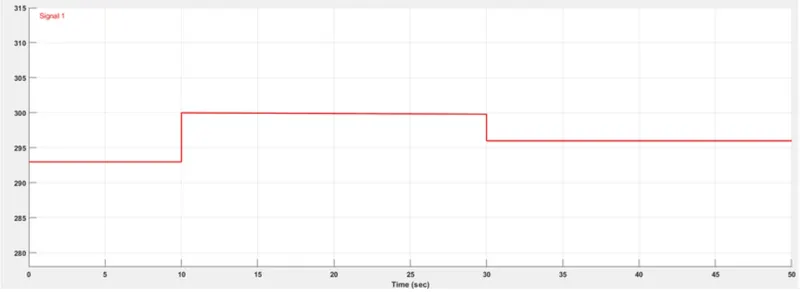
The above plot is signal builder in which the signals are generated according to the given temperature and time. Then generated signals ae given as input to the controlled temperature source.
In the plot time is taken 50 seconds and temperature in 300 kelvin.
from 1 to 10 seconds - 293 k.
from 10 to 30 seconds - 300 k.
from 30 to 50 seconds - 298 k.
INPUT SIGNAL IN SCOPE :
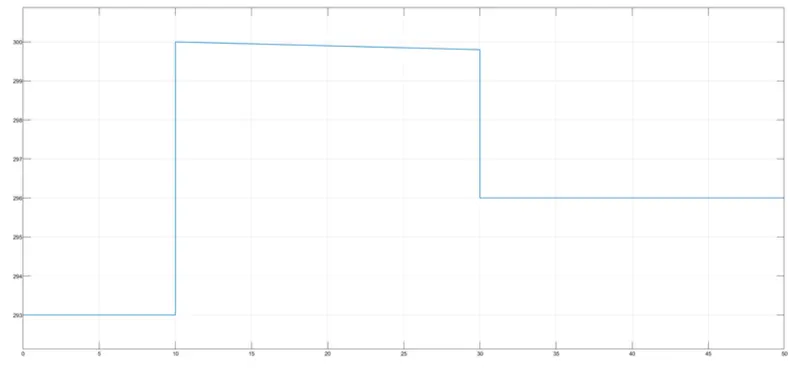
This is the signal plot which shows in the scope which is connected to the signal builder.
OUTPUT SIGNAL OF VOLTAGE VS TIME :
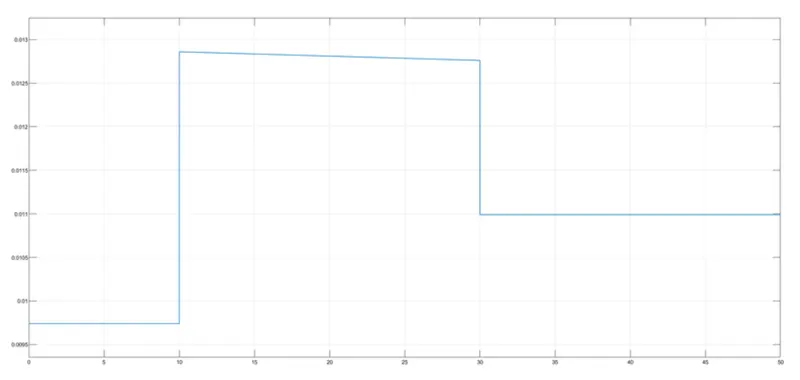
The above plot shows the voltage generated in the voltage sensor.
This plot is shown in the scope which is conncted by PS-Simulink convertor. And the value of the voltage is displayed in the display block, which is connected by PS-Simulink convertor.
Obtained value is 0.01099.
OUTPUT OF THE IDEAL ROTATIONAL MOTION SENSOR :
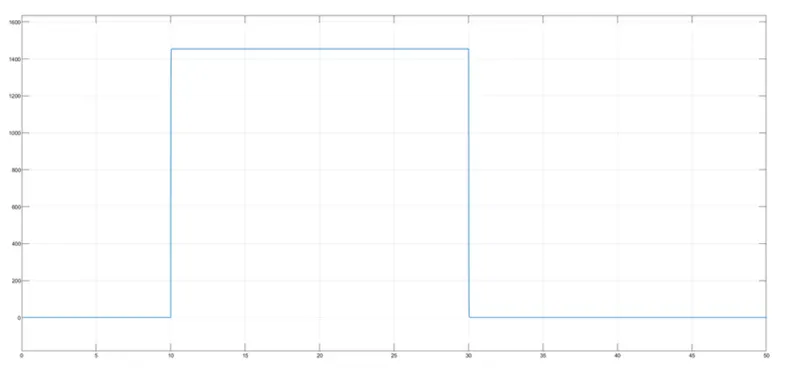
The output of the ideal rotational sensor is plotted in the scope.
There is a change in the plot from 10 to 30 seconds which shows the angular velocity. The above plot shows the fan conditions ON when the temperature is above 25 degrees, by the motor getting power and rotating.