Week -2
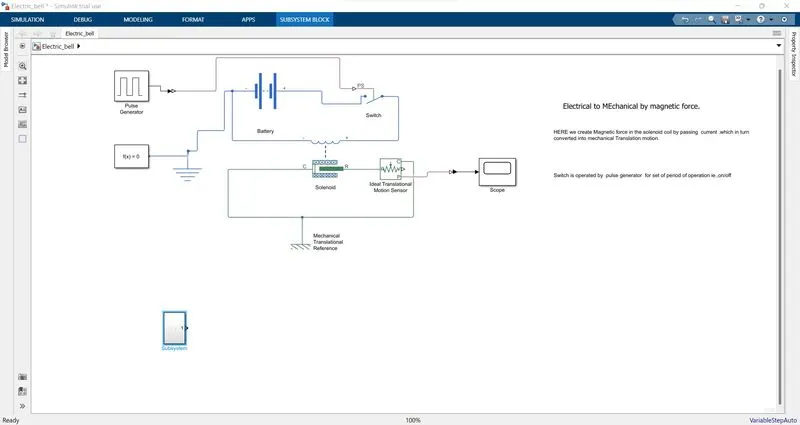
Aim: To draw an circuit diadram for Electric bell.
Components required : Battery,switch,solenoid element,Ideal translational motion sensor.
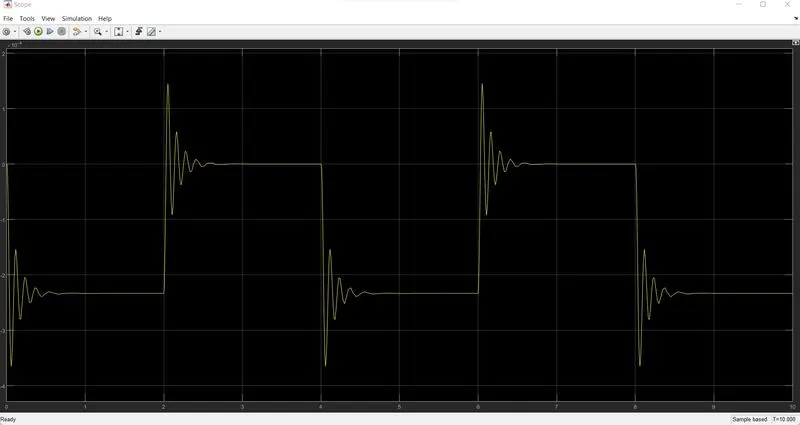
working process: Due to battery source that we are provided,the current I flow through the circuit diagram ,& it is controlled by the switch & by pulse generator which is a acceleration.The solenoid in the circuit consider as coil ,the current flow through the coil behaves as magnetic force of attraction ..becomes the elctro magnet .The magnetic force developed, the coil turns to mechanical work produced by ringing bell,the mechanical work that produced is a Translation motion . ie.
Any conductor such as straight through which the electric current flows is an Electo magnet because of magnetic field around it
Strength of magnetic field depend on the current in the wire.
cond1_increase in current _increase in strength of magnetic field occurs
cond2_Increase in more no of turns of wire _increase in the magnetic field occurs.
The mechanical work: force*displacement
ie.,force=Magnetic force that induced by electric current
ie.,displacement=ringing the bell.
Battery: is a source of generating electric power measured by flow rate per time by whiich electrical energy is transferred to electric circuit, consisting of one or more electrochemical cells capable of generating electric power from chemical reactions.The cells are called as voltaic /galvanic cells which involves chemical reactions When a battery is supplying power, its positive terminal act as the cathode and its negative terminal act as the anode.
All electrochemical cells consist of two electrodes separated by some distance. The space between the electrodes is filled with an electrolyte an ionic liquid that conducts electricity.
Cathode (-)& Anode(+):are Electrodes ,an electrode is a substance that helps in the conduction of electricity wherein the electric current either enters or leaves the non-metallic medium like an electrolytic cell.&describes the direction of flow of current
They are both defined by the flow of current. Therefore, a cathode is an electrode from which the current exits a polarized electrical device. Likewise, an anode is an electrode from which a current enters into a polarized electrical device.
The anode is the electrode where electricity moves into.
The cathode is the electrode where electricity is given out or flows out of.
A battery for the purposes of this explanation will be a device that can store energy in a chemical form and convert that stored chemical energy into electrical energy when needed.
switch: is the key ,when we press the switch the switch is closed,the current passes through the circuit & due to flow of electric the magnetic developed
Battery:Foundation Library_Electrical _Electrical sources
switch:Foundation Library_Electrical_Electrical Elements
solenoid: Foundation Library_Electrical_elecro mechanical_Mechatronic actuators
Ideal Translational sensor:Foundation Library_Mechanical_mechanical sensors
AIM: To calculate or to represent b/w the RESISTANCE of Thermistor & Temperature
About Thermistor:A Thermistor is a resistor,which depends on the temperature.They are simply Thermally Sensitive Resistor is a that works on the principle of varying resistance with temperature. They are made of semiconducting materials & has resistance capacity more than a conducting material & less than insulating material.
Thermistor _____ 2 types
1.NTC(negative temp coefficient thermistor),where its relation is decrease in resistance value when temp increases.
2.PTC(positive temp coefficient thermistor),where its relation is increase in resistance when temp increases.
Thermistor relation with temp also depends on the material which is made & have high sensitivity which can be up 10percent change per degree celcius.
symbol: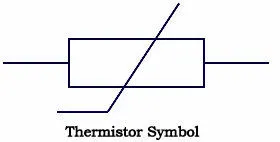
NTC Applications: PTC Applications:
Temp measurements Circuit_protection
Temp control Current_limiting resistors.
Explanation of process: The Thermistor consists of Electrical ports which are positive(+) & Negative(-) terminals will be connected to the dc voltage source ,The port A is connected to the Controlled temp source block. here the rate of flow of heat takes placeie., The amt of heat flow is temp difference/variance(t1,t2,....tn) is given to the Thermistor & due to heat its resists the heat flow electric current & voltage across the thermistor ,so these two are output of an thermistor.
And the Resistance can be found by relation of voltage & current by R=V/I
from V is directly proportional to the current I & its constant is Resistance.
NTC Thermistor calculated by R0=R0(1+alpha(t-t0)
Amt of heat flow=kd*tc*dT/dt-i^2*R
This block represents an NTC thermistor using the B-parameter equation. The resistance at temperature T is given by R(T) = R0*exp(B*(1/T-1/T0)) where R0 is the Nominal resistance at the reference temperature T0, and B is the Characteristic temperature constant. The temperature T of the thermistor is governed by the equation m*c*dT/dt = Q where Q is the net heat flow into port A, m is the mass and c is the lumped specific heat capacity. The thermal mass m*c is calculated from the Thermal time constant t_c and the Dissipation factor K_d using the equation m*c = K_d*t_c.
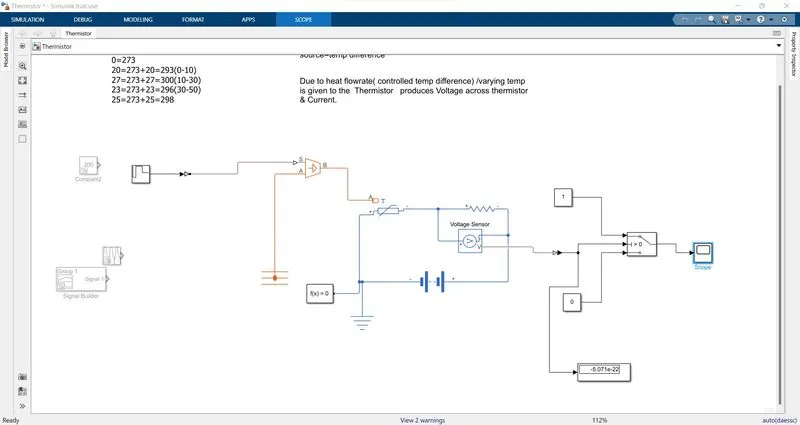
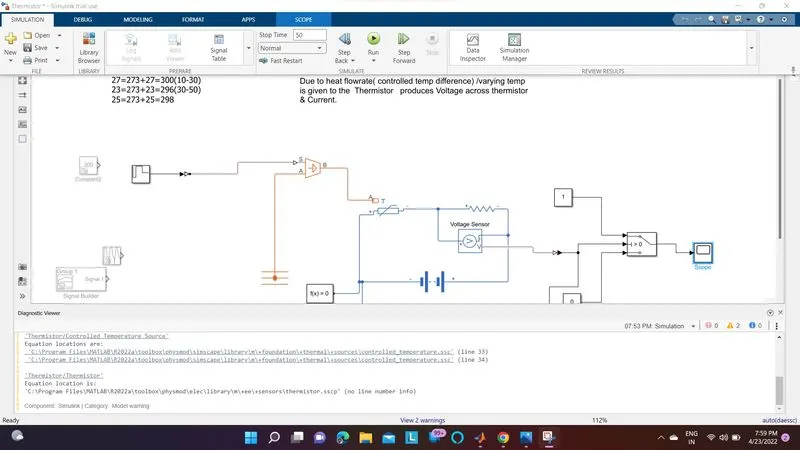
The above diagnostic error ....
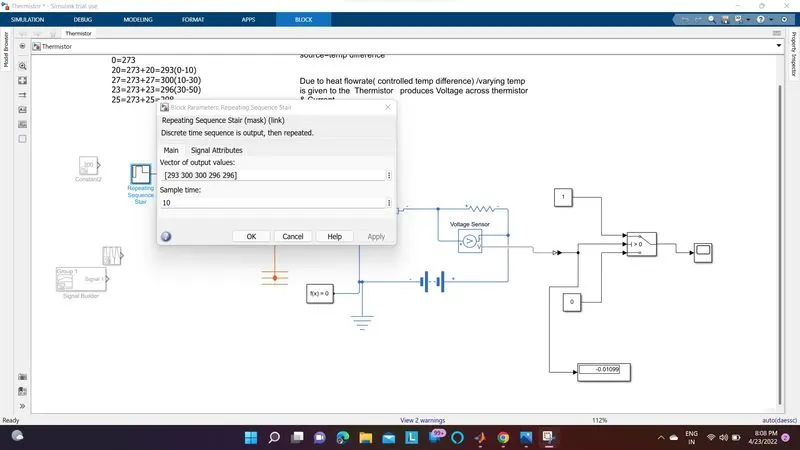
This how inputs are provided..