Week -2
- Make a Simulink model of Doorbell using solenoid block with the following details:
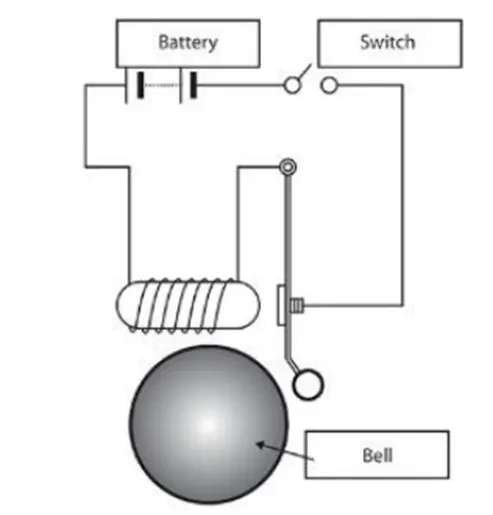
Figure 1 Doorbell
In the above arrangement, when the switch is closed the electromagnet receives electrical power from the battery and pulls the metal arm to hit the bell producing sound.
Create a situation where the switch is closed for 2 seconds and then released. Observe the physical movement of the plunger.
Solution:
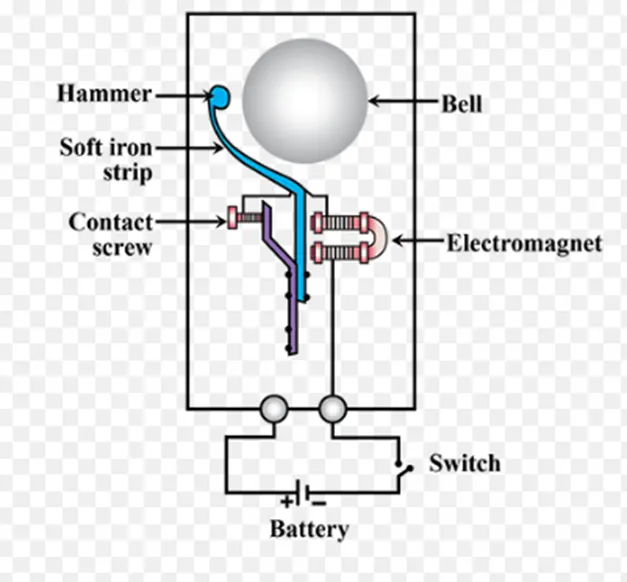
Figure 1.2 Construction of Doorbell
SOLENOID:-
- A Solenoid is device comprised of a coil of Wire
- The housing and moveable plunger armature
- When this wire is wrapped around a matelic block in a coil and current passed through it has some special magnetic properties electromagnetic induction make it an electromagnet that can be switch on and off
- the side in which the current appear to be passing clockwise is the south pole and the side in which the current seem to be passing aniticlock wise the north pole
- the solenoid work just like a bar magnet and therefore has many uses
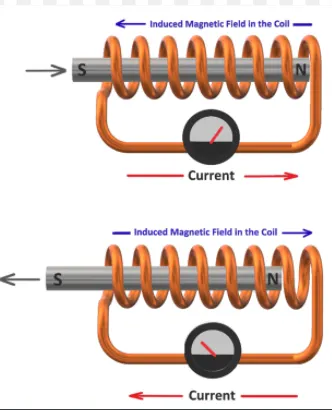
Figure 2 Construction of Solenoid
BLOCK USED
To make this project different types of bloks used Given in below
- Pulse Ganerater
- Switch
- Battery
- Simulink-PS Converter
- PS-Simulink Converter
- Electrical Reference
- Solenoid
- Mechanical Translational Reference
- Solver Configuration
- Scope (2)
- Ideal Translational Motion Sensor
Simulink model of Doorbell useful Solenoid
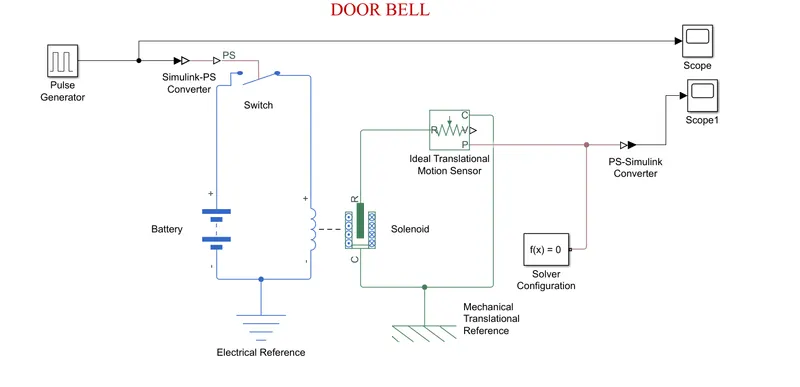
Figure 3 Simulink model of Doorbell useful solenoid
INPUT PULSE RATE:-
CYCLE TIME 4 SEC
Phase delay (secs): 2 SEC
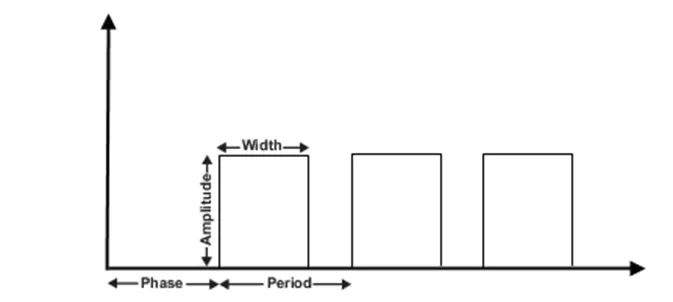
- Pulse generator: The Pulse Generator block generates square wave pulses at regular intervals. The block waveform parameters, Amplitude, Pulse Width, Period, and Phase delay, determine the shape of the output waveform.
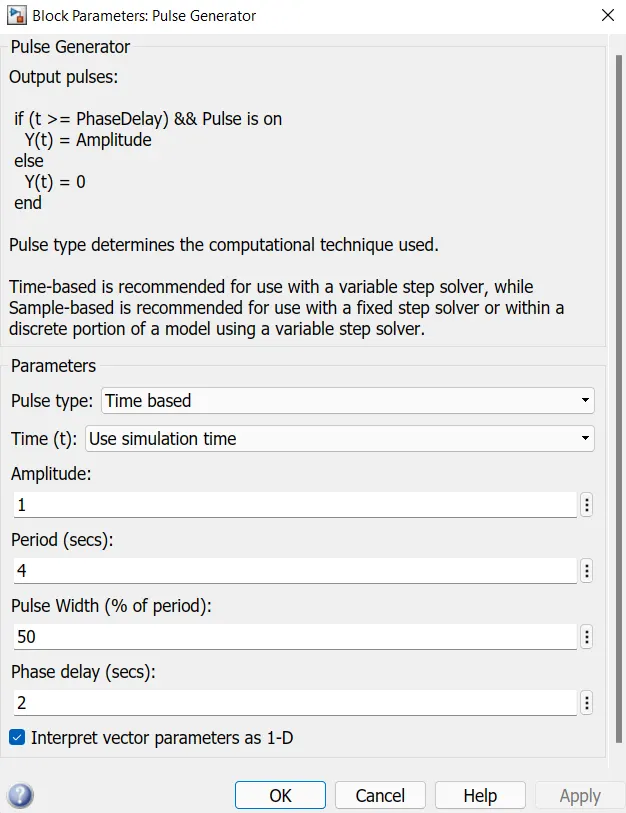
Figure 4.1 INPUT PULSE RATE
- Switch: Switch controlled by an external physical signal.
- Battery: It gives the power to the close loop
- Simulink-PS Converter: It Converts the Simulink input signal into a physical signal.
- PS-Simulinik Converter: It Converts physical signal into Simulink output signal.
- Electrical reference: It shows a Connection to electrical ground.
- Solenoid: Electrical characteristics and generated force of solenoid.
- Mechanical Translational References: Reference connection for mechanical translational ports
- Solver Configeration:- Each physical network represented by a connected Simscape™ block diagram requires solver settings information for simulation.
- Scope: it displays signals generated during simulation.
- Ideal translational Motion Sensor: It is a motion sensor in mechanical translational systems.
Input Waveform:-
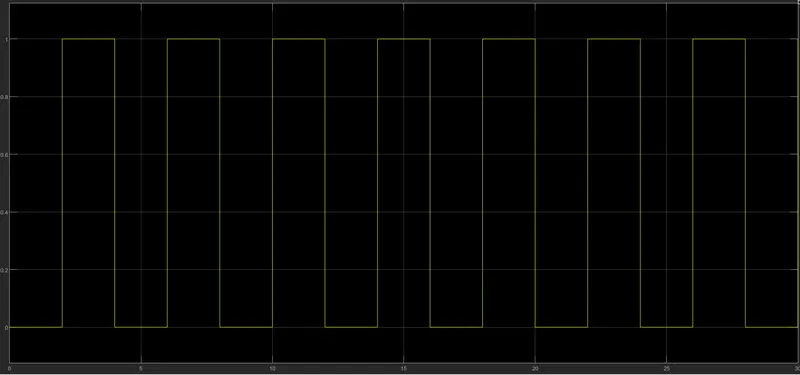
Figure 4.2 INPUT PULSE WAVE
Output Waveform:-
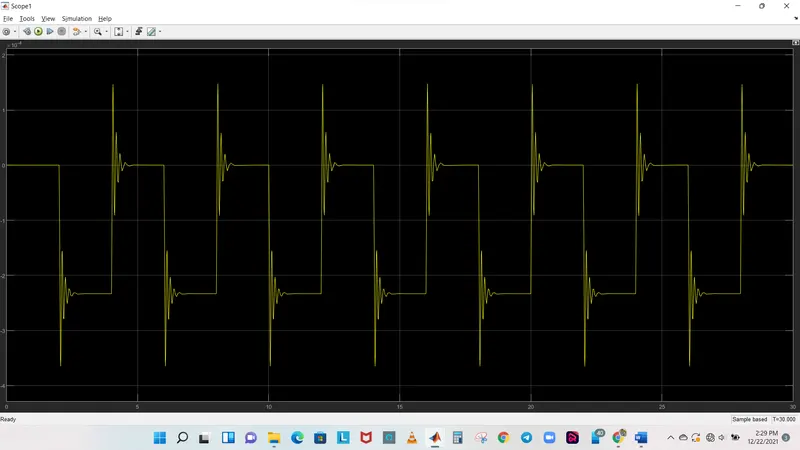
Figure 5 Output Waveform
RESULT:-
In the above results, the switch is closed the electromagnet receives electrical power from the battery and pulls the metal arm to hit the bell producing sound.
The motion of the plunger was simulated and recorded and plotted by using an ideal motion sensor and scope.
2. Use a thermistor to sense the temperature of a heater & turn on or turn off the fan as per the below conditions:
Thermistor:-
It is a type of resistor in which the flow of electric current changes rapidly with a small change in temperature.
Thermistors derived from the term thermally sensitive resistors are a very accurate and cost-effective sensor for measuring temperature available in 2 types. NTC (Negative temperature coefficient) and PTC (Positive temperature coefficient). It is the NTC thermistor that is commonly used to measure temperature.
A thermistor is a resistance thermometer or a resistor whose resistance is dependent on temperature. The term is a combination of "thermal" and "resistor. It is made of metallic oxides, pressed into a bead, disk, or cylindrical shape and then encapsulated with an impermeable material such as epoxy or glass.
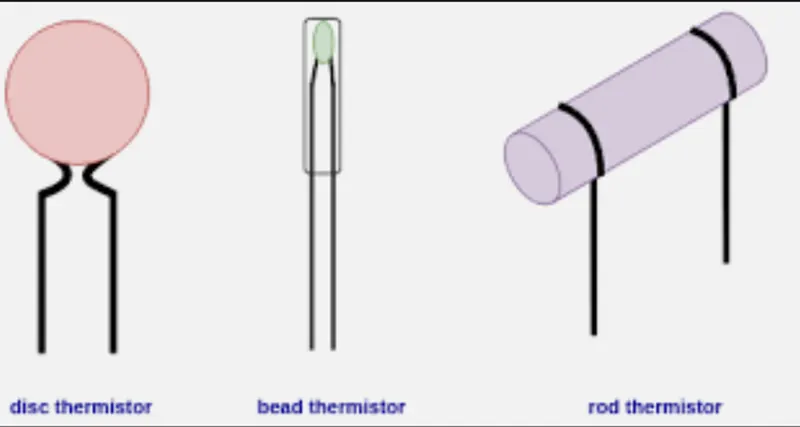
Figure(2.1):- Different form of construction of thermistor.
SIMULINK MODEL OF THERMISTOR:-
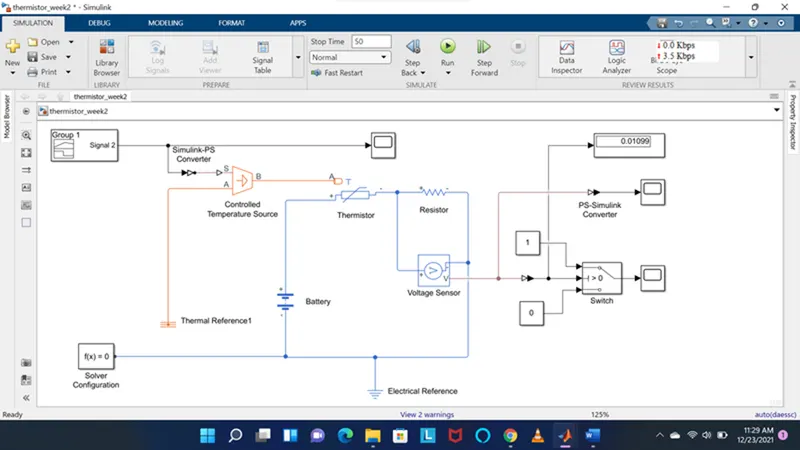
Figure(2.2):- Simulink Model for Fan Controlled By Thermistor.
SIMULINK MODEL EXPLANATION:-
- Signal Builder:- It is used to input the values as per the given condition.
|
Sr. no. |
At position |
Time(second) |
Temperature(kelvin) |
|
1 |
At point 1 |
0 |
293 |
|
2 |
At point 2 |
10 |
293 |
|
3 |
At point 3 |
10 |
300 |
|
4 |
At point 4 |
30 |
300 |
|
5 |
At point 5 |
30 |
296 |
|
6 |
At point 6 |
50 |
296 |
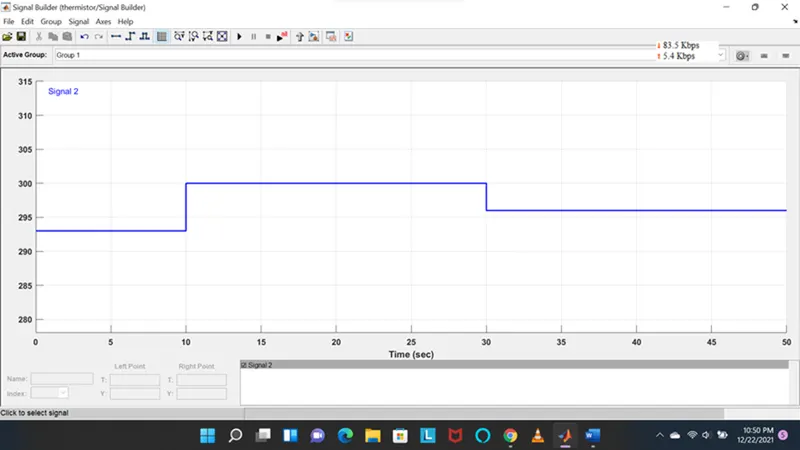
Figure(2.3):- Signal Builder Block.
- Controlled Temperature Source:-
This block represents an ideal source of thermal energy that is powerful enough to maintain specified temperatures difference across the sources regardless of the heat flow consumed by the system. Connection A and B are thermal conserving ports corresponding to the source inlet and outlet respectively. Port S is a physical signal port, through which the control signal that drives the source is applied.
- Resistor:- The resistor block models a linear resistor described with the following equation.
V=IR
Where, V=Voltage
I=current
R=resistance
- Voltage Sensor:-
It is used to convert the voltage measured between two points of an electrical circuit into a physical signal proportional to the voltage.
- Voltage Source:- The block implements a voltage source with DC, AC, and noise components.
- Electrical Reference:-
The block represents an electrical ground. Electrical conserving ports of all the directly connected blocks to the ground must be connected to an Electrical Reference Block. A model with electrical elements must contain at least one Electrical Reference block.
Input Waveform:-
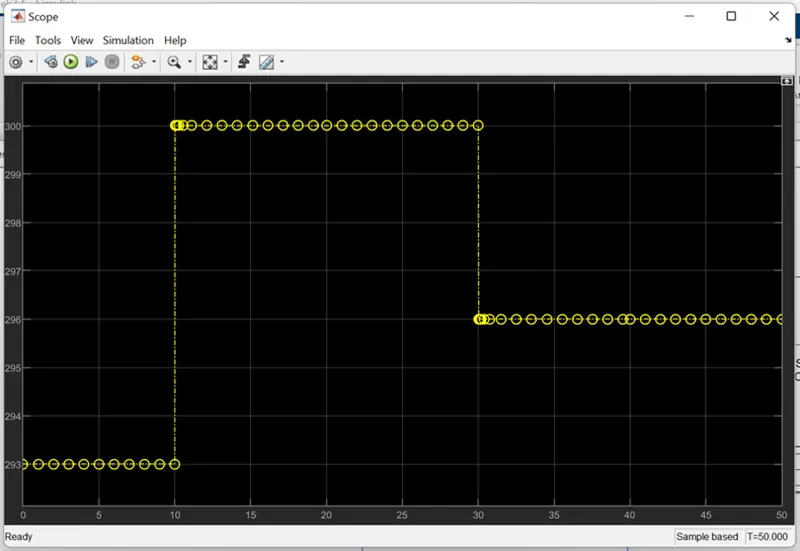
Figure(2.4):- Input Waveform.
Output Waveform:-
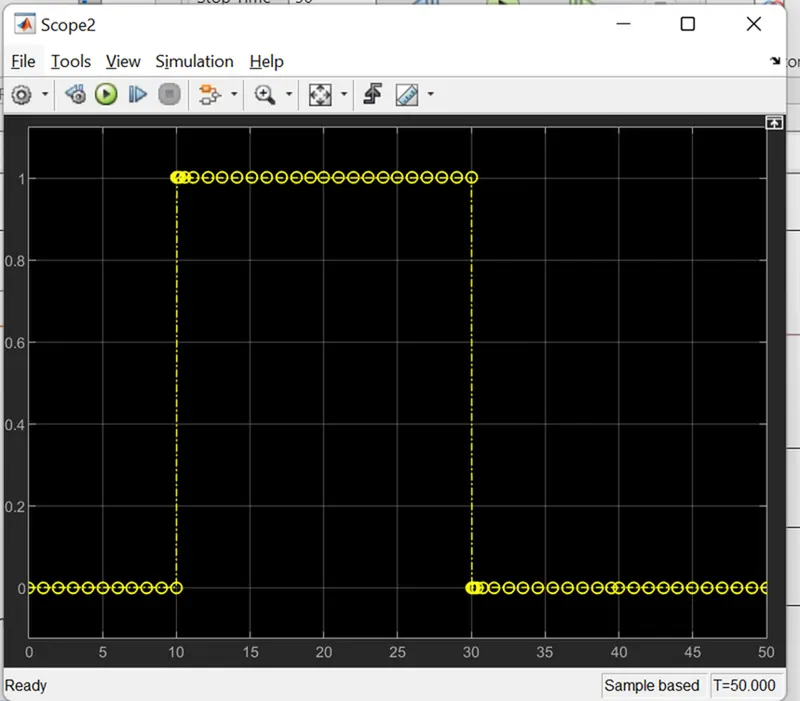
Figure(2.5):- Output Waveform.
Result:-
- A thermistor is used to sense the temperature of a heater and turn on or turn off the fan as per the above conditions.
- Therefore the fan conditions are executed by switch block and plotted in scope block.