Week -2
Challenge 2
SIMULINK MODEL OF DOOR BELL USING SOLENOID BLOCK
Aim:
Make a Simulink model of Doorbell using solenoid block.
Objective:
In the above arrangement, when the switch is closed the electromagnet receives electrical power from the battery and pulls the metal arm to hit the bell producing sound.
Create a situation where the switch is closed for 2 seconds and then released. Observe the physical movement of the plunger.
Working:
Electric door bell work on the principle of electromagnetism. When the electric circuit completes (as shown in fig 3, where pressing Push switch), the current flows through the circuit from positive terminal to negative terminal of battery. The coil becomes energized when the current flows through it and a strong magnetic field is generated. The generated magnetic field attracts the soft iron towards it and in the process, striker hits the bell. When the striker hits the bell, the contact is broken and current stops flowing in the circuit. This causes electromagnet to lose its magnetic field. The striker arm returns through original position. The contact is restored and current flows through the circuit again (provided switch is in ON condition always). The process is repeated again.
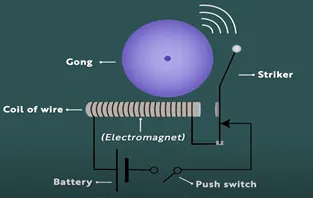
Fig 1 – Electric circuit of door bell
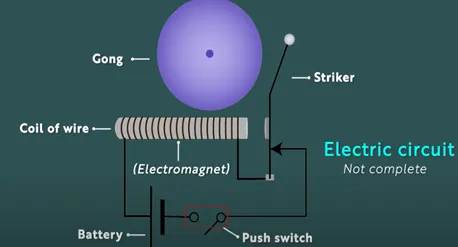
Fig 2 – Electric circuit – (not complete)
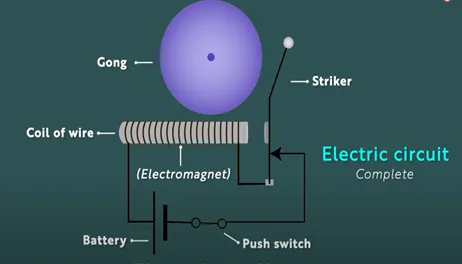
Fig 3 – Electric circuit – (complete)
Simulink model
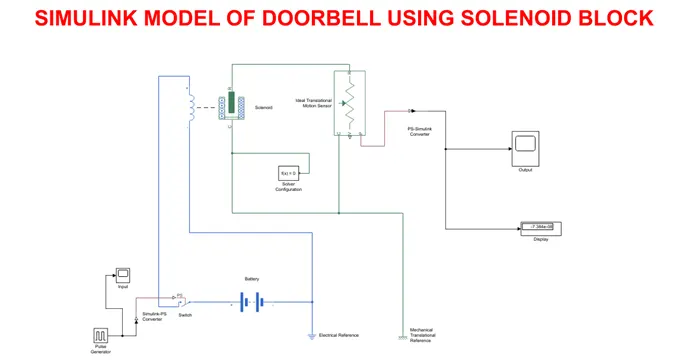
- Pulse generator is used as an input to the electric circuit with the delay of 2 seconds.

- Simulink – PS converter is used to connect the Simulink block to simscape physical system. Here, pulse generator is connected to switch using Simulink-PS converter.
- One end of switch is connected to battery and other end is connected to solenoid.
- The solenoid block represents electrical characteristics and generates the force for solenoid. It converts electrical characteristics to mechanical.
- The Solenoid block has (R- Plunger mechanical, C- case mechanical port). The Plunger in solenoid (R) is connected to ideal translational motion sensor.
- Ideal translational motion sensor is a device that converts an across variable measured between two mechanical translational nodes into a control signal proportional to velocity and position.
- The case mechanical is connected to ideal translational motion by the reference of mechanical translational. The solver is connected in this circuit in order to run without error.
- An output from ideal translation motion sensor connected to scope using PS-simulink converter.
Output:
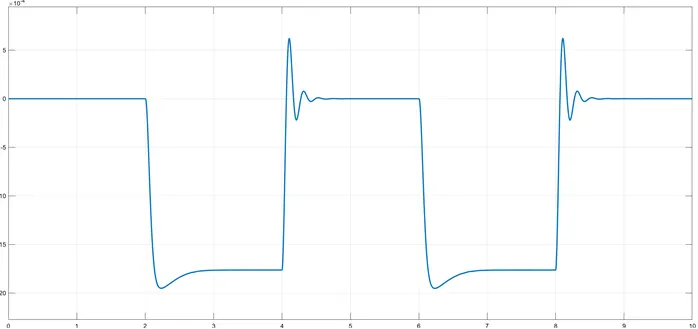
Result:
In the above results, when the switch is closed the electromagnet receives electrical power from the battery and pulls the metal arm to hit the bell producing sound.
The motion of plunger is simulated and for every 2 seconds door bell rang (pulse is generated) for observation.
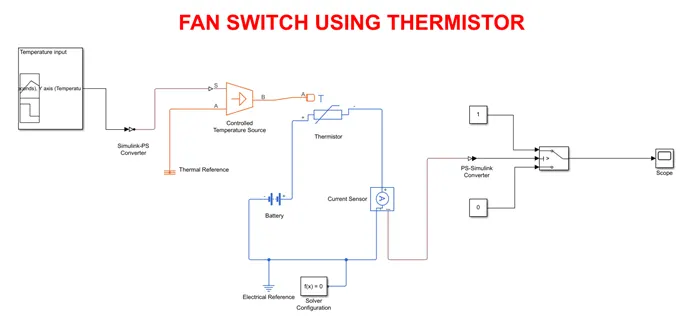
FAN SWITCH USING THERMISTOR
Aim:
Make a Simulink model of fan switch using thermistor.
Objective:
Use a thermistor to sense the temperature of a heater and turn ON or OFF the fan as per below conditions:
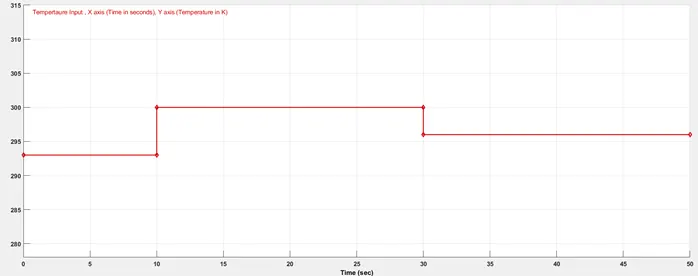
- Temperature source: 20 °C from 0 to 10 seconds, 27 °C from 10 to 30 seconds, 23 °C from 30 to 50 seconds.
- Fan conditions: ON if the temperature above 25 °C, OFF otherwise
Working:
A thermistor is defined as a type of resistor whose electrical resistance varies with change in temperature. There are two types of thermistors – Negative temperature coefficient (NTC) thermistor, Positive temperature coefficient (PTC) thermistor.
In the below figure, the Simulink bocks are creating to find the threshold value to fix the fan switch condition.
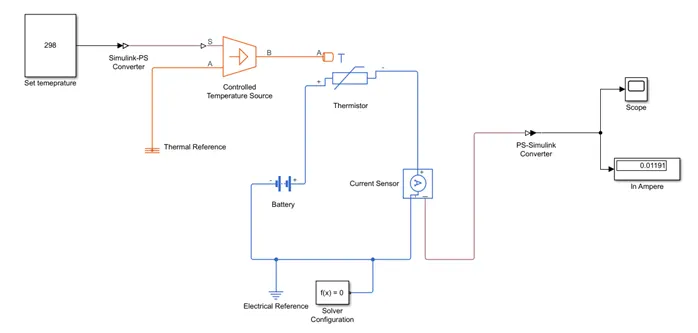
When we run the circuit, the displayed value of 0.01191A as an output for an input temperature of 298K. In order to operate the switch, we assign threshold value as 0.01191A. If the current coming to the swich is greater than threshold limit, swich ON and output is framed as ‘1’. Similarly, for Switch OFF condition, output is framed as ‘0’.
Input:
The heater temperature input is given as signal builder to the system.
Output:

Result:
For the first 10 seconds, fan is OFF as the temperature is less than threshold value 25°C (300K).
During the period of 10 to 30 seconds, fan is ON as the temperature is greater than 25°C (300K).