Week 12:Project-1-Meshing of Door Inner Panel Challenge
Aim -
To perform preprocessing on the given car side door [Inner Panel] plastic component using hypermesh preprocessing software.
Follow the Quality Criteria and mesh the following component and assign thickness:
Target Element Length = 4 Units
| S.N | Quality Criteria | Value |
| 1 | Aspect Ratio | 5 |
| 2 | Skewness | 45 |
| 3 | Warping | 15 |
| 4 | Taper | 0.5 |
| 5 | Min. Length | 2 Units |
| 6 | Max. Length | 6 Units |
| 7 | Min angle Quad | 45 |
| 8 | Max angle Quad | 135 |
| 9 | Min angle Tria | 20 |
| 10 | Max angle Tria | 120 |
| 10 | Tria % | 10 |
Objective:
- To generate the mid surface manually and do a geometry clean up on the component.
- To generate a mesh and to get a proper mesh flow on the given component with low tria concentration criteria.
- To check the the elements quality according to the given quality that
- To create a different collectors and organize the elements to collectors to assign a thickness.
Theoretical Framework -
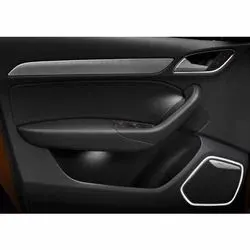
- Door panels serve as an interface between the interior of the car and the inner workings of the door, and between vehicle occupants and the door.
- They are expected to meet a variety of design specifications regarding safety, aesthetics, and functionality. In addition, they are expected to continue the material theme of the dashboard and pillars while concealing intricate electrical and mechanical components for operating locks, windows, and other tures.
- The door panel has evolved from a simple two-part system of latch and simple winding mechanism to a more sophisticated enclosure.
- Doors currently have an inner full-width panel consisting of electronic windows, central locking system, and speakers. These panels typically consist of a foamed core covered with either textiles or plastics.
- Door panels were formerly made of cardboard with an upholstered interior finish of vinyl, leather, cloth, carpet, or other materials for the decorative trim. Modern cars typically have door cards made of plastic, most often using injection moulding, as well as incorporating other decorative materials.
- The design should incorporate both the necessary service amount and the functional unit (such as it is strong and it looks and feels good") so that a given car door panel "would service a car body's life span of 200,000 kilometres (124,274 mi). The door panel typically incorporates other parts that contribute to the appearance, functionality, and ergonomics of the vehicle. These include armrests switches or other controls for windows and the locking mechanism, convenience lights, audio speakers, storage compartments, and other features
- In most cases, the door card is attached to the car's door frame by visible screws and ones hidden behind decorative plugs or under the armrest, as well as spring clips
Procedure:
- Hence we are importing a given CAD geometry into hypermesh.
- While importing the file into the graphical user interface,Be sure whether the file is .step or .iges file. File> Import > Import Model > File type > Open File > Import File.
- Switch to the topo mode and examine whether the solid exsist in the component or not,If solids exsist,Delete the solids cause we are doing 2d meshing on the component.
- If solids exsist,It will be highlighted in the green colour.
- Before working on the model.We have to check the geometry if thereare any errors like
a. Damaged Geometry.
b. Free edges in unnecessary areas.
c. Unnecessary points on the lines.
d. Unnecessary Connections and connectivity error.
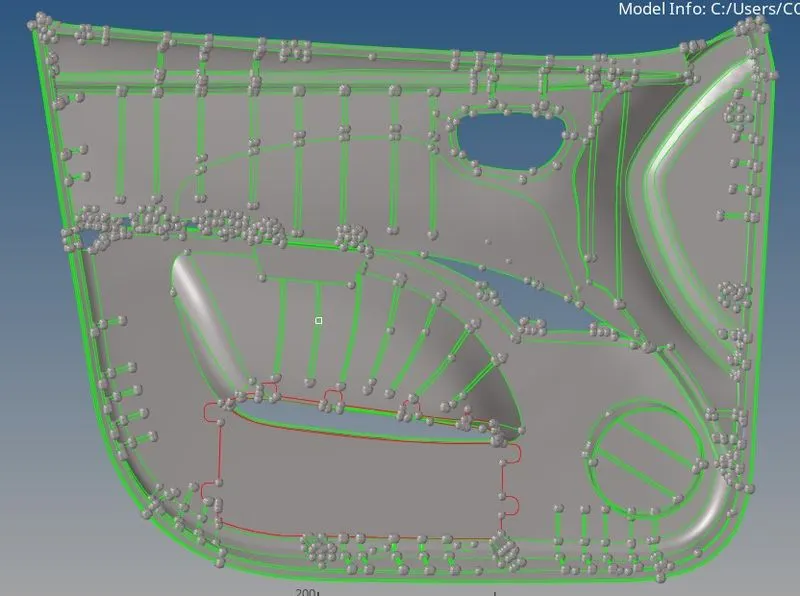
- By assessing the Car Side Door [Inner Panel] Model, The other components dosen't exsist in the model.
- There are some free edges in the inner surfaces,Clear that free edges. There are some features present in the side door inner panel model like
i. Door Handle
ii. Speaker Housing
iii. Space for Placing our things like water bottle, etc.
- Now go and measure the distance in every region. Cause this an plastic component, The plastic component will be having varying thickness. We are ensuring whether some regions of this component having uniform thickness or not.
- If we want we can do geometry clean up on the parent component or after extracting the midsurface we can do geometry clean up on mid surface.
Defeaturing Ribs Fillet Regions:
- For this component we will be doing 2D Mesh so it cannot capture the fillet feature properly,So we are defeaturing it.
- We are going to generate a mid surface between two flat surfaces,So no need of curved (fillet) regions,we can eliminate it. Since it will effect while extracting the mid surface. So defeature the fillets to get sharp edges,If we get the sharp edges,we can extract mid surface very easily.
Defeaturing the Ribs Fillets Manually:
- We have to delete the corner edges and replace with straight edges.
- Once we delete the edges a gap will be present and we will fill the gap by extending the ribs.
midsurface:
- Manual mid surface is preffered always because of varying thickness for the plastic component. so Perform an action by going to surface edit>Offset> give half distance of the thickness and duplicate the top surface by checking the vector normal and click offset for exact midsurface.
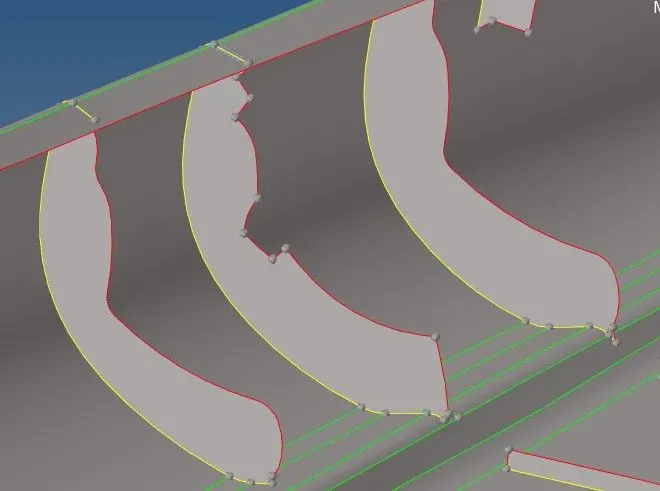
- In the same manner create some new components which are having different thickness and offset the ribs and other surface in the corresponding component.
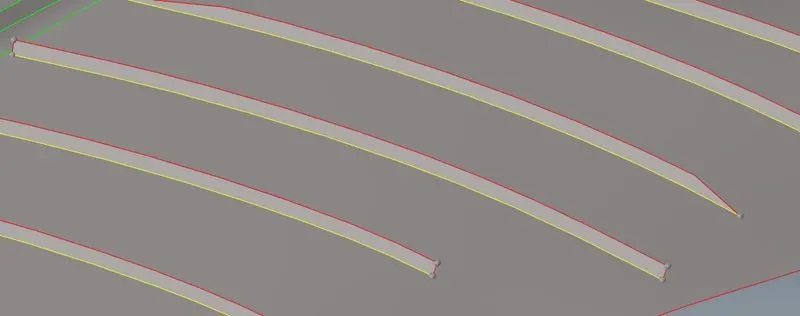
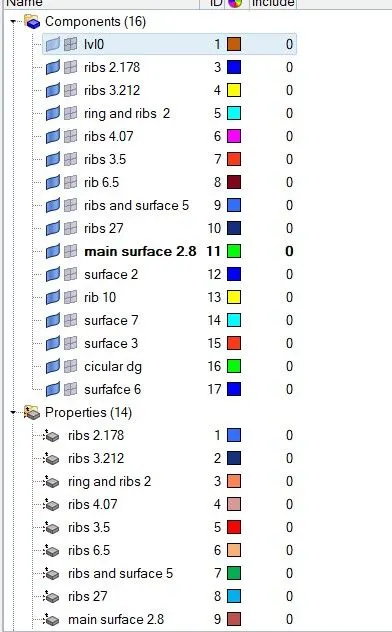
- Also create a property for every component and assign the thickness to it.
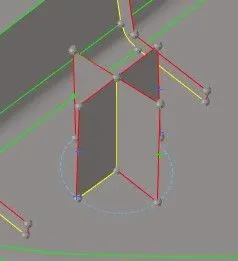
- Dog houses are created in the manner given below.
MESH:
- Meshing is done with criteria and parameter ranges. Here batch mesh is performed with traget element length of 4mm.
- but batch mesh wont give perfect mesh at all areas, so some areas needs repair so that perform mesh for those areas by deleting the elements and creating by spline, ruled tools to modify.
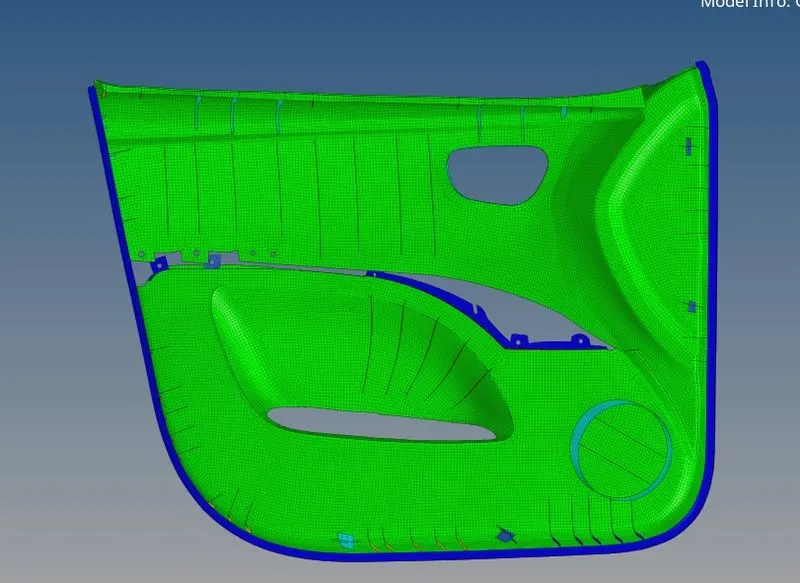
- Using cleanup tools, replace options all the failed elements are corrected and perfect mesh is generated on the surface.
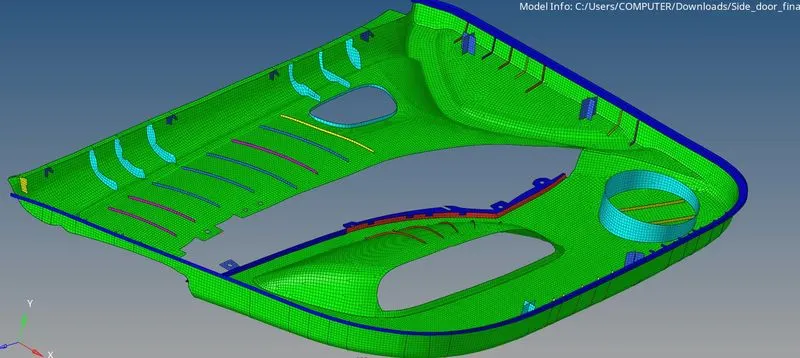
- after that Turn on the 2D detailed mesh to see the meshed surface with thickness and compare with the original one.
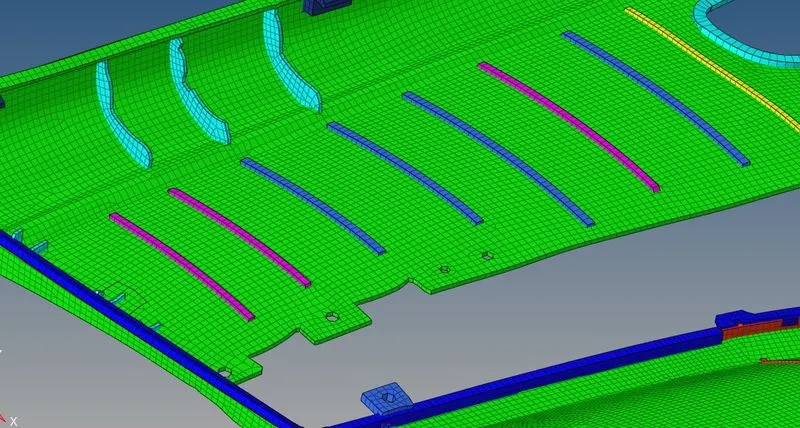
Result: The given side door panel was meshed as per the given quality criteria. due to it being a platic component, different regions have different thicknesses so that the component was split in the multiple sub-component as a result before meshing and they were assigned their respective thicknesses.