Week 11 - Simulation of Flow through a pipe in OpenFoam
Simulation of flow through the pipe in open Foam:
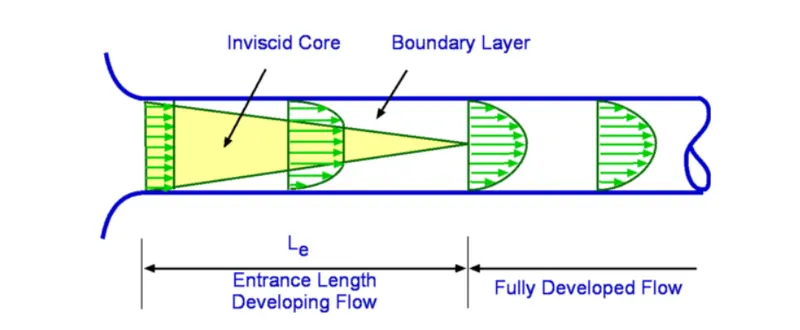
Hydrodynamic entrance length:
Formulas:
Average velocity`V_(avg)=(R_e*mu)/(rho*D)`
Maximum velocity`V_(max)=2*V_(avg)`
Pressure difference`deltaP=8*mu*L*V_(avg)*L/(R^2)`
Kinematic pressure difference`deltaP_k=(DeltaP)/rho`
Shear stress`tau=(2.mu*V_(max)*R)/r^2`
Program in Matlab that can generate the computational mesh automatically for any wedge angle and grading schemes:
clear all
close all
clc

%input data

D=0.004; %diameter of the pipe
R=D/2 ;  %radius of the pipe
Re=2100  ;%reynolds number
Le=0.05*Re*D;   %entry length
theta=4;      %wedge angle
mu=8.96e-04;    %kinematic viscosity of water
rho=997;    %density of water
nu=(mu/rho);
L=Le+0.7;      %total length of the pipe

%calculating solution according to Hagen poiseuille's equation
 V=(Re*mu)/(rho*D); %average velcoity
 U_max=2*V; %max velocity
 del_Pdel_x=(8*mu*V)/(R^2); % pressure gradient
 delta_P=(8*mu*V*L)/(R^2); % pressure drop
 Kin_P= delta_P/rho ; % kinematic pressure

 %vertices;
v0=[0 0 0];    %point o
v1=[0 R*cosd(theta/2) -R*sind(theta/2)];%point 1
v2=[0 R*cosd(theta/2) R*sind(theta/2)];%point 2
v3=[L 0 0];%point 3
v4=[L R*cosd(theta/2) -R*sind(theta/2)];%point4
v5=[L R*cosd(theta/2) R*sind(theta/2)];%point 5

f1= fopen('BlockMeshDict.txt','w');
fprintf(f1, '%s\n', '/*--------------------------------*- C++ -*----------------------------------*');
fprintf(f1, '%s\n', '=========                |                                                     ');
fprintf(f1, '%s\n', '\      /  F ield         | OpenFOAM: The Open Source CFD Toolbox              ');
fprintf(f1, '%s\n', ' \    /   O peration     | Website:  https://openfoam.org                     ');
fprintf(f1, '%s\n', '  \  /    A nd           | Version:  8                                        ');
fprintf(f1, '%s\n', '   \/     M anipulation  |                                                    ');
fprintf(f1, '%s\n', '*---------------------------------------------------------------------------*/');
fprintf(f1, '%s\n', 'FoamFile');
fprintf(f1, '%s\n', '{');
fprintf(f1, '%s\n', '   version     2.0;');
fprintf(f1, '%s\n', '   format      ascii;');
fprintf(f1, '%s\n', '   class       dictionary;');
fprintf(f1, '%s\n', '   object      blockMeshDict;');
fprintf(f1, '%s\n', '}');
fprintf(f1, '%s\n\n', '// * * * * * * * * * * * * * * * * * * * * * * * * * * * * * * * * * * * * * //');
fprintf(f1, '%s\n\n', 'convertToMeters 1;');

%defining the vertices of the geometry
fprintf(f1, '%s\n', 'vertices');
fprintf(f1, '%s\n\n', '(');
fprintf(f1, '(%d %d %d)\n' ,v0(1),v0(2),v0(3));
fprintf(f1, '(%d %d %d)\n' ,v1(1),v1(2),v1(3));
fprintf(f1, '(%d %d %d)\n' ,v2(1),v2(2),v2(3));
fprintf(f1, '(%d %d %d)\n' ,v3(1),v3(2),v3(3));
fprintf(f1, '(%d %d %d)\n' ,v4(1),v4(2),v4(3));
fprintf(f1, '(%d %d %d)\n\n' ,v5(1),v5(2),v5(3));
fprintf(f1, '%s\n\n',');');

%defining the blocks
fprintf(f1, '%s\n', 'blocks');
fprintf(f1, '%s\n\n', '(');
fprintf(f1, '    hex(0 3 5 2 0 3 4 1) (%d %d %d) simpleGrading(1 1 1)\n\n',250,25,1);
fprintf(f1, '%s\n\n',');');

%defining the edges
fprintf(f1, '%s\n', 'edges');
fprintf(f1, '%s\n\n', '(');
fprintf(f1, '%s\n\n',');');

%defining the boundaries
fprintf(f1, '%s\n','boundary');
fprintf(f1, '%s\n\n','(');

fprintf(f1, '%s\n','    Inlet');           %inlet
fprintf(f1, '%s\n','    {');
fprintf(f1, '%s\n','        type patch;');
fprintf(f1, '%s\n','        faces');
fprintf(f1, '%s\n','        (');
fprintf(f1, '%s\n','          (0 1 2 0)');
fprintf(f1, '%s\n','        );');
fprintf(f1, '%s\n','    }');

fprintf(f1, '%s\n','    outlet');           %outlet
fprintf(f1, '%s\n','    {');
fprintf(f1, '%s\n','        type patch;');
fprintf(f1, '%s\n','        faces');
fprintf(f1, '%s\n','        (');
fprintf(f1, '%s\n','          (3 5 4 3)');
fprintf(f1, '%s\n','        );');
fprintf(f1, '%s\n','    }');

fprintf(f1, '%s\n','    top');           %top
fprintf(f1, '%s\n','    {');
fprintf(f1, '%s\n','        type wedge;');
fprintf(f1, '%s\n','        faces');
fprintf(f1, '%s\n','        (');
fprintf(f1, '%s\n','          (1 4 5 2)');
fprintf(f1, '%s\n','        );');
fprintf(f1, '%s\n','    }');

fprintf(f1, '%s\n','    front');           %front
fprintf(f1, '%s\n','    {');
fprintf(f1, '%s\n','        type wedge;');
fprintf(f1, '%s\n','        faces');
fprintf(f1, '%s\n','        (');
fprintf(f1, '%s\n','          (0 3 4 1)');
fprintf(f1, '%s\n','        );');
fprintf(f1, '%s\n','    }');


fprintf(f1, '%s\n','    back');           %back
fprintf(f1, '%s\n','    {');
fprintf(f1, '%s\n','        type wedge;');
fprintf(f1, '%s\n','        faces');
fprintf(f1, '%s\n','        (');
fprintf(f1, '%s\n','          (0 2 5 3)');
fprintf(f1, '%s\n','        );');
fprintf(f1, '%s\n','    }');


fprintf(f1, '%s\n','    axis');           %axis
fprintf(f1, '%s\n','    {');
fprintf(f1, '%s\n','        type empty;');
fprintf(f1, '%s\n','        faces');
fprintf(f1, '%s\n','        (');
fprintf(f1, '%s\n','          (0 3 3 0)');
fprintf(f1, '%s\n','        );');
fprintf(f1, '%s\n\n','    }');

fprintf(f1, '%s\n\n',');');
fprintf(f1, '%s\n','mergePatchParis');
fprintf(f1, '%s\n','(');
fprintf(f1, '%s\n\n',');');
fprintf(f1, '%s\n\n','// ************************************************************************* //');
Program in OpenFOAM:
/*--------------------------------*- C++ -*----------------------------------*\
  =========                 |
  \\      /  F ield         | OpenFOAM: The Open Source CFD Toolbox
   \\    /   O peration     | Website:  https://openfoam.org
    \\  /    A nd           | Version:  8
     \\/     M anipulation  |
\*---------------------------------------------------------------------------*/
FoamFile
{
    version     2.0;
    format      ascii;
    class       dictionary;
    object      blockMeshDict;
}
// * * * * * * * * * * * * * * * * * * * * * * * * * * * * * * * * * * * * * //

convertToMeters 1;

vertices
(

(0 0 0)//point 0
(0 1.99e-3 6.97e-5)//point 1
(0 1.99e-3 -6.97e-5)//point 2
(1.12 0 0)//point 3
(1.12 1.99e-3 6.97e-5)//point 4
(1.12 1.99e-3 -6.97e-5)//point 5

);

blocks
(

    hex (0 3 5 2 0 3 4 1) (250 25 1) simpleGrading (1 0.2 1)

);

edges
(

);

boundary
(

    Inlet
    {
        type patch;
        faces
        (
    	       (0 1 2 0)
        );
    }
    outlet
    {
        type patch;
        faces
        (
    	        (3 5 4 3)
        );
    }
    top
    {
        type wall;
        faces
        (
	    	(1 4 5 2)
        );
    }
    front
    {
        type wedge;
        faces
        (
	    	(0 3 4 1)
        );
    }
    back
    {
        type wedge;
        faces
        (
		(0 2 5 3)

        );
    }
    axis
    {
        type empty;
        faces
        (
	 	(0 3 3 0)
        );
    }

);

mergePatchPairs
(
);

// ************************************************************************* //
Pressure:
/*--------------------------------*- C++ -*----------------------------------*\
  =========                 |
  \\      /  F ield         | OpenFOAM: The Open Source CFD Toolbox
   \\    /   O peration     | Website:  https://openfoam.org
    \\  /    A nd           | Version:  8
     \\/     M anipulation  |
\*---------------------------------------------------------------------------*/
FoamFile
{
    version     2.0;
    format      ascii;
    class       volScalarField;
    object      p;
}
// * * * * * * * * * * * * * * * * * * * * * * * * * * * * * * * * * * * * * //

dimensions      [0 2 -2 0 0 0 0];

internalField   uniform 0;

boundaryField
{
    Inlet
    {
        type           zeroGradient;
    }
    outlet
    {
        type            fixedValue;
        value           uniform 0;
    }
   top
    {
        type           zeroGradient;
    }
    front
    {
        type           wedge;

    }
    back
    {
        type           wedge;

    }

    axis
    {
        type            empty;
    }
}
// ************************************************************************* //
Velocity:
/*--------------------------------*- C++ -*----------------------------------*\
  =========                 |
  \\      /  F ield         | OpenFOAM: The Open Source CFD Toolbox
   \\    /   O peration     | Website:  https://openfoam.org
    \\  /    A nd           | Version:  8
     \\/     M anipulation  |
\*---------------------------------------------------------------------------*/
FoamFile
{
    version     2.0;
    format      ascii;
    class       volVectorField;
    object      U;
}
// * * * * * * * * * * * * * * * * * * * * * * * * * * * * * * * * * * * * * //

dimensions      [0 1 -1 0 0 0 0];

internalField   uniform (0.4718 0 0);

boundaryField
{
    Inlet
    {
        type            fixedValue;
        value           uniform (0.4718 0 0);
    }
    outlet
    {
        type           zeroGradient;
    }
    top
    {
        type           noSlip;
        value          uniform 0;
    }
    front
    {
        type           wedge;

    }
    back
    {
        type           wedge;

    }

    axis
    {
        type            empty;
    }
}

// ************************************************************************* //
ControlDict:
/*--------------------------------*- C++ -*----------------------------------*\
  =========                 |
  \\      /  F ield         | OpenFOAM: The Open Source CFD Toolbox
   \\    /   O peration     | Website:  https://openfoam.org
    \\  /    A nd           | Version:  8
     \\/     M anipulation  |
\*---------------------------------------------------------------------------*/
FoamFile
{
    version     2.0;
    format      ascii;
    class       dictionary;
    location    "system";
    object      controlDict;
}
// * * * * * * * * * * * * * * * * * * * * * * * * * * * * * * * * * * * * * //

application     icoFoam;

startFrom       startTime;

startTime       0;

stopAt          endTime;

endTime         5;

deltaT          0.0007;

writeControl    timeStep;

writeInterval   20;

purgeWrite      0;

writeFormat     ascii;

writePrecision  6;

writeCompression off;

timeFormat      general;

timePrecision   6;

runTimeModifiable true;


// ************************************************************************* //
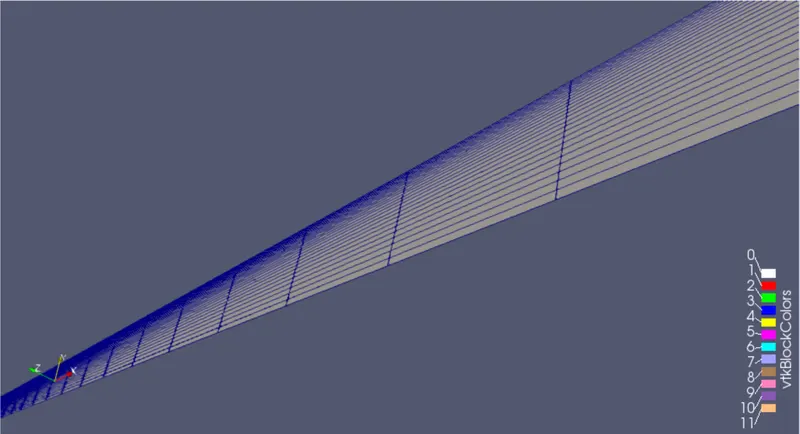
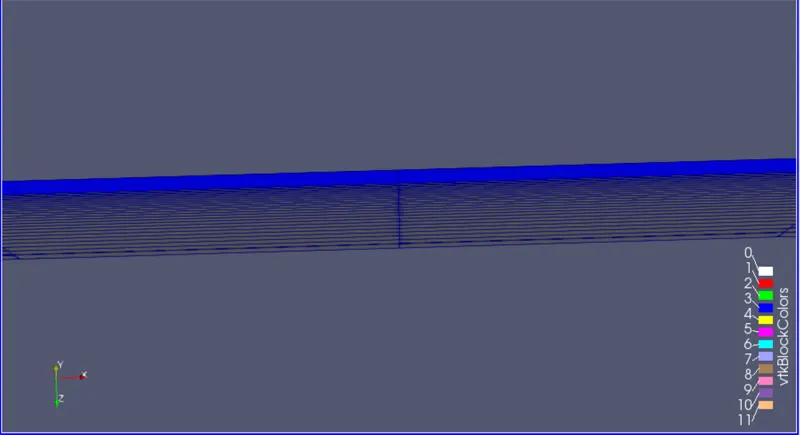
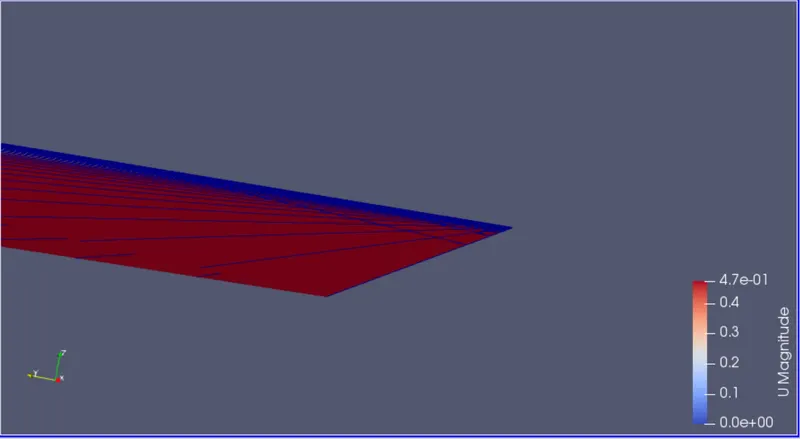
Obtained geometry :
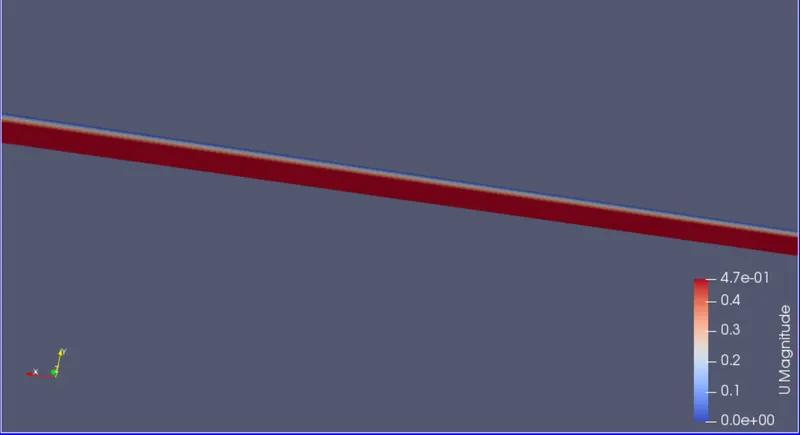
Velocity variation profile:
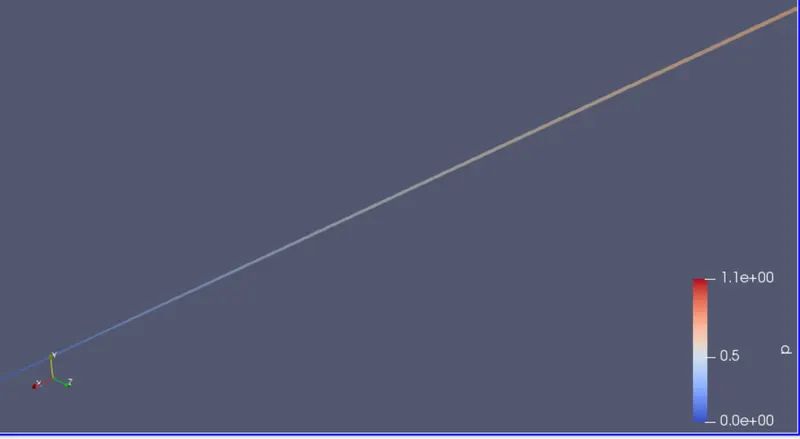
Pressure variation profile:
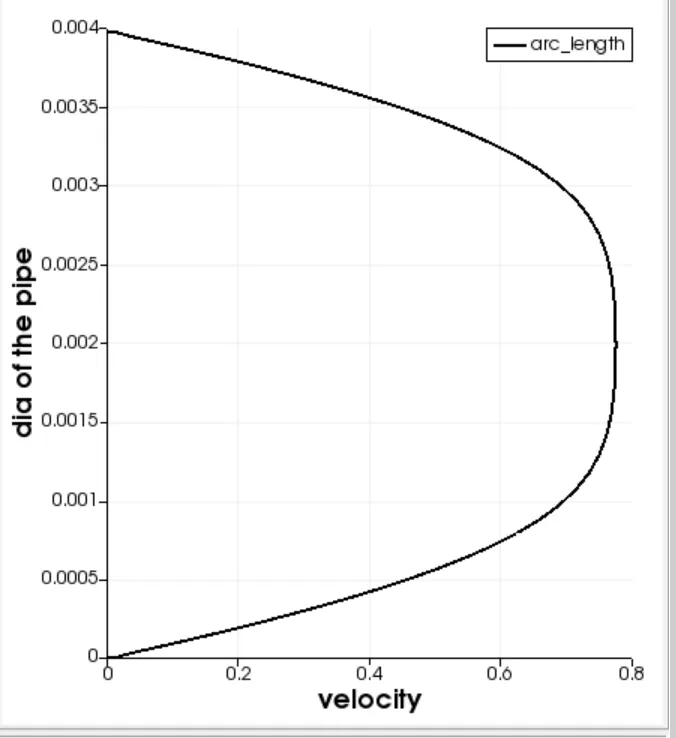
Velocity profile at L=0.1(fig 1)
At 0.42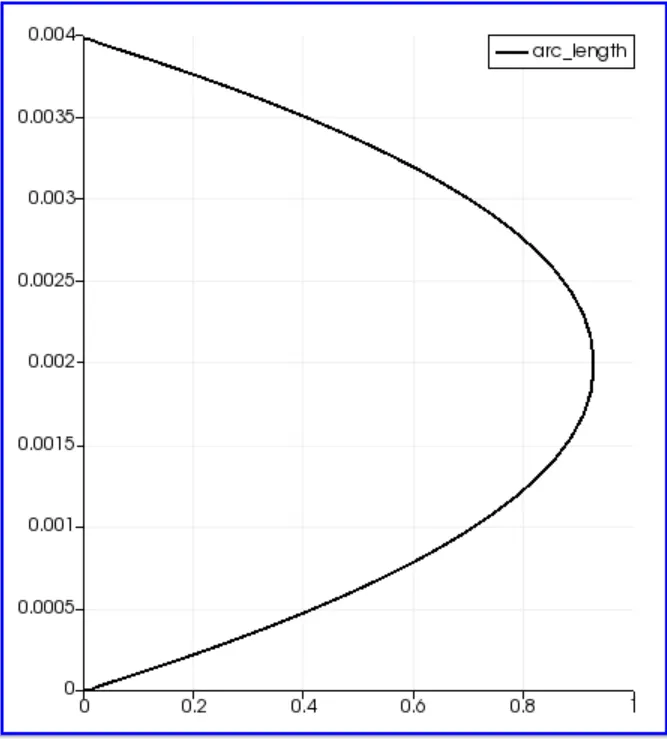
fig(2)
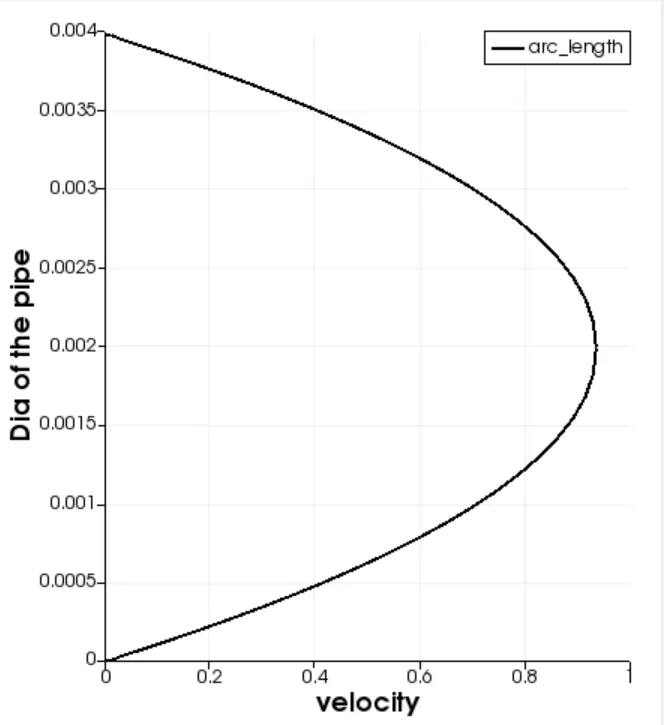
Velocity profile at L=0.56
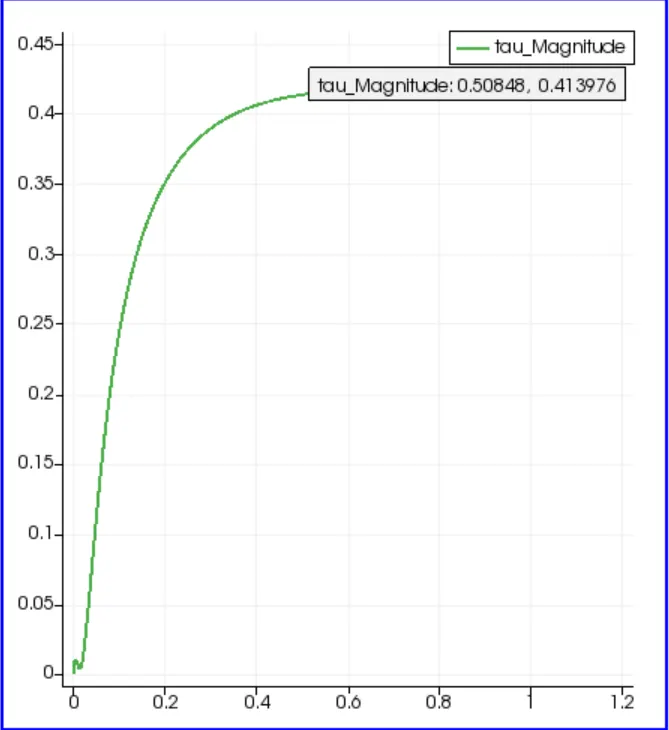
Shear stress plot:
Conclusion:
At the entrance of the pipe, the flow profile is not developed as shown in the figure.1
But after the hydrodynamic entrance length i.e 0.42m, the flow is fully developed as shown in the fig(2)
| Maximum values | velocity (m/sec) | shear stress |
| Analytical solution | 0.958 | 0.413 |
| Numerical solution | 0.9436 | 0.4199 |
| Error % | 1.15 | -1.67 |