Week 11: Project 2 - Emission characterization on a CAT3410 engine
Objective :
The project aims at obtaining emission characteristics of two different pistons, the open-W_piston, and Omega_Pistons.
Introduction :
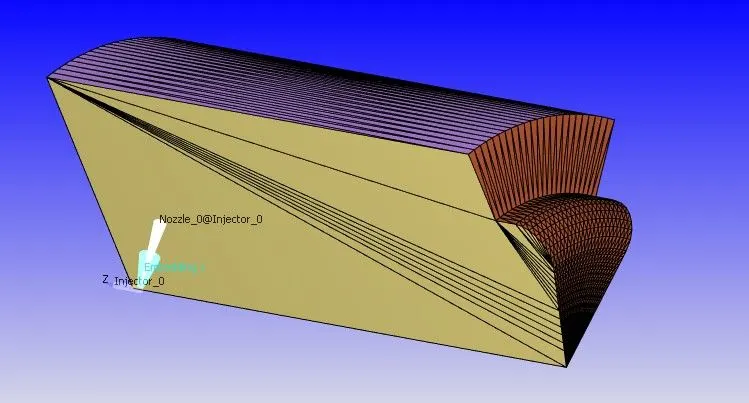
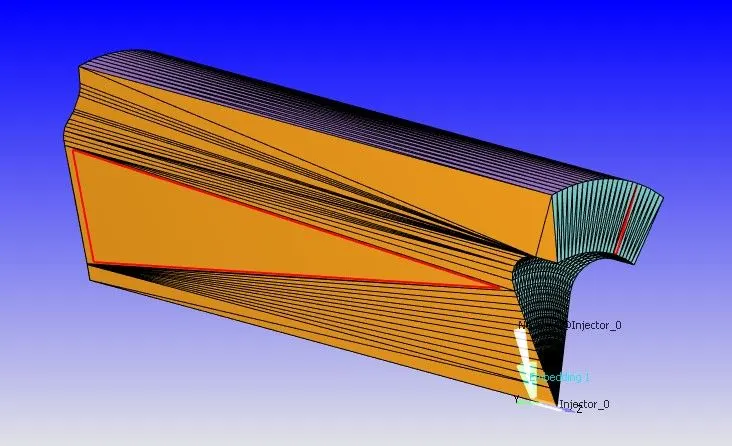
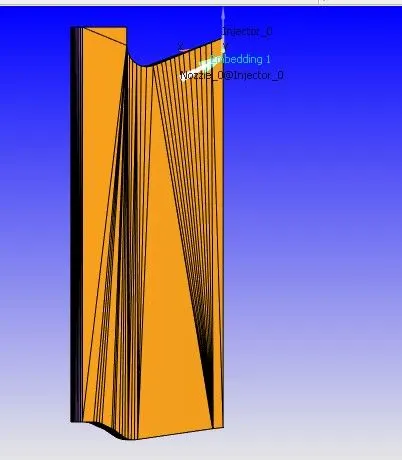
Setting up a working engine initially requires importing a CAD file of the component from another environment to the CONVERGE studio. The CAD file is then cleaned up by using the repair and patch options present in the software. This geometry was later flagged and the case set up carried out step by step as mentioned in the coming sections.
In this project, we have introduced two pistons as W-piston and the omega piston to simulate using converge CFD and to find the power, torque, Engine efficiency, combustion efficiency, and Emission (SOOT, Nox, UHC) for the same engine specifications and the results were analyzed.
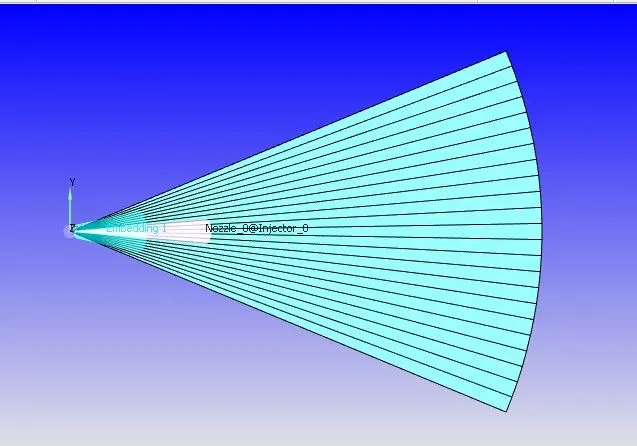
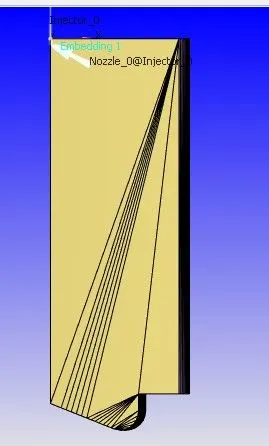
Omega_Piston:
Open-W_Piston:
Governing Equations :
This simulation is run on the basis of the Navier-Stokes equations. This NS equation consists of three momentum, one continuity, and one energy equation. The energy equation is solved only during the time when there is a heat transfer taking place. This is done to reduce unnecessary computational time.
Engine geometric parameters :
1. Bore = 0.13716 m
2. Stroke = 0.1651 m
3. Connecting rod length = 0.263 m
4. RPM = 1600
5 . Angle = 60 degree
The workflow involves :
1. Import the surface.dat file to extract the bowl profile.
2. Using the bowl profile to extract the sector geometry.
3. Running the diagnosis to find out the error in the geometry.
4. Flagging the boundaries starting from the flow into the model and the fluid exiting from it.
5. Certain the required case set up and set up the parameters according to the requirements.
6. Transporting the input files and running the simulation.
7. Convert the obtained 3D files into the corresponding viewable form.
8. Obtaining the contour and animation and drawing results from them using a 3D viewing platform such as Paraview.
Case setup :
Before starting with the case setup, a sector geometry of the engine was created. The sector was created to be 60 degrees. It was done so as to obviously increase the simulation time. To begin with, the surface.dat file was loaded to obtain the bowl profile of that particular piston. Later, the file that contained the bowl profile was loaded with the compression ratio fixed at 17.5, and the bore and stroke measurements were provided accordingly. This process churns out a sector geometry of the engine with a sector angle of 60 degrees.
Results and graph :
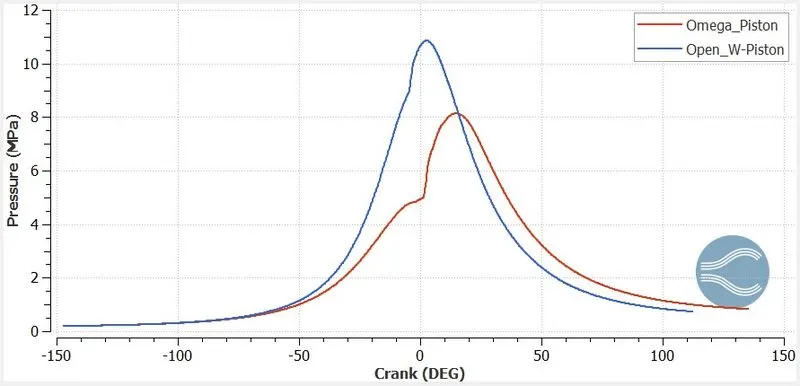
The variation of pressure, mean temperature, heat release rate, emission of Nitrogen oxide, and hydrocarbons are shown in the below plots for both piston profiles.
The pressure plot for both the pistons shows that Open-w_piston has a peak of 10.5MPa compared to the 8MPa of the Omega piston. This shows that the peak value of cylinder pressure is not much different.
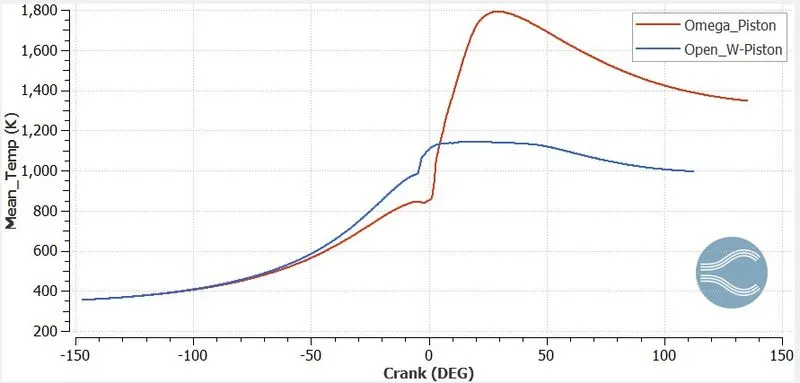
The peak temperature reached by the omega piston is around 1800k whereas the Open-W_piston reaches only about 1200k. The low-temperature peak of the Open_W would mean that NOx levels would be down. But there's another possibility where the low temperature can mean that the cylinder chamber contains unburnt fuel.
Open-W_Piston did not reach a higher temperature, this could be because the heat release rate is not as high as in the Omega_Piston engine case which becomes evident after observing the graph attached below.
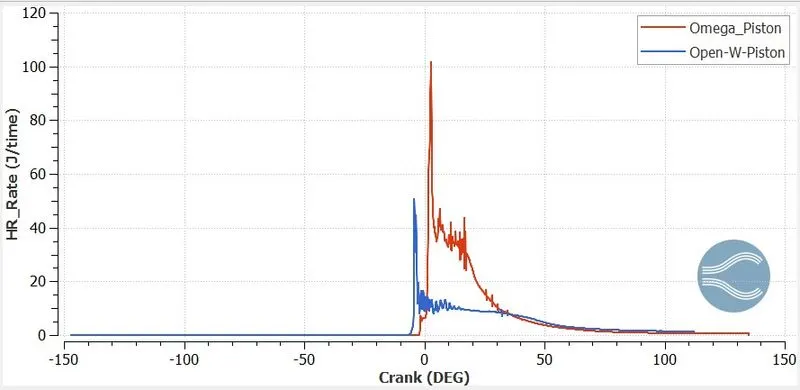
Although from the integrated heat release rate at the end seems to be the same, from the -4deg to 32deg (the time when combustion is taking place ) in the heat release rate graph high heat is released in the omega piston which leads to high temperature and high NOx formation.
Emission results :
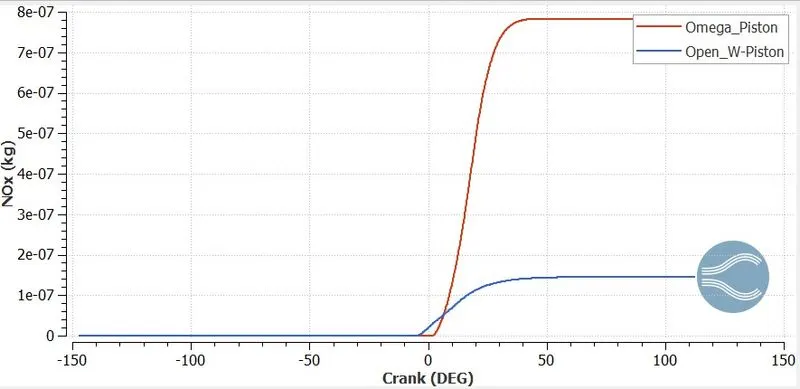
NOx is produced from the reaction of nitrogen and oxygen gases in the air during combustion, especially at high temperatures. In areas of high motor vehicle traffic, such as in large cities, the number of nitrogen oxides emitted into the atmosphere as air pollution can be significant.
We can observe in the below plot that the omega piston has more NOx compared to the Omega_W-piston because the omega piston has sharp edges and there in turn increases the temperature and pressure inside the cylinder as there is more temperature the Nox emission are produced more whereas in Open_W-piston there is less temperature and the fuel burning will be less and particles remains inside the cylinder.
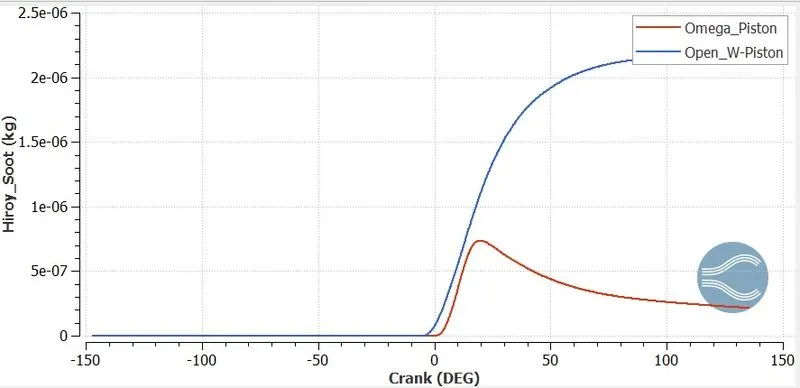
Soot results from the incomplete combustion of hydrocarbons. Here in our case, we can see that Open_W-piston produces more compared to the omega piston. Omega piston has less soot as compared to the given plot below.
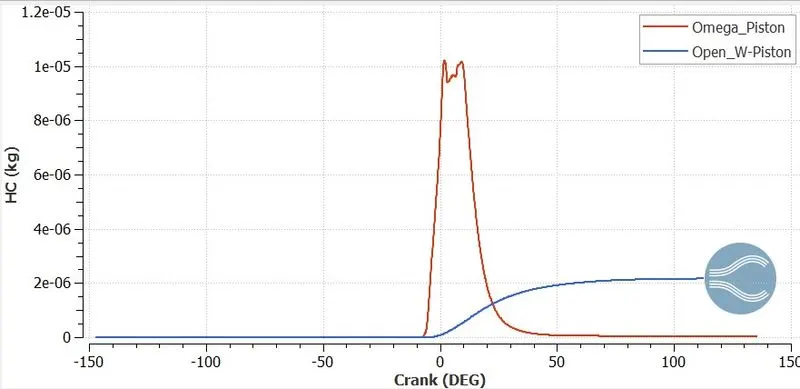
Hydrocarbon emissions are a sign of low fuel ignition. As we can observe below that the Open_W-piston produces more HC emission compared to the omega piston and seen in this case the omega piston seems to the better.
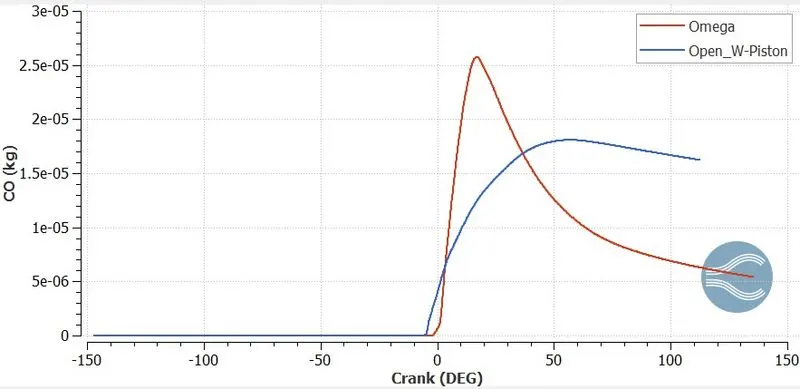
Carbon monoxide(CO) is produced in the incomplete combustion of carbon-containing fuels. As we can see the Omega piston produces less carbon monoxide and Open_W-piston gives more CO hence omega piston is better compared to Open_W-piston.
Animation :
1. Velocity Animation of Omega_Piston
2. Velocity Animation of Open_W_Piston
Engine Performance parameters:
First of all, go to CONVERGE -> Line Plotting -> Tools -> Engine calculation -> Engine Performance
Here, given the appropriate value of stroke and bore in the box in my case i.e
Bore = 0.13716 m, Stroke = 0.1651 m
Then, upload the 'thermo. out' DAT file by clicking the 'add file' and also uploading the engine.in IN file by clicking on the 'Load from engine. in' and hit Calculate.
The performance parameters for both configurations are calculated using the performance calculator tool in converge:
| Omega_Piston |
Open_W_Piston |
|
| Duration | 270.25 | 224.607 |
| Gross Work(N*m) | 461.074 | 239.038 |
| IMEP(Pa) | 188897 | 97931.2 |
| Crank angle10(deg) | 2.72406 | -2.17937 |
| Crank angle50(deg) | 14.2748 | 23.2762 |
| Crank angle90(deg) | 47.3846 | 71.9406 |
From the above results, we can clearly say that work done by the omega piston is higher and the IMEP is also higher for the omega piston.
Open-W_Piston:
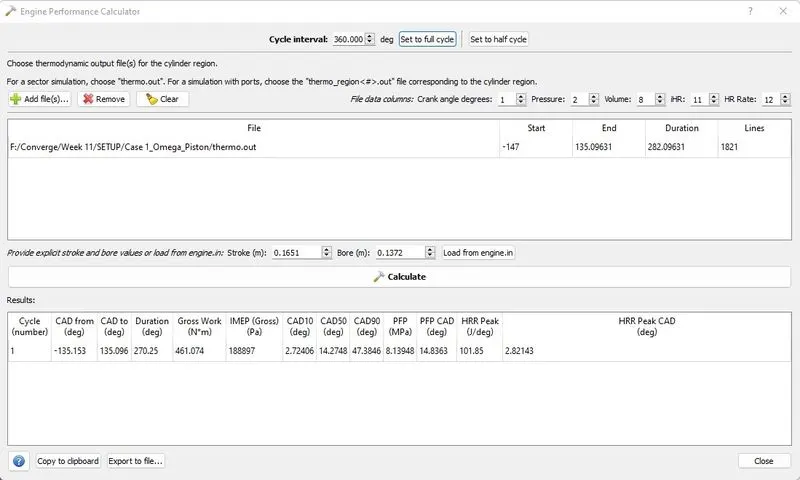
Power is defined as the ratio of work done per unit of time.
Power = work done/time
Power (P) = 2`pi`*N*T/60
Work done = 461.078
Rotations per minute = 1600
Rotations per second = 1600/60 = 26.667
Degree per second = 360*RPM /60 = 360*1600/60 = 9600
Time moving per second = 1/degree per second
= 1/9600 = 0.0001041
Time for 270.25 degrees = 270.25*0.0001041
= 0.028151
From the engine performance calculator
Gross work done = 461.074
Power = 461.074/ 0.028154 = 16.376KW
Open_W_Omega:
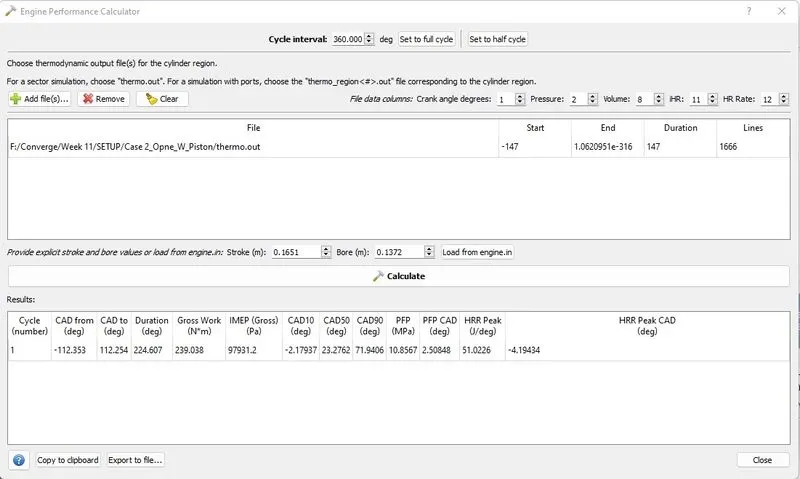
Power is defined as the ratio of work done per unit of time.
Power = work done/time
Power (P) = 2`pi`*N*T/60
Work done = 461.078
Rotations per minute = 1600
Rotations per second = 1600/60 = 26.667
Degree per second = 360*RPM /60 = 360*1600/60 = 9600
Time moving per second = 1/degree per second
= 1/9600 = 0.0001041
Time for 224.607 degrees = 224.607*0.0001041
= 0.023381
From the engine performance calculator
Gross work done = 239.038
Power = 239.038/ 0.023381 = 10.223KW
Conclusion:
The performance characteristics of Omega Piston are better than Open W piston. Omega piston delivers more Work/power.
The combustion characteristics of the Omega piston is better than Open-W-piston. In the case of Omega_piston, more amount of heat is released from the same amount of fuel as compared to the Open-W-piston.
The mean temperature in the cylinder is higher in the case of Omega piston, so it produces more Nox.
Due to incomplete combustion of fuel in the case of Open-W-Piston, it produces a greater amount of soot, CO, and HC but a lesser amount of CO2.
Based on all parameters and Emission characteristics, Omega piston is the better choice. Open-W-Piston is better for only if aims to reduce the NOx emissions.