Week-11 Challenge: Braking
2. Why electric motor can’t develop braking torque at high speed similar to starting? How electric and mechanical brakes are coordinated?
Answer :- A electric motor requires a high current at starting to make a motor run which produces the high torque at the time of starting . the speed torque characteristics of an electric motor show us that torque of a motor will be high and constant for speed below critical speed where the torque starts reducing the once it reaches the critical speed and maintanenace the constant power at high speeds.
While braking for the electric motors the supply will be cut off at once and the motor will reduce the speed of the motor. During the reduction speed, the motor will keep rotation due to moment of interia which helps to produce some back emf which leads to negative torque which is less and this negative torque leads to production of reverse current from the motor this is called regenerative braking and the reverse current is stored in the battery or will be used for other applications in the vehicle . So, while braking there will be negative torque and at high speed , there will be constant power , low torque due to speed more than the critical speed.
The electric braking and mechanical braking are both used widely in hybrid electric vehicles. These brakes are applied in two types i.e i) Series & ii)Parallel. In series braking, the electric and mechanical braking is applied one after another. In parallel braking , the electrical and mechanical braking is applied at once parallel.
For parallel braking , a technology called Electonic Driven Intelligent Braking, this method allows us to apply both mechanical and electrical brakes at a higher speed, and at the lower speed, it applies more mechanical brake than the electric brakes.
3.Make a MATLAB program which plots contour of given motor speed, torque and efficiency values. Attach the code as a .m file attach a screenshot of all the plots
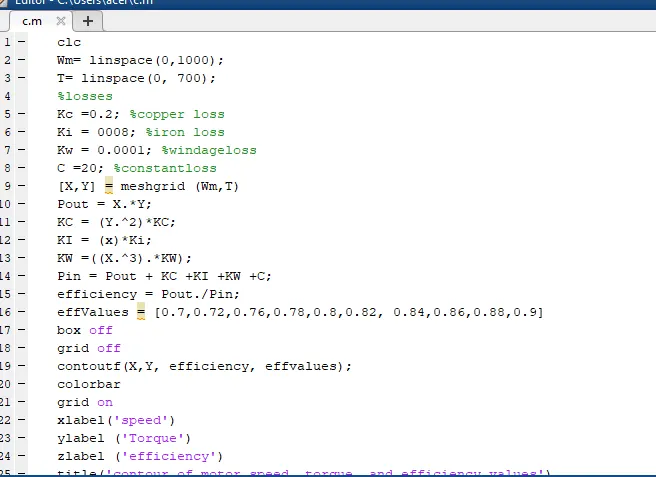
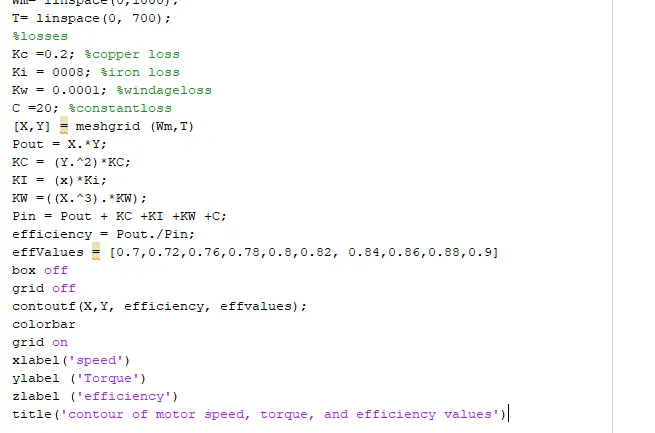
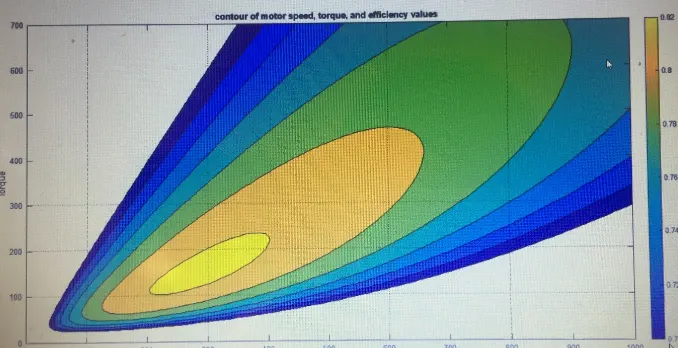
- For a defined driving cycle, calculate the energy required for braking.
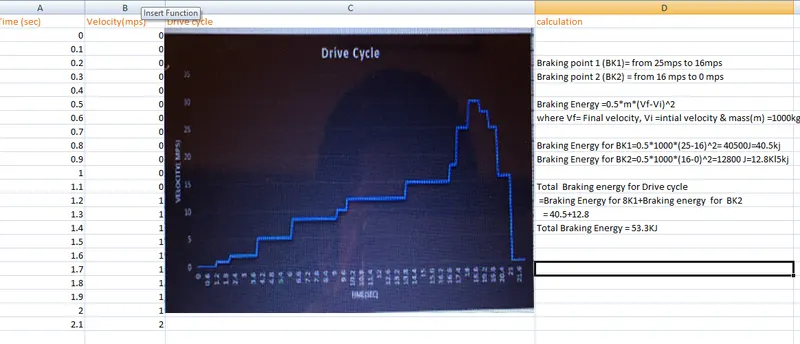
we will apply brakes any numbers of times in a single drive cycle, so the net or total braking energy of a drive cycle will be the sum of braking energy consumed per each time brake applied. in the above drive cycle, the brake has been appliedfor two times. So the braking energy is the sum of the braking energy of two times applied.