Week-11 Challenge: Braking
Solution to Question 1:
The function of the braking system is to retard the speed of the moving vehicle or bring it to rest in the shortest possible distance whenever required. The vehicle can be held on an inclined surface against the pull of gravity by the application of a brake.
Brakes are mechanical devices for increasing the frictional resistance that retards the turning motion of the vehicle wheels. It absorbs either kinetic energy or potential energy or both while remaining in action and this absorbed energy appears in the form of heat. While moving down a steep gradient the vehicle is controlled by the application of brakes. In this case, brakes remain in action for a longer period making it imperative to dissipate the braking heat to the atmosphere as rapidly as possible.
Automobiles are fitted with two brakes; the service or foot brake and the emergency or hand brake. The foot brake is used to control the speed of the vehicle and to stop it, when and where desired, by the application of force on the brake pedal. The hand brake, applied by a lever, is used to keep the vehicle from moving when parked. Hand brakes are called emergency brakes because they are applied when the service brake fails. Virtually all vehicles are now equipment with 4-wheel brakes. The front brakes must operate without interfering with the steering action.
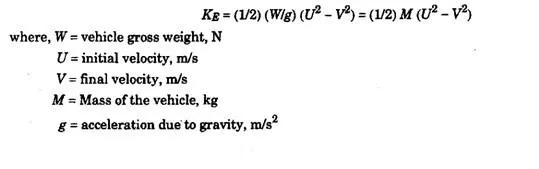
Kinetic energy is dissipated as heat by the brakes during application of breaks. The kinetic energy of a vehicle during braking is given by
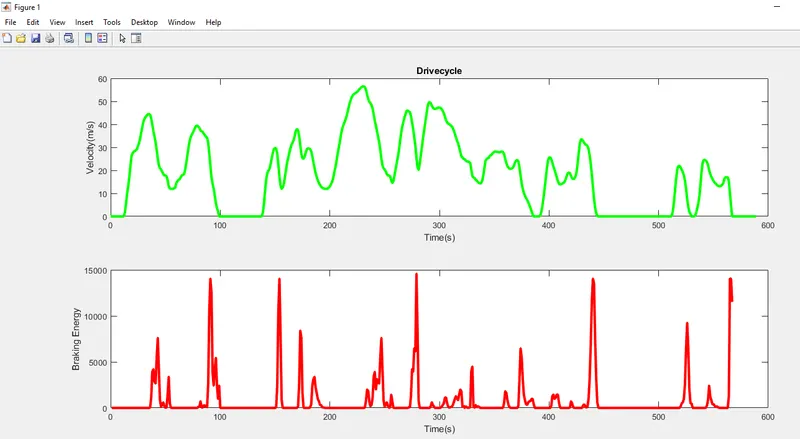
For calculating the braking energy required for an EV, first the drive cycle data is taken in excel sheet and the same data is imported into matalb. In the matlab script the code for calculating braking energy is implemented and the results are as follows:
The excel sheet data and the matlab code is attached here for reference.
Solution to Question 2:
We can see that, at the time of accelerating vehicle at starting the maximum torque available motor is operating at constant torque region, in that motor will have maximum torque available, but as motor starts deaccelerating motor characteristics are shifted towards braking region, in this we don’t have max torque available for braking as motor is already running at higher speed.
Due to this operation, electric motor can’t develop braking torque at high speed similar to starting
Electrical and mechanical braking systems can are coordinated by using Brake strategy subsystem
1) Serial Braking Strategy
2) Parallel Braking Strategy
Implementation of serial braking strategy
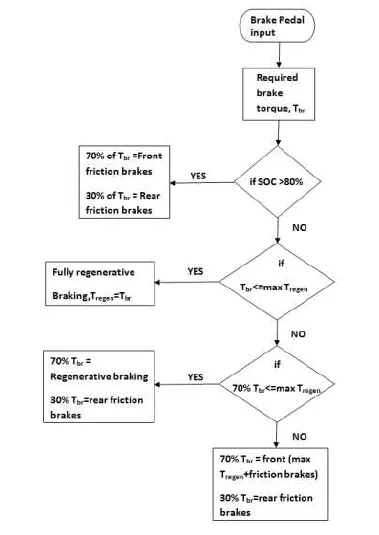
Once the brake pedal is pressed and depending on the level of depression, a brake torque is sent. Now this brake torque passes into the brake control strategy block. Here, firstly it is checked if battery state-of-charge is below 80% which is set as the maximum permissible level of charge. If that condition is satisfied, then the battery is recharged. The brake torque requested is compared to the maximum regenerative torque limit of the motor-generator. If the overall brake torque requested is less than or equal to the maximum regenerative torque, then the vehicle brakes purely on regenerative torque and the battery is charged. The amount of charge ultimately put in depends also on the motor-generator operation efficiency and the battery charging efficiency. If the overall brake torque requested is greater than what the motor-generator can provide, then the friction brakes kick-in. Now since the vehicle is front driven, it is checked if the total brake torque requested from front is less than or equal to maximum regenerative torque capability of motor-generator. If yes, then front braking is provided purely by regeneration and rear (non-driven axle) by friction. Once the total brake torque request increases further, then front friction brakes (driven axle) comes into play in combination with rear friction brakes and front regenerative braking, to satisfy the overall brake torque demand. This has been represented in a chart manner
Parallel Braking:-
Once the brake pedal is applied and a desired overall brake torque request is sent from the driver block. This brake torque on passing through the brake control strategy gets divided between regeneration and friction braking at all times. The strategy is so modeled with the comfort and brake pedal feel in mind. As a parallel regenerative braking is an add-on to the conventional systems, it is devoid of any integrated control. So to make the transition and co-performance of regenerative braking with friction smooth, it is assigned in such a way that, there is a clear division between the amount of brake torque that will be achieved from regeneration and friction braking.
Solution to Question 3:
clear all;
close all;
clc;

Torque= linspace(1,250,250)             %Input Torque
Speed= linspace(1,1000,250)             %Input Speed
[w,T]= meshgrid (Speed,Torque);         %Converting to 2D array

Kc= 0.3;         % Coppper loss constact
Ki= 0.009;       % Iron loss Constant
Kw= 0.00005;     % Windage loss constat
C=30;            % constant loss

Pout= w.*T;         %Output Power
C_loss=Kc*(T.^2);   %Copper loss
I_loss=Ki*w;         %Iron loss
W_loss=Kw*(w.^3);    %Windage loss

Pin=Pout+C_loss+I_loss+W_loss+C;    %Input power
eff=Pout./Pin


contour(Speed,Torque,eff)
title('Torque-speed-efficincy Contor of the induction motor');
xlabel('RPM');
ylabel('TORQUE (N-m)');
Code Explanation:-
The efficiency of the motor is calculated by using the formula given below:
Pi=Pout+Kc*T^2+Ki*w+Kw*^3+Constant loss
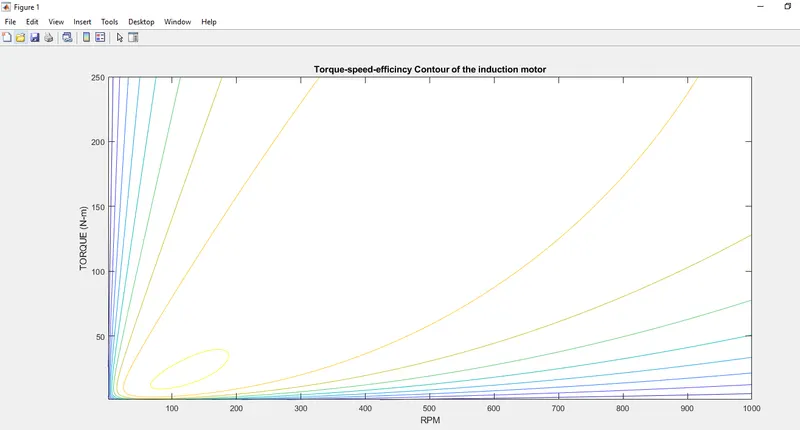
In this program we are plotting speed Vs torque characteristic with the efficiency values. For this, first we are defining speed and torque values of motor.
Then as we need to draw a contour, we convert this 1D array to 2D array using “MESHGRID” command.
Then we are defining the Cu constants for losses, like Cu loss constants, iron loss constant and windage loss constant.
The resultant contour graph is as shown below: