Study about Electrical braking
Aim
To study about braking and to simulate the speed torque characteristics
Objectives
- To calculate the energy required for breaking for a defined driving cycle.
- To find out why electric motor can’t develop braking torque at high speed similar to starting and how electric and mechanical brakes are coordinated.
- To make a mat lab programme which plots contour of given motor speed, torque and efficiency values.
Explanation
1. Energy required for breaking
A driving cycle was created using excel sheet and the representation of that is given below.
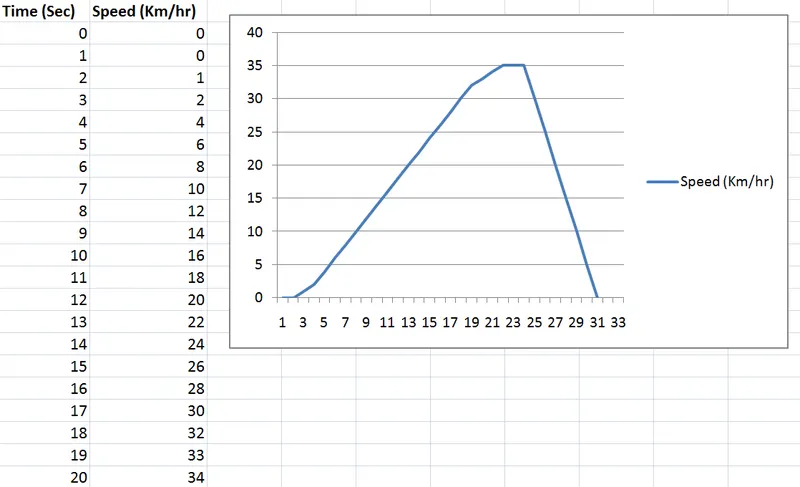
Here, we need to calculate the energy required for breaking. So the deceleration situation is taken. Vehicle took 7 seconds to come to rest. By the help of another excel sheet, we can calculate the energy or breaking and it is given below. Required assumptions are also considered.
Breaking energy = ½*mass*(final velocity-initial velocity) 2
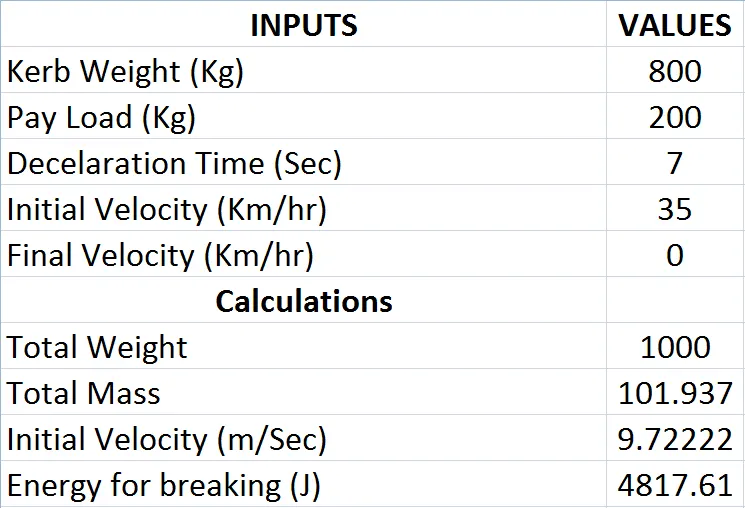
So for the considered condition, the breaking energy is 4.8 KJ.
2. Electric and mechanical braking
Here, we have to find out why electric motor can’t develop braking torque at high speed similar to starting and how electric and mechanical brakes are coordinated. Let’s see the difference between the starting and braking torque.
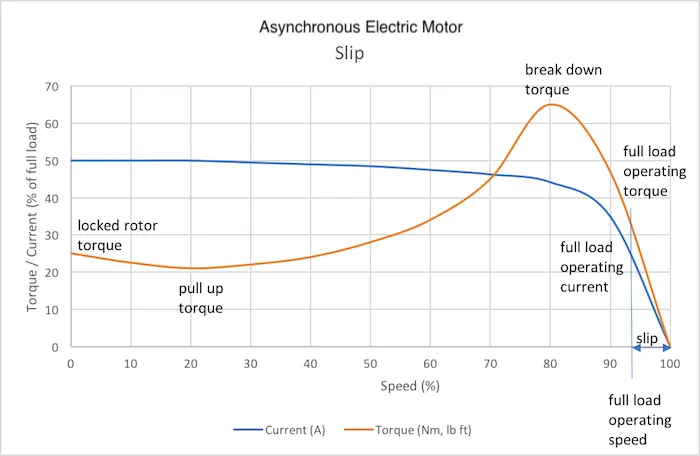
Starting torque is also named as locked rotor torque. It is the torque an electrical motor develops when starting at zero speed. A high torque is more important for application or machine to start. If the starting load is closer to zero, then low starting torque is acceptable like in centrifugal fans.
Braking torque is also named as full load torque or rated torque. It is the torque required to produce the rated power of an electrical motor at full-load speed. It can be expressed as follows.
T = 9550*rated power/rated rotational speed
So the main difference is that, starting torque is the maximum torque that can be produced by a motor in order to start rotational movement of the load. Braking torque is the maximum torque that can be applied to the shaft and cause the motor to stop rotating. Now the relation between torque and speed shows that they are inversely proportional. So when speed is high, torque will be low.
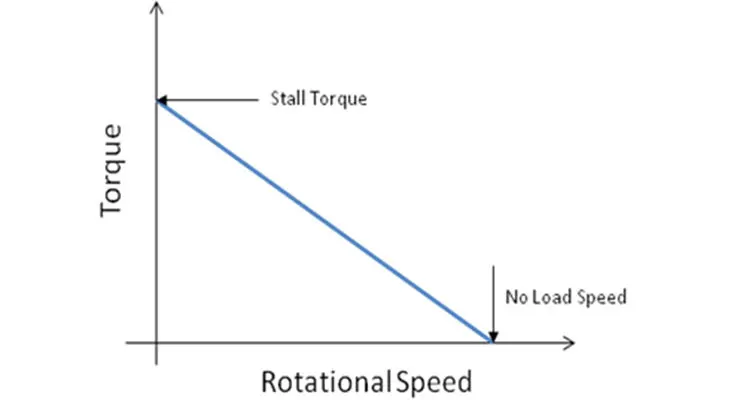
Now we can solve the next question about electrical and mechanical braking. They are also represented as regenerative and frictional braking respectively.
Electrical braking systems are used for functional braking and mechanical braking systems are used for emergency stopping or for parking. Electrical braking is usually very smooth and comfortable. Mechanical braking is usually rough and uncomfortable. There are no wear results from electrical braking but mechanical braking on the other hand causes wear in the braking components and requires regular maintenance. It is possible in electrical braking systems to return the regenerated energy back to main supply but this is not possible in mechanical braking systems and the energy is always lost as heat, noise and wear. The electrical braking system cannot be used as a safety device. Most systems will require a mechanical braking system as a backup safety device. So in these conditions we use braking strategies were both electrical and mechanical braking is coordinated.
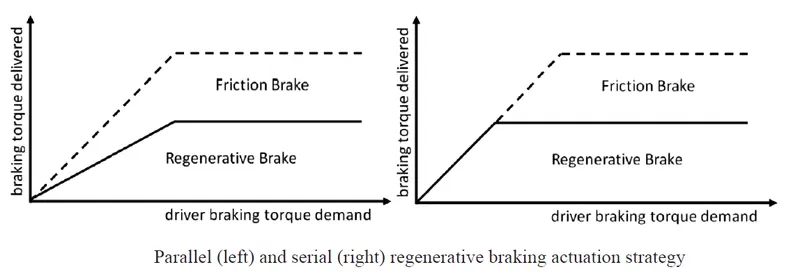
Parallel braking strategy, where the electrical brake starts to operate together with the mechanical brake. Serial braking strategy, where the electrical brake starts to operate ahead of the mechanical brake. In this strategy, the regenerative braking ratio can be increased in comparison to the parallel braking strategy. The mechanical brake starts to operate only in the case, when the electrical brake reaches its maximum, which is lower than that requested by the driver.
3. Making contour
Now, we have to make a mat lab programme which plots contour of given motor speed, torque and efficiency values. The code is given below.
% Plotting efficiency conotur for electrical motor
clear
close all
clc
% Setting arrys for range
x=linspace(1,1000);             % Speed(rad/s)
y=linspace(1,250);              %0 to 40NM
% Motor loss constants
kc=0.2;                         % Copper loss
ki=0.008;                       % Iron loss
kw=0.00001;                     % Windage loss
ConL=20;                        % Constant motor loss
% Creating mesh
[X,Y]=meshgrid(x,y);
outputpower=(X.*Y);
B=(Y.^2)*kc;                    % Copper loss
C=(X*ki);                       % Iron loss
D=(X.^3)*kw;                    % Windage loss
inputpower=outputpower+B+C+D+ConL;
Z=outputpower./inputpower;
% Contour efficiency
V=[0.7,0.8,0.85,0.9,0.91,0.92,0.925,0.93];
box off
grid off
contour(X,Y,Z,V);
colorbar
xlabel('Speed/rad.s^-^1');
ylabel('Torque/Nm');
zlabel('Efficiency');
title('Torque Speed Curve')
hold on
% Plotting contour
V=[8000,10000];
contour(X,Y,outputpower,V);
figure
surf(X,Y,Z);
colorbar
xlabel('Speed/rad.s^-^1');
ylabel('Torque/Nm');
zlabel('Efficiency');
title('Efficiency of motor')
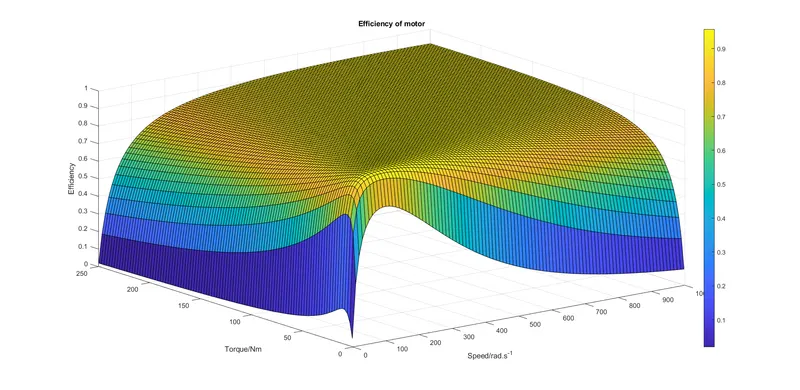
First of all, range for the plots was defined as arrays by linspace command. Then the required constants for calculations were given. All the equations for the calculation were given order. Contour efficiency range was also specified. Colorbar command was used to get the plot in colour bar. Surf command was used in efficiency plot. Label commands and title commands were given for specifications.
Results were obtained when the code as executed and the plots are represented below.
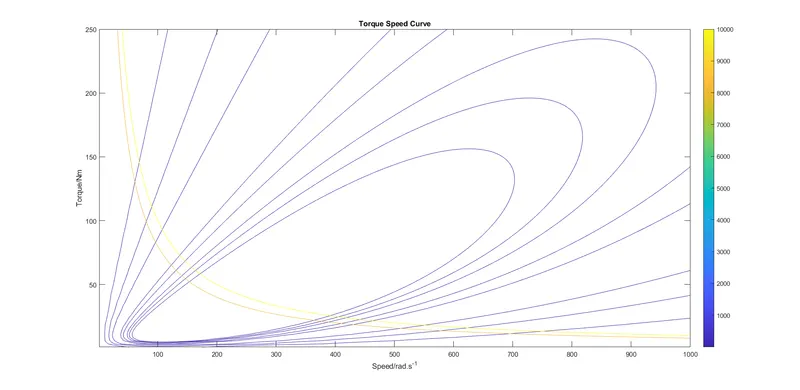
As the blue colour represents values under 5000, contour does not exceed the value. Efficiency plot was also obtained and it is given below.
Conclusion
Energy for breaking was calculated with a defined diving cycle. Electric motor characteristics and their relation with mechanical brakes were studied. A programme for plotting contour of given motor speed, torque and efficiency values was also created.
Reference
[1] https://www.engineeringtoolbox.com/electrical-motors-torques-d_651.html
[2] https://www.groschopp.com/start-vs-stall-torque-brushed-brushless-dc-motors/