Week-11 Challenge: Braking
Aim:
- For a defined driving cycle, calculate the energy required for braking.
- Why electric motor can’t develop braking torque at high speed similar to starting? How electric and mechanical brakes are coordinated?
- Make a MATLAB program which plots contour of given motor speed, torque and efficiency values. Attach the code as a .m file attach a screenshot of all the plots
Question 1:
- For a defined driving cycle, calculate the energy required for braking.
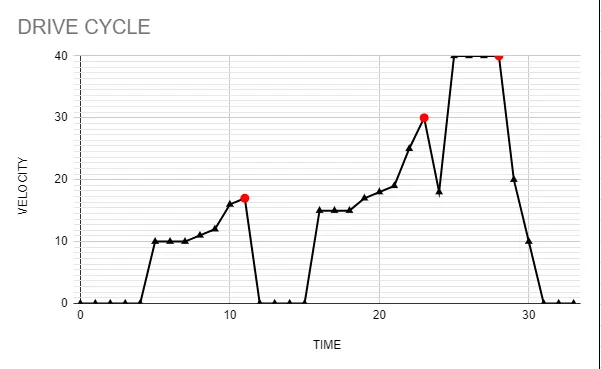
Drive cycle is defined as a series of data points that depicts the speed of vehicle with respect to time. Different countries and organisations produces drive cycles to analyse the performance of the vehicle such as fuel consumption and polluting emissions.
Braking system is one of the most important safety feature developed in the automobiles. The function of the braking system is to slow down the speed of the vehicle or bringing it to rest in the shortest possible distance when required.
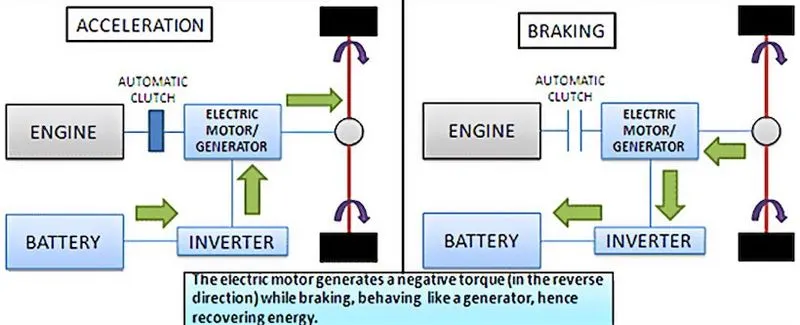
Regenerative braking is a mechanism in which energy is recovered by converting its kinetic energy into a form that can be used immediately or stored when needed. In case of regenerative braking the motor act as a generator so the kinetic energy is recovered so as to increase the energy in the battery
Two type of breakings are :
- Electric breaking
- Mechanicel breaking
Mechanical brake :
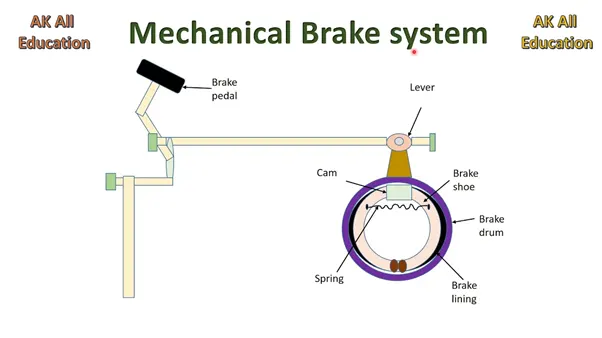
Mechanical brakes are assemblies consisting of mechanical elements for the slowing or stopping of shafts in equipment drives. They use levers or linkages to transmit force from one point to another.
Braking slows or stops the movement of the coupled shafts. mechanical brake acts by generating frictional forces as two surfaces rub against each other. The stopping power or capacity of brake depends largely on the surface area of frictional surface. They are mainly of two types (Drum brake and Disc brake).
These are rough and uncomfortable and they cause wear to braking components. In mechanical braking the whole energy is lost in the form of heat we cannot reuse it.
Electrical brake :
Electrical brake is a brake in which the braking is controlled by a electric current. Electric brakes are devices that use an electrical current or magnetic actuating force to slow or stop the motion of a rotating component. They are used in industrial and vehicular braking applications that require fast response times and precise tension control. They are of several types such as (permament brakes, electromagnetic brakes, eddy current brakes, regenerative brake).
In electric vehicles regenrative braking is widely used to charge the battery that is providing current to the motor. These are smooth and comfortable and they do not cause any wear and here we can use that the energy that is lost in the form of heat to recharge the battery. For low speed vehicle the electrical brake is itself capable of providing effective braking but fot high speed vehicles it is required to use mechanical brake along with electrical brake
FORMULAS USED TO CALCULATE THE BRAKING POWER,
- Energy = 0.5*m*(Vi-Vf)^2
- Deceleration = ( Vf-Vi)/ Time taken
- Deceleration force = Mass * Deceleration * Acceleration due to gravity
- Deceleration Power = Mass * 1.5* ((Vf- Vi) ^2)/(2*t*1000)
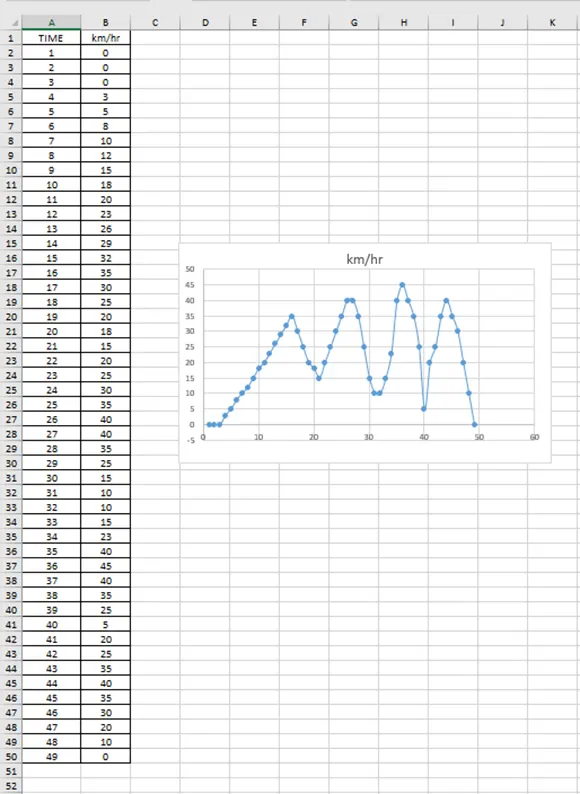
in the above fig. you can see that the drive cycle is created for 33 seconds and velocities are varied up and down. The plot of this drive cycle is shown below
Question 2: Why electric motor can’t develop braking torque at high speed similar to starting? How electric and mechanical brakes are coordinated?
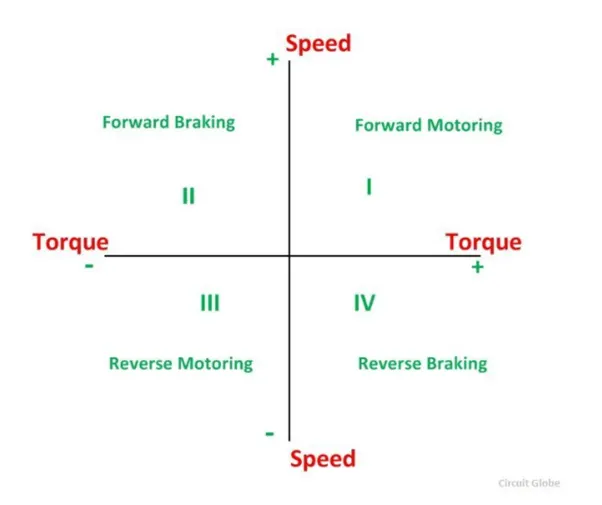
In braking mode, the motor acts as a generator and converts mechanical energy into electrical energy, it opposes the motion. So, the motor can operate in both forward and reverse direction which is motoring and braking operation.
When the motor is operated in the forward direction the speed of the motor is considered positive. The rotation of the motor in the opposite direction gives reverse speed which is denoted by a negative sign
QUADRANT 1
In the first quadrant the power developed by the motor is positive and supplying mechanical energy so the first quadrant operation is known as forward motoring.
QUADRANT 2
In this quadrant the operation performed is known as braking. In this quadrant the power developed by the motor is negative as the direction of rotation is positive and the torque is negative so the motor act as a generator that opposes the motion.
Theory:
Braking is as important as acceleration for acceleration and braking the vehicle certain amount of energy required. When considering the electric motor application in EV vehicles the braking of electric motor itself is braking the vehicle, electric braking is where the motor inherently apply brakes and the propulsion source itself provides the braking power .
Consider the case where electric vehicle operated by electric motor took 10 sec to reach 0 to 100 kmph speed and also took 10 sec to reach 100 to 0 speed. We analyse this case to understand why electric motor can’t develop braking torque at high speed similar to starting?
Case 1 : Electric motor took 10 sec to reach 0 to 100 kmph :
When the vehicle is starting from zero speed at this stage the torque maintained by electric motor is almost constant. so,at low speed characteristics of motor the torque produced is constant hence the motor operates in constant torque region therefore the vehicle has higher acceleration power possible at low speed the motor torque is high.So it is easier for the motor to reach 0 to 100 speed . At this stage the both the speed and torque are positive this also called the first quadrant operation of motor here power is also positive this stage is called forward motoring stage.
Case 2 : Electric motor took 10 sec to reach 100 to 0 kmph :
When it comes to braking part where the torque is negative and the speed is positive therefore the power is negative this is called second quadrant operation of motor or forward braking stage. When this stage compared with the first quadrant operation of motor the peak acceleration torque and peak deceleration torque are not equal for electric motor vehicle because at high speed the value of the torque is lower. Here we are operating the motor in field weakening region or we are operating the motor above base speed we must know that the torque value is compromised
How electric and mechanical brakes are coordinated:
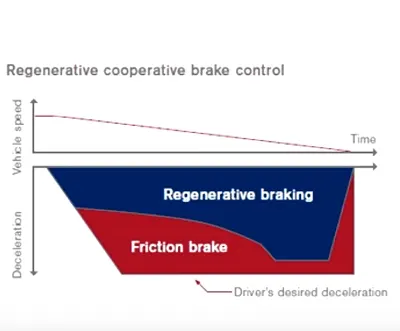
This is explained by the brake force distribution between electric(regenerative braking) and mechanical brakes.
The brake forces are distributed keeping the safety in consideration here there are two axels of the vehicle where the brake force is distributed not equally but almost same. When the vehicle is running with low speed the electric brakes can be applied but when the vehicle is at high speed we have to apply both electric and mechanical brakes to make the vehicle come to zero speed in less time otherwise if we only apply electric brakes the time taken for the vehicle to come to rest is large and more this can happen if we allow the vehicle to run in coasting or free wheeling mode.
1) moment of inertia of vehicle
2) vehicle speed
3) kinetic energy stored in the vehicle
4) forces acting on the vehicle
5) time required for braking
6) mechanical losses like friction and windage losses.
The above all factors decide the type of braking needed for the vehicle at that particular instant of time based on that the electric and mechanical brakes are coordinated.
There are two brake control strategies developed they are:
1)Series braking:
We apply the mechanical brakes and electric brakes one after another. even one type only
2)Parallel braking:
We apply both mechanical brakes and electric brakes brakes simultaneously at a time.
Motor of electric vehicle is able to be used to brake regeneratively, so braking energy can be recycled. Braking stability of electric vehicles with electro-hydraulic hybrid braking system can be influenced by braking force distribution between hydraulic braking force and regenerative braking force.
In order to research on braking stability and braking energy recovery, simulation platform of electro-hydraulic hybrid brake system based on Carsim and Matlab/Simulink is built, and a control strategy of electro-hydraulic hybrid brake were proposed.
The vehicle simulation models with electro-hydraulic hybrid brake system and with conventional hydraulic braking system were applied the brake on different adhesion coefficient separately.
CONCLUSION:
The breaking torque of an electric vehicle is not as high as compared to acceleration torque because of this the regenerative breaking is not as effective. Hence, we cannot get all the power back to the battery as the deceleration torque is less than the acceleration torque.
C code:


EXPLANATION
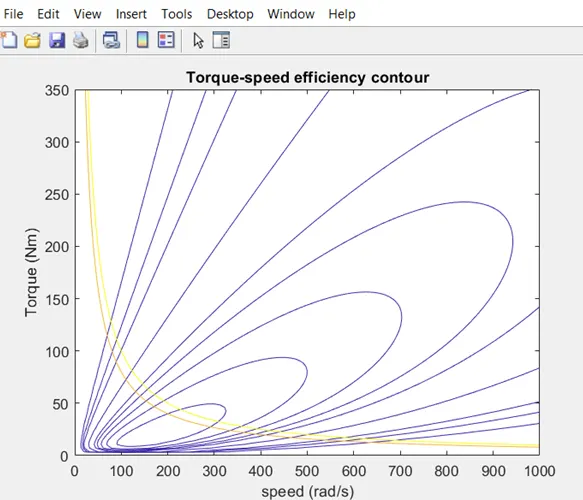
- Linspace command is used to create arrays for speed and torque of the motor. For speed the values are ranging from 0 to 1000 radians per second and torque values ranging from 0 to 350Nm
- Copper losses
- Iron losses
- winding losses
- constant loss
These different types of losses depend upon the speed and torque of the motor and the loses have constant of proportionality which are assumed for calculation which is denoted by the letter K
The input power is calculated by adding all the losses plus the output power and the efficiency of the motor is calculated by output / input
Finally, the contour plot of speed torque characteristics of the motor is plotted using the contour command. An array of efficiency values is plotted and denoted by V and the values are ranging from 0.75 to 0.96.
This array helps in creation of the contour and the x axis and y axis are labelled as speed and torque respectively.
Result:
CONCLUSION :
All the tasks that are given to me has been completed successfully and the results are shown.