Week-11 Challenge: Braking
1. For a defined driving cycle, calculate the energy required for braking:
Braking is a condition to slow down or stops a moving vehicle as required. There are several techniques to apply brakes, which can be mechanical or electrical. The most commonly used technique is by applying friction. It consumes energy .The consumed kinetic Energy can be derived as following equation
Calculated energy required for braking formula is Energy=1/2*MV^2
M=Mass of Vehicle(Kerb Weight + Pay load)
V=Velocity
In pratical case Velocity is Intial and final velocity are considered
VF= Final Velocity
VI=Intial Velocity
Mass of Vehicle is 500 Kg, VI=50m/sec, VF=10m/sec,
Braking Energy =1/2*500*(50-10))^2
Braking Energy = 1/2*500*(40)^2
Braking Energy is= 400J
Here i have attached driving cycle excel for to calcuclate braking energy when slow down and stop of vehicle.
2.Why electric motor can’t develop braking torque at high speed similar to starting? How electric and mechanical brakes are coordinated?
Eectric motor can’t develop braking torque at high speed similar to starting, because Braking torque is applied in the opposite direction of the rotation. We can use a mechanical brake to produce a braking torque. We can also do it electrically.
Here i have attached image of forward and reverse Quadrant image.
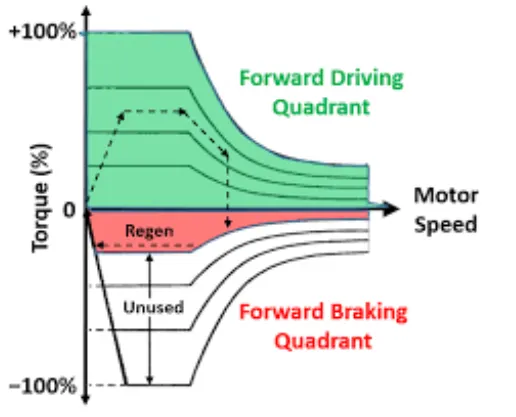
Regenerative Braking:
Regenerative braking takes place whenever the speed of the motor exceeds the synchronous speed. This baking method is called regenerative baking because here the motor works as generator and supply itself is given power from the load, i.e. motors. The main criteria for regenerative braking is that the rotor has to rotate at a speed higher than synchronous speed, only then the motor will act as a generator and the direction of current flow through the circuit and direction of the torque reverses and braking takes place.
Accleration and Deaccleration:
Peak Acceleration Torque and Peak Deceleration torque are not equal for Electric Vehicle Motor. So the Peak Torque during acceleration and the Peak torque during deceleration or braking are not equal. Acceleration is usually higher, at low speed we get higher Torque but high speed the value of the torque gets lower. So we cannot say that the motor which is producing 7Nm Torque for Acceleration can also produce -7Nm of Braking Torque. So beacuse we Operating the Motor in Field Weakening region or we are operating the Motor above base speed we must know that the torque is compromised or the torque value is lower. So Electric motor can’t develop braking torque at high speed similar to starting, because Braking Torque of an EV Motor is not as high as the Acceleration Torque. Therefore Regenerative braking is cannot happen so effectively that we can get all the power back to the battery.
How electric and mechanical brakes are coordinated?
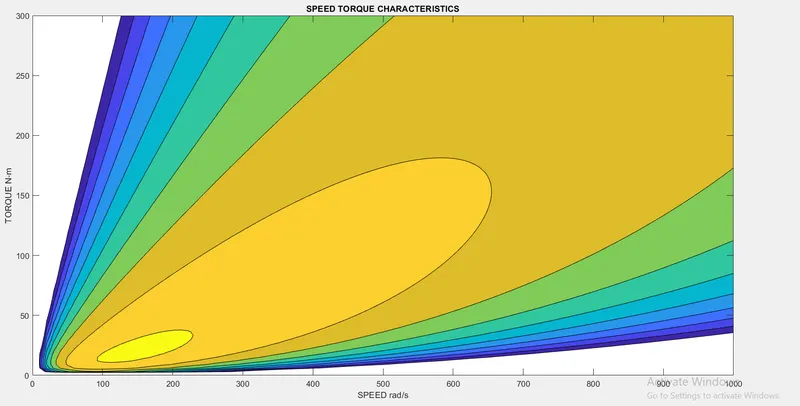
close all
clc
% SPEED ARRAY
w = linspace(0,1000);
% TORQUE ARRAY
T = linspace(0,300);
% LOSS COEFFICIENTS
kc = 0.18; % COPPER LOSSES
ki = 0.006; % IRON LOSSES
kw = 0.000015; % WINDAGE LOSSES
% MESHGRID
[X,Y] = meshgrid(w,T);
copper_loss = (Y.^2)*kc;
iron_loss = X*ki;
windage_loss = (X.^3)*kw;
K = 20;
output_power = X.*Y;
input_power = (copper_loss)+(iron_loss)+(windage_loss)+(output_power)+K;
Eff = (output_power)./(input_power);
n = linspace(0.7,0.95,10);
contourf(X,Y,Eff,n);
title('SPEED TORQUE CHARACTERISTICS')
xlabel('SPEED rad/s')
ylabel('TORQUE N-m')
Results: