Week-11 Challenge: Braking
Q.1.For a defined driving cycle, calculate the energy required for braking.
ANS:
Deceleration conditions are similar to acceleration conditions. Acceleration increase in speed and deceleration is a reduction In speed. So similar way to calculate braking power.
During braking also required the same amount of power required for acceleration so applying those standard equations we can calculate the energy for braking by the following formula :
Energy=1/2*M*V^2
Where M= mass of the vehicle.
V= Velocity.
By this formula, we can calculate the energy in watt/h
Assumptions:
M: 1000kg
Vi: 100kmph (Initial speed)
Vf: 0 kmph(final speed)
Acceleration time: 10sec
Acceleration: 2.5m/s^2
from that,
Acceleration power: 58
converted into sec so 58/3600*10=0.1611kw
Now from 100 to 0 how much is braking power is required that we have to calculate.
Energy=1/2*M*V^2
=0.5*1000*(10.12)^2
=13.88 KJ
Q.2.Why electric motor can’t develop braking torque at high speed similar to starting? How electric and mechanical brakes are coordinated?
ANS:
Now Speed torque characteristics of the motor is shown below,
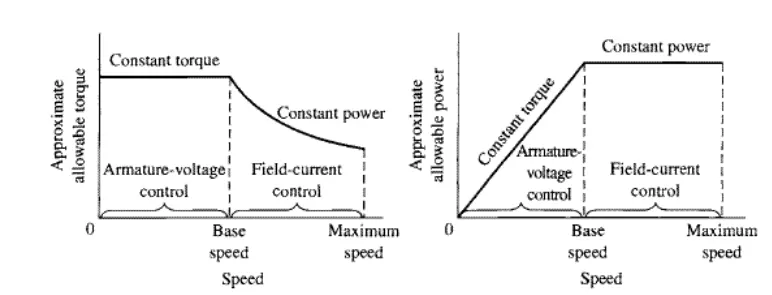
Here it is clearly shown in the first graph that till the motor reaches the critical speed it has constant torque and once it reaches the critical speed, the curve is having a downslope which is a constant power region. And this graph denotes the accelerating operation of the motor. For the deceleration or braking operation of the motor, this graph is mirrored down which will be having the speed (+ve) and torque (-ve).
For example,
we can say that an EV can achieve 0-100 kmph in 10sec. Acceleration operation goes this way, with low speed and high torque Constant torque region is achieved which has accelerating power and by reaching the critical speed it shifts to constant power region and thus it easy for an EV to reach 0-100 kmph.
As said the breaking operation graph will be the mirrored image of the above plot. So we cannot say that the motor producing 7Nm torque for acceleration can also produce -7Nm for breaking. Because we are operating in the field weakening region and operating above the base speed. Thus Peak Acceleration torque is greater than the Peak Deceleration torque. Thus for acceleration, it has high torque with low speed and for deceleration, it has low torque for high speed.
The regenerative braking system may not be used under many conditions, such as with a high State of Charge (SOC) or a high temperature of the battery. In these cases, the mechanical braking system works to cover the required total braking torque.
Thus, cooperation between the mechanical braking system and the regenerative braking system is a main part of the design of the EV braking control strategy and is known as torque blending.
Electrical and mechanical braking systems can are coordinated by using Brake strategy subsystem:
1) Series Braking Strategy
2) Parallel Braking Strategy
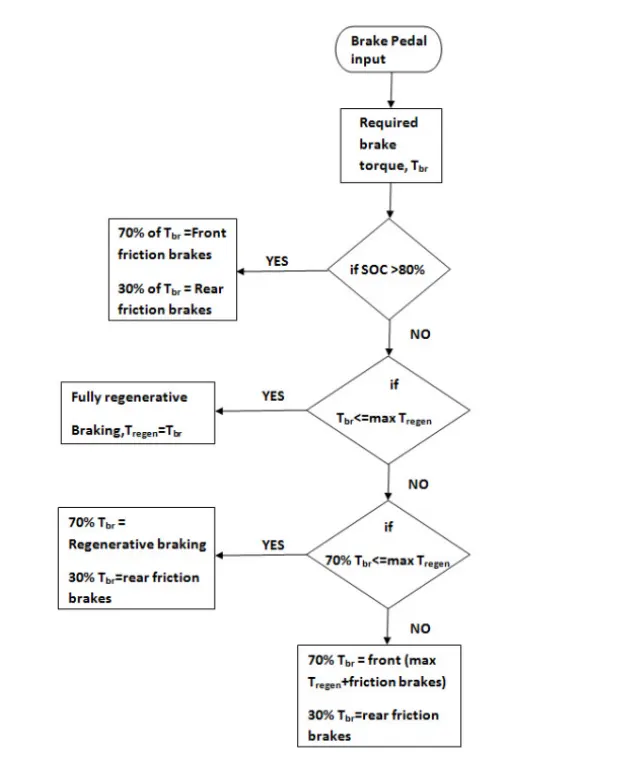
Implementation of series braking strategy:
Brakes will be applied one after another so which they are connected in series. Either one brake stragety at a time either Regenerative braking or Mechanical braking at a time.
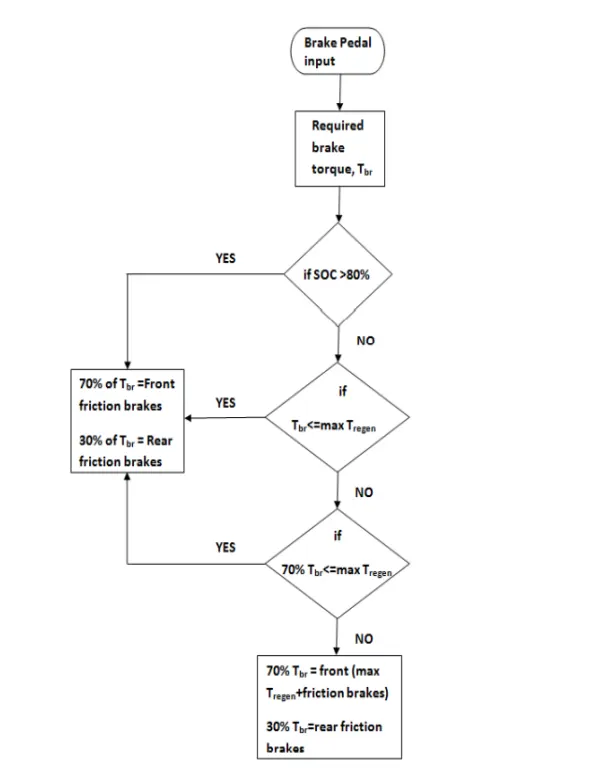
Implementation of parallel braking strategy:
In the case of parallel both the brakes are applied simultaneously, Both at a time.
ELECTRIC DRIVEN INTELLIGENT BRAKE:
Application of Braking Combination : EDIB (ELECTRIC DRIVEN INTELLIGENT BRAKE:) in NISSAN LEAF
- EDIB allows and controls optimization of the regenerative brake and regular friction brake (hydraulic brake).
- The system produces an adequate braking force keeping energy regeneration increased as much as possible.
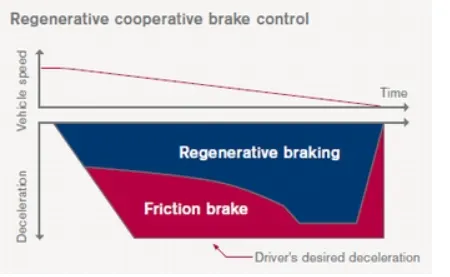
- At higher speeds, a combination of regenerative and friction braking is applied.
- At lower speeds, regenerative braking is given a higher proportion for maximised energy conversion.
Q.3. Make a MATLAB program which plots contour of given motor speed, torque and efficiency values. Attach the code as a .m file attach a screenshot of all the plots.
ANS:
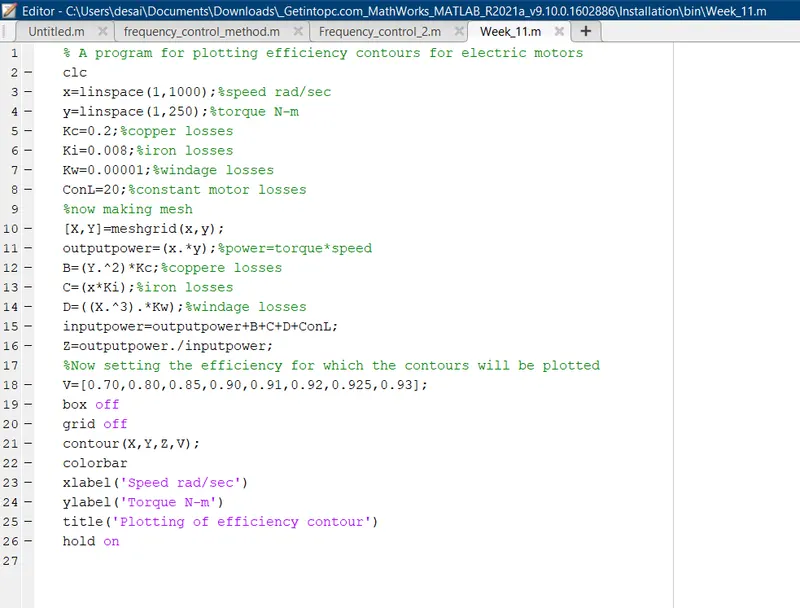
MATLAB program :
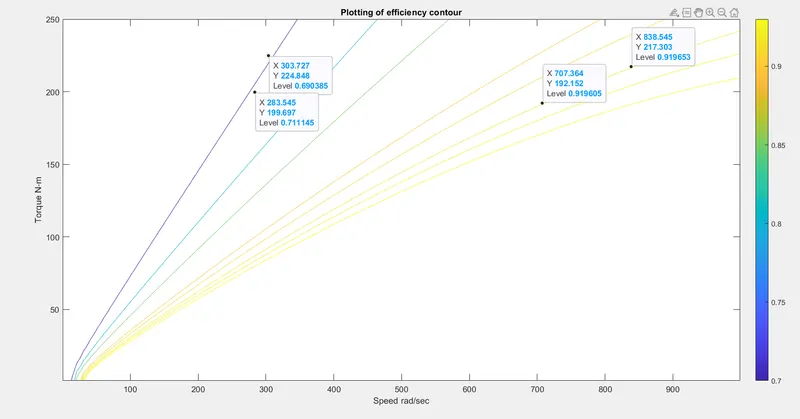
Output:
Syntax Explanation:-
In this program we are plotting speed Vs torque characteristic with the efficiency values. For this, first we are defining speed and torque values of motor.
Then we are defining the Cu constants for losses, like Cu loss constants, iron loss constant and windage loss constant.
Pi=Pout+Kc*T^2+Ki*w+Kw*^3+Constat loss
Using this formula, we calculate the efficiency and then plot the contour.
As we see in output we going inside to circle our efficiency get increase and outside it will decreases.