Week-11 Challenge: Braking
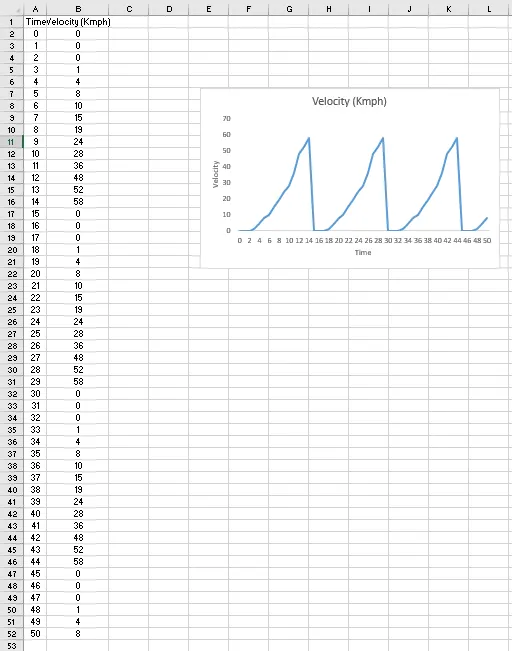
1) For a defined driving cycle, calculate the energy required for braking.
Ans:-1 Braking is a condition where a user slows down or stops a moving vehicle. There are many ways to apply brakes such as mechanical brakes or regenerative braking. The most common technique used is to apply friction which consume lot of energy.
Braking energy= (1/2)*m*v^2
where, m is total mass
v is initial-final velocity
suppose the initial speed of vehicle is 120m/s and final is 20 m/s. and mass is 800 Kg, then the required braking energy is
(1/2)*800*(120-20)^2
4000 KJ energy is required
2) Why electric motor can’t develop braking torque at high speed similar to starting? How electric and mechanical brakes are coordinated?
Ans:-2 Torque decreases at high speed and at lower speed the we can achieve high torque. This does not occur at the begining of acceleration because most of the torque is used to increase the kinetic energy but when the speed is already high and no extra load is applied It is not possible to increase the torque as well as develop braking torque. The braking happens in the proportion which is distributed in regenerative and mechanical braking
Electric and Mechanical brakes coordination.
i) Series- Regenerative and mechanical braking are applied one after another.
ii) Paraller- Regenerative and mechanical braking are applied simultaneously
Mechanical Braking- It is applied as by generating frictional forces between two surfaces rub against each other. The stopping power mainly depends largely on the surface and it consist of mechanical elements such as:
1) Band brakes
2) Drum brakes
3) Disc brakes
Electric braking- It is a device which use an electric current to slow or stop a moving vehicle. They are used in vehicle application for fast time response and precision control. It is called regenerative braking where with one pedal we can control acceleration and deccelration. In this operation motor acts as a generator, during this process it produces counter torque which opposes the motion of motor and it comes to halt. Moreover this brake energy is converted to electrical energy and fed back to motor.
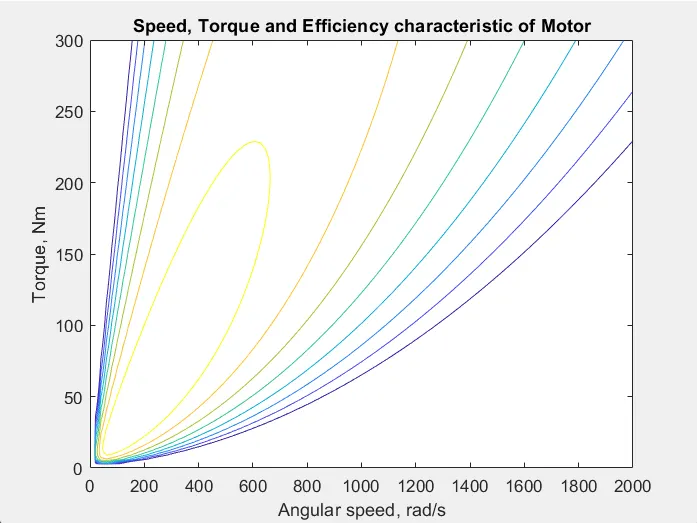
3) Make a MATLAB program which plots contour of given motor speed, torque and efficiency values. Attach the code as a .m file attach a screenshot of all the plots.
Ans:-3
clear all
close all
clc
omega=linspace(0,300,100);
T=linspace(0,2000,100);
[X,Y]=meshgrid(T,omega)

cu= 0.17;
fe= 0.006;
win= 0.000015;

cu_loss= cu*(Y.^2)
fe_loss= fe*(X.^2)
win_loss= win*(X.^3)
cond_loss= 18

p_out= (X.*Y)
p_in= p_out+cu_loss+fe_loss+win_loss+cond_loss
n= ((p_out)./(p_in));

W=linspace(0.75,0.95,10)

contour(X,Y,n,W)
xlabel('Angular speed, rad/s')
ylabel('Torque, Nm')
title('Speed, Torque and Efficiency characteristic of Motor')
Output