Week-11 Challenge: Braking
- For a defined driving cycle, calculate the energy required for braking.
- Why electric motor can’t develop braking torque at high speed similar to starting? How electric and mechanical brakes are coordinated?
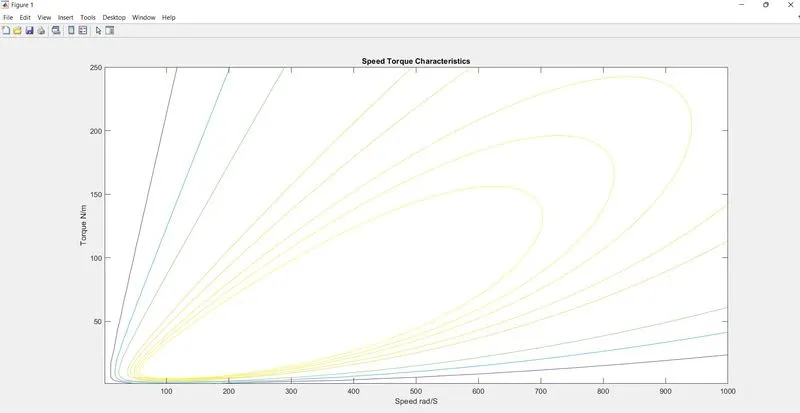
- Make a MATLAB program that plots the contour of given motor speed, torque and efficiency values. Attach the code as a .m file attach a screenshot of all the plot
- For a defined driving cycle, calculate the energy required for braking.
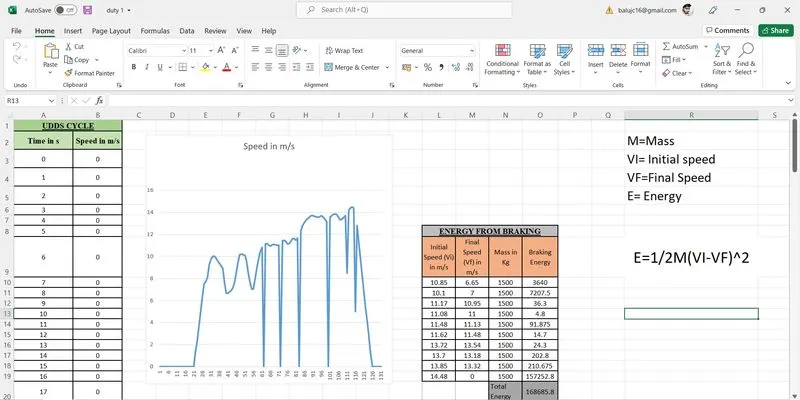
| M=Mass |
| VI= Initial speed |
| VF=FinalSpeed |
| E= Energy |
E=1/2M(VI-VF)^2
| ENERGY FROM BRAKING | |||
| Initial Speed (Vi) in m/s | Final Speed (Vf) in m/s | Mass in Kg | Braking Energy |
| 10.85 | 6.65 | 1500 | 3640 |
| 10.1 | 7 | 1500 | 7207.5 |
| 11.17 | 10.95 | 1500 | 36.3 |
| 11.08 | 11 | 1500 | 4.8 |
| 11.48 | 11.13 | 1500 | 91.875 |
| 11.62 | 11.48 | 1500 | 14.7 |
| 13.72 | 13.54 | 1500 | 24.3 |
| 13.7 | 13.18 | 1500 | 202.8 |
| 13.85 | 13.32 | 1500 | 210.675 |
| 14.48 | 0 | 1500 | 157252.8 |
| Total Energy | 168685.8 | ||
2. Why electric motor can’t develop braking torque at high speed similar to starting? How electric and mechanical brakes are coordinated?
Electric vehicles (EVs) run primarily off the charge they stored when plugged into an outlet, but use regenerative braking to help top up the battery. In addition to the regenerative system, all electrified vehicles have conventional braking systems as regular vehicles do.
Electric vehicles are changing all of that thanks to something called regenerative braking. Regenerative braking turns a vehicle's motor into a power generator of sorts. Every time a driver hits the brakes, the friction, or drag, created by the braking process generates energy
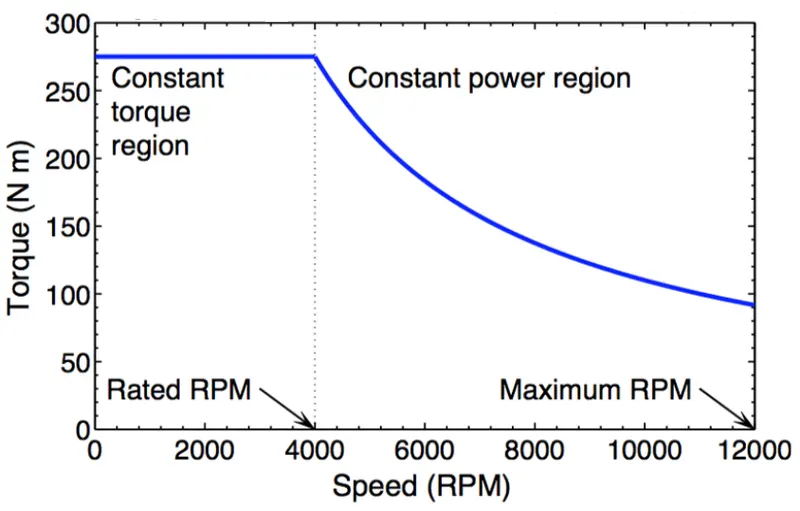
Electric motor can't develop braking torque at high speed similar to starting, because Braking torque is applied in the opposite direction of the rotation.
Regenerative braking:
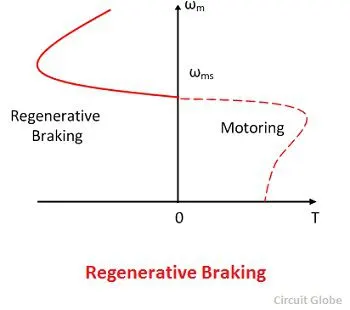
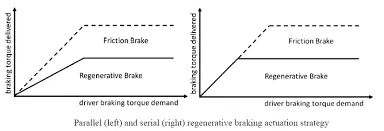
Regenerative braking which can effectively improve a vehicle's fuel economy by recuperating the kinetic energy during deceleration processes has been applied in various types of electrified vehicles as one of its key technologies. To achieve high regeneration efficiency and also guarantee vehicle brake safety, the regenerative brake should be coordinated with the mechanical brake. Therefore, the regenerative braking control performance can be significantly affected by the structure of the mechanical braking system and the brake blending control strategy. By-wire brake system, which mechanically decouples the brake pedal from the hydraulic brake circuits, can make the braking force modulation more flexible. Moreover, its inherent characteristic of ‘pedal-decouple’ makes it well suited for the implementation in the cooperative regenerative braking control of electrified vehicles. With the aims of regeneration efficiency and braking performance, a regenerative braking control algorithm for electrified vehicles equipped with a brake-by-wire system is researched in this paper. The layout of the adopted brake-by-wire system is introduced. The proposed regenerative braking control algorithm is illustrated. To validate the control performance of the algorithm, hardware-in-the-loop simulations are carried out. The simulation results show that, based on the brake-by-wire system, the proposed control algorithm, coordinating regenerative brake and hydraulic brake well, can further improve the regeneration efficiency of the electrified vehicle and guarantee the braking performance in the meantime
Friction braking:
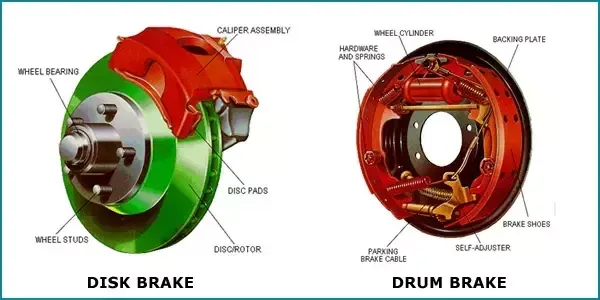
There are two kinds of service brakes, or the brakes that stop your vehicle while driving: disc and drum brakes. Additionally, almost all vehicles come with emergency brakes and anti-lock brakes.
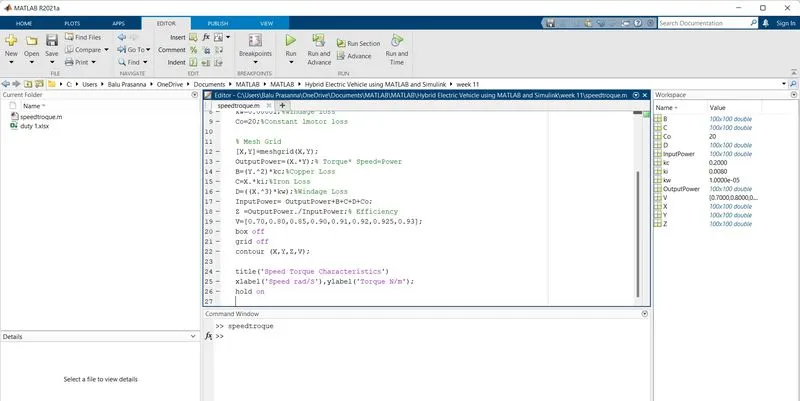
X=linspace(1,1000);% speed array
Y=linspace(1,250);% Torque Array
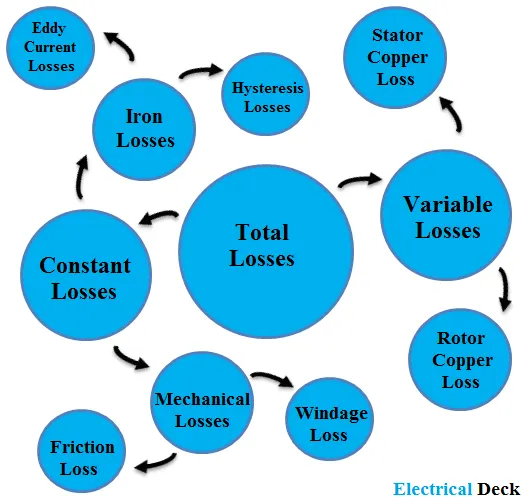
% Loss of Coefficients
kc=0.2;% Copper loss
ki=0.008;%iron loss
kw=0.00001;%windage loss
Co=20;%Constant lmotor loss
% Mesh Grid
[X,Y]=meshgrid(X,Y);
OutputPower=(X.*Y);% Torque* Speed=Power
B=(Y.^2)*kc;%Copper Loss
C=X.*ki;%Iron Loss
D=((X.^3)*kw);%Windage Loss
InputPower= OutputPower+B+C+D+Co;
Z =OutputPower./InputPower;% Efficiency
V=[0.70,0.80,0.85,0.90,0.91,0.
box off
grid off
contour (X,Y,Z,V);
title('Speed Torque Characteristics')
xlabel('Speed rad/S'),ylabel('Torque N/m');
hold on