Week-11 Challenge: Braking
EV_21-WEEK -11
1.For a defined driving cycle, calculate the energy required for braking
the equation of kinetic energy from braking is given as
E = 1/2m(Vi - Vf)^2
m= mass of the vehicle
Vi = initial speed of the vehicle
Vf = final speed of the vehicle
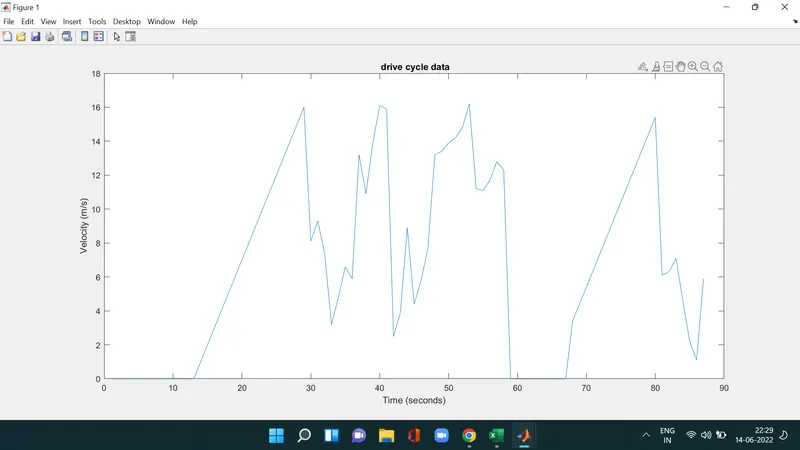
from drive cycle 10 braking points were obtained the mass is set at a constant 1500 kg the energy required for the braking is given below

therefore the total energy required for braking is 36.kw
2.Why electric motor can’t develop braking torque at high speed similar to starting? How electric and mechanical brakes are coordinated
in electric vehicles two types of braking systems are used electric brake system and mechanical brake system
electric braking system :-
in electric braking the winding of the motor is used to produce a braking torque a braking torque is developed during the braking operation this braking torque opposes the motion of the shaft this is achieved by suitbly changed the connections of the motor the motor operates on speed torque characterstics
An energy recovery device used to slow down a moving car otherwise an object by changing its energy from kinetic to another form to use immediately otherwise stored until required is known as regenerative braking. In this device, the energy can be recovered by using the moment of a car from an electric traction motor
mechanical braking system :-
in mechanical braking the frictional force between the rotating parts and brake drum produces the required braking to achieve this mechanical equipment such as brake linings and brake drumsare required whether electrical or mechanical the braking of the drive should stop the motor at specified point of the time and position
Mechanical brakes are assemblies consisting of mechanical elements for the slowing or stopping of shafts in equipment drives. They use levers or linkages to transmit force from one point to another. Braking slows or stops the movement of the coupled shafts. There are several types of mechanical brakes. Band brakes, the simplest brake configuration, have a metal band lined with heat and wear resistant friction material. Drum brakes, which are commonly used on automobile rear wheels, work when shoes press against a spinning surface called a drum. Disc brakes are constructed of brake pads, a caliper, and a rotor. During operation, the brake pads are squeezed against the rotor. Cone brakes are made with a cup and a cone, which is lined with heat and wear resistant material. During actuation, the cone is pressed against the mating cup surface.