Week-11 Challenge: Braking
1)Braking:-
Braking is the process of controlling the velocity of an object by inhibiting its motion.An object in motion possesses kinetic energy and to bring the object to a stop this kinetic energy must be removed.Removing the kinetic energy can be accomplished by diiipating the energy to the atmosphere throughfriction or by converting it into another form of energy.The most common type of braking is a mechanical brake which inhibits motion through friction brake pads.A mechanical brake applies a friction force to convert the kinetic energyof the vehicle into thermal energy which then dissipates into the atmosphere.Braking systems which don't use friction are referred to as Regenerative Braking Systems in RBS the kinetic energy is converted into other forms of useful energy, which can be stored for later use,increasing fuel efficiency
∑Ein=∑Eout
The energy present in an objecct invmotion is given by the following equation.
Ekinetic = 0.5*m*V^2
M-Mass of the object in kilogram(Kg)
V-Velocity of the object in meters per seconds(m/s)
Ekinetic-Kinetic energy in joules(J)
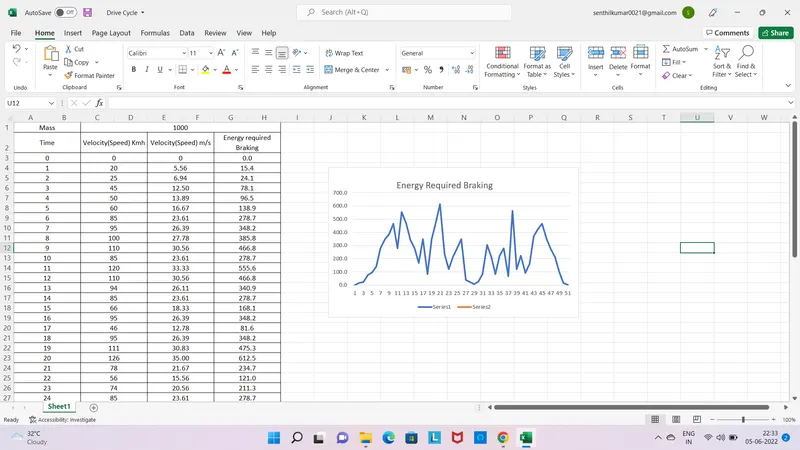
Braking Energy Calculation:-
2)Why electric motor can’t develop braking torque at high speed similar to starting? How electric and mechanical brakes are coordinated?
|
S. No. |
Mechanical Braking |
Electrical Braking |
|
1 |
Mechanical braking produces excessive wear and tear of brake block shoes of brake lining. Therefore, frequent replacement is necessary. |
No such need |
|
2 |
Due to constant wear and tear of brake lining frequent adjustments are necessary to compensate the offset error, therefore is costly |
Less maintenance |
|
3 |
Produce metal dust causing wearing of bearings |
No such a dust is formed |
|
4 |
If they are not correctly adjusted the sudden braking action produce shock, this result in discomfort to passengers |
Adjustment is easy and braking action is gradual and smooth |
|
5 |
Heat is produce in brake shoes of brake lining, which may damage the lining and may result in failure of braking system. |
Heat is produce at a convenient place which is no way harmful to braking system. |
|
6 |
No such possibility |
60 to 80 % kinetic energy of apparatus can be fed back to line in regenerative brake. |
|
7 |
Mechanical braking alone can be used |
Electrical braking is alone not sufficient, it is to be supplement by mechanical braking. |
|
8 |
Low Cost |
High Initial cost |
What is regenerative braking?
Moving vehicles have a lot of kinetic energy, and when brakes are applied to slow a vehicle, all of that kinetic energy has to go somewhere. Back in the Neanderthal days of internal combustion engine cars, brakes were solely friction based and converted the kinetic energy of the vehicle into wasted heat in order to decelerate a car. All of that energy was simply lost to the environment.
Fortunately, we have evolved as a species and developed a better way. Regenerative braking uses an electric vehicle’s motor as a generator to convert much of the kinetic energy lost when decelerating back into stored energy in the vehicle’s battery. Then, the next time the car accelerates, it uses much of the energy previously stored from regenerative braking instead of tapping in further to its own energy reserves.
It is important to realize that on its own, regenerative braking isn’t a magical range booster for electric vehicles. It doesn’t make electric vehicles more efficient per se, it just makes them less inefficient. Basically, the most efficient way to drive any vehicle would be to accelerate to a constant speed and then never touch the brake pedal. Since braking is going to remove energy and require you to input extra energy to get back up to speed, you’d get your best range by simply never slowing down in the first place.
But that obviously isn’t practical. Since we need to brake often, regenerative braking is the next best thing. It takes the inefficiency of braking and simply makes the process less wasteful.
How well does regenerative braking work?
To evaluate regenerative braking, we really need to look at two different parameters, efficiency and effectiveness. Despite sounding similar, the two are quite different. Efficiency refers to how well regenerative braking captures ‘lost’ energy from braking. Does it waste a lot of energy as heat, or does it turn all of that kinetic energy back into stored energy? Effectiveness, on the other hand, refers to how large of an impact regenerative braking really makes. Does it measurably increase your range, or will you not notice much of a difference?
Efficiency
No machine can be 100% efficient (without breaking the laws of physics), as any transfer of energy will inevitably incur some loss as heat, light, noise, etc. Efficiency of the regenerative braking process varies across many vehicles, motors, batteries and controllers, but is often somewhere in the neighborhood of 60-70% efficient. Regen usually loses around 10-20% of the energy being captured, and then the car loses another 10-20% or so when converting that energy back into acceleration, according to Tesla. This is fairly standard across most electric vehicles including cars, trucks, electric bicycles, electric scooters, etc. Keep in mind that this 70% does not mean that regenerative braking will give an 70% range increase. This isn’t going to bump your range from 100 miles to 170 miles. This simply means that 70% of the kinetic energy lost during the act of braking can be turned back into acceleration later.
Coordination of Electric mechanical Brake:-
In a electric moor the total brake distribution in two aspects which are Electrical Brake its called Regenerative Brake and Mechanical brake or classical brake with hydralic cylindrical system.Brake force distribution must be uniform,if the regenerative braking power requirement is more thanthe charging limit of the battery or more than regenerative capacity of the machine we must apply mechanical brakes as well.In practical case the combinationof these two is applied.So usually it is combined response of mechanical brake and Regenerative brake.The reason for how these brake force are combined ,that particular is called Brake control strategies There are two Brake control Strategies
Series:-
In case of series we apply mechanical brake and Regenerative electric brake one after another.We can apply only one brake strategy at atime either apply Regenerative or apply Mechanical Brake.This Series Brake Control Strategy has further classification, that is based on whether we want comfort of driver or brake behaviour compared to energy efficiency.
Parallel:-
In case of parallel we apply both brakes simultaneously This particular parallel braking is going to happen both at a time.
Electric Driven Intelligent Braking System:-
Electric Driven Intelligent system works, Most of the power brake systems derive vacuum from the engine intake manifold and use this energy to apply brake force which greatly reduces driver’s pedal force and brakes become highly responsive and easy to operate. One major disadvantage of this system is that it puts load on the engine since the braking energy is extracted from the engine. Also the energy lost in stopping the car almost all goes waste in conventional braking systems.
In the Electric Driven Intelligent Braking System, the braking force is provided with the help of a ECU controlled motor and ball screw arrangement. This means that no direct load on the engine while applying brakes. This means that a motor operated the brake for providing the braking energy. A more controlled and uniform braking force is applied since its ECU controlled, this helps to recover braking losses when a regenerative braking system is used.
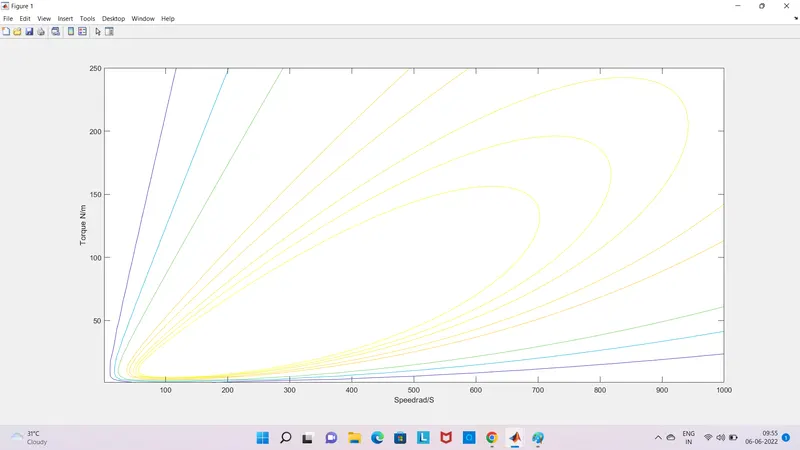
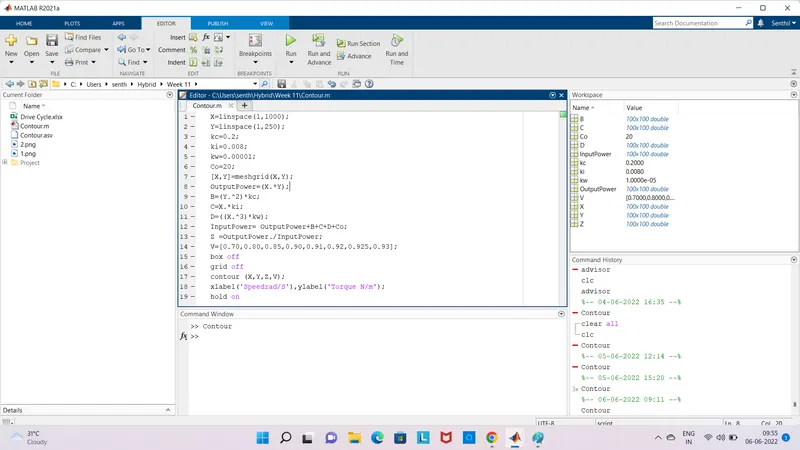
3)Make a MATLAB program which plots contour of given motor speed, torque and efficiency values. Attach the code as a .m file attach a screenshot of all the plots.
X=linspace(1,1000);% speed array
Y=linspace(1,250);% Torque Array
% Loss of Coefficients
kc=0.2;% Copper loss
ki=0.008;%iron loss
kw=0.00001;%windage loss
Co=20;%Constant lmotor loss
% Mesh Grid
[X,Y]=meshgrid(X,Y);
OutputPower=(X.*Y);% Torque* Speed=Power
B=(Y.^2)*kc;%Copper Loss
C=X.*ki;%Iron Loss
D=((X.^3)*kw);%Windage Loss
InputPower= OutputPower+B+C+D+Co;
Z =OutputPower./InputPower;% Efficiency
V=[0.70,0.80,0.85,0.90,0.91,0.92,0.925,0.93];
box off
grid off
contour (X,Y,Z,V);
title('Speed Torque Characteristics')
xlabel('Speed rad/S'),ylabel('Torque N/m');
hold on
Output:-