Week-11 Challenge: Braking
1.Enery required for braking is calculated as follows
E=0.5*m*(v2-v1)^2 where
E= energy in jouls
m=mass in kg
v2 =initial speed in meters/sec
V1=final speed in meters/sec
output graph is as below
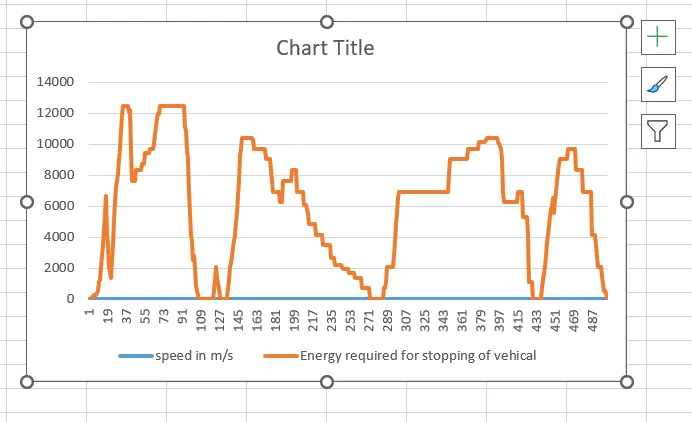
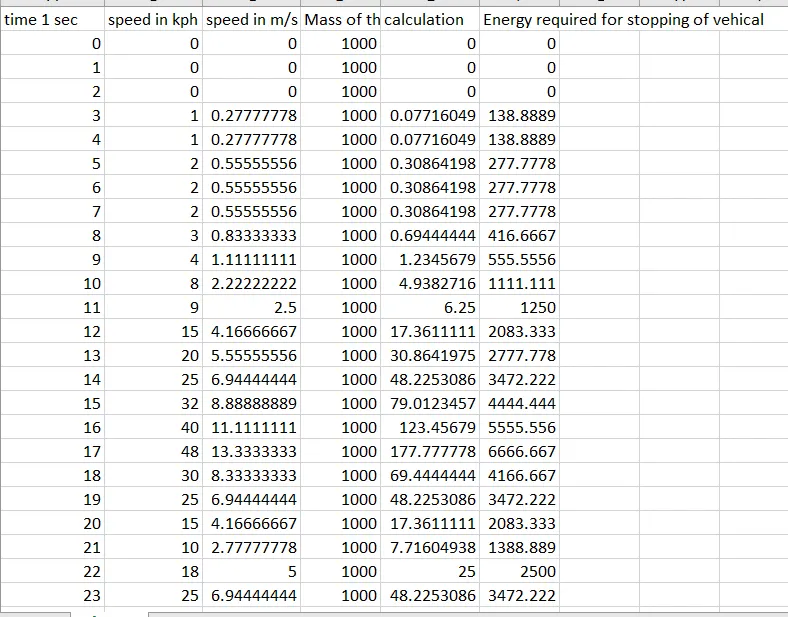
actual calculation is attached with excel sheet
2.Electric motor can’t develop braking torque at high speed similar to starting beacuse, Here for both in case of AC or DC there is no torue at max speed torque decrearses at high speed .This Situation dones not occure at the beggining of acceleration because most of the torque is used to increase the kinetic energy of the load .but when speed is high and no extra load is applied it is not possible to increas the torque as well as to develop braking torque.the braking operation happens in the motion which is been distributed as per prportin in the brake energy and the regenerative braking.
Most brakes use friction on the two sides of the wheel, the collective press on the wheel converts the kinetic energy of the moving object into heat. For example, regenerative braking turns much of the energy to electrical energy, which may be stored for later use. Eddy current brakes use magnetic fields to turn kinetic energy into electrical current in the brake disc, blade, or rail, which is converted into heat.
There Two type braking happens
1.Mechanical
2.Electrical
1. Mechanical
DISC BRAKE
The disc brake is a mechanism for slowing or stopping the rotation of a wheel from its motion. A disc brake is normally made of cast iron, but in some cases, it is also made of composites such as carbon-carbon or ceramic -matrix composites. This is linked to the wheel and/or the axle. To stop the wheel, friction material in the form of brake pads is forced against both sides of the disc. Friction caused, on the disc wheel will slow or stop.
DRUM BRAKES
A drum brake is a traditional break in which the friction is caused by a set of shoes or pads that press against a rotating drum-shaped part called a brake drum.
The term \"drum brake\" usually means a brake in which shoes press on the inner surface of the drum. Where the drum is pinched between two shoes, similar to a standard disk brake , it is sometimes called a \"pinch drum brake\", although such brakes are relatively rare.
1.Electrical
Electromagnetic braking systems can be found in many modern and hybrid vehicles. The electromagnetic braking system uses the principle of electromagnetism to achieve frictionless braking. This serves to increase the life span and reliability of brakes. Also, traditional braking systems are prone to slipping while this is backed with the quick magnetic brakes. So without friction or need of lubrication, this technology is preferred in hybrids. Also, it is quite modest in size compared to the traditional braking systems. It is mostly used in the trams and trains.
To make electromagnetic brakes work, a magnetic flux when passed in a direction perpendicular to the rotating direction of the wheel, we see rapid current flowing in a direction opposite to the rotation of the wheel. This creates an opposing force to the wheel rotation and it slows down the wheel
Regenerative braking is an energy recovery mechanism that slows down a moving vehicle or object by converting its kinetic energy into a form that can be either used immediately or stored until needed. In this mechanism, the electric traction motor uses the vehicle's momentum to recover energy that would otherwise be lost to the brake discs as heat. This contrasts with conventional braking systems, where the excess kinetic energy is converted to unwanted and wasted heat due to friction in the brakes
Electrical and Mechanical break coordinated in 2 way
1 series
Im this Electrical brakes are used first and as the need arrives mecanical breaks are applied hence the name series braking
2.Parallel
In the Both Electrical and Mechanical breaks are applied togather
3.