Week-11 Challenge: Braking
1.For a defined driving cycle, calculate the energy required for braking.
Ans:
we know the braking energy=diffeerence in kinettic energy
=KE initial -KE final
=0.5*mass*Vinitial^2-0.5*mass*Vfinal^2 where V=velocity of the vehicle
breaking occure within few seconds so we can rewrite the equation as
=0.5*mass(Vinitial-Vfinal)^2
to find braking period we have to compare velocity if initial value is greater than the final value ,its time for braking
we defined a drive cycle in excel and loaded the value to matlab then calculated the energu during braking
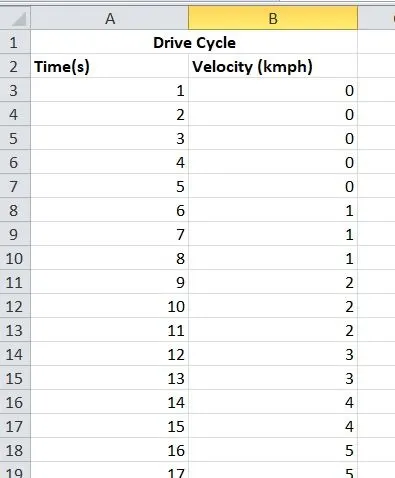
we developed a matlab program for calculating braking energy for defined drive cycle ,
clc;
clear all;
drivecycle=xlsread("DriveCycle.xlsx"); %loading excel sheet to workspace
t= drivecycle(:,1); %loadingfirst column of excel sheet to variable t
v =(5/18)*drivecycle(:,2); %loading velocity and converting kmph to mps
m=1500;
for i=1:(length(drivecycle)-1);
    if v(i)>v(i+1)
       E(i)=(0.5*m*(v(i)-v(i+1))^2); %calculating braking energy in joule for each braking
       end
end
Brak_Energy=sum(E)/1000;%adding each braking energy and converting to kiloJoule
 plot(t,v);%ploting drive cycle
 xlabel('time in sec')
 ylabel('velocity in m/s')
 title('DriveCycle')
 fprintf('The total braking energy for given drive cycle  %d kJ',Brak_Energy);
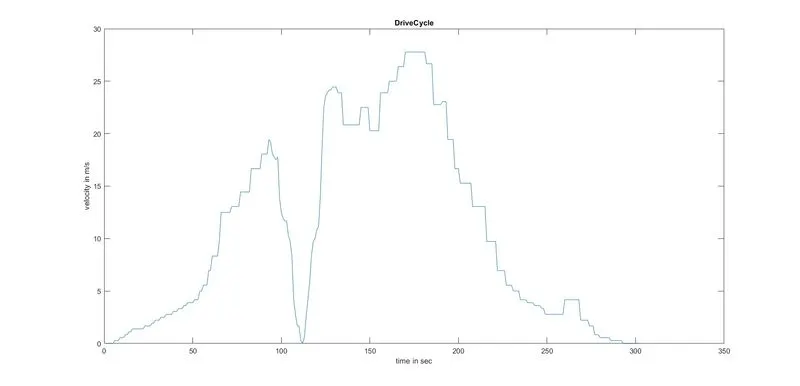
Output:after running the program we got the braking energy=98.6kJ for given drive cycle and we plotted the drive as shown below

2.Why electric motor can’t develop braking torque at high speed similar to starting? How electric and mechanical brakes are coordinated?
Ans:
A)
Regenerative braking is a unique technique that is used in EVs to capture energy that the vehicle has due to its motion or, in other words, its kinetic energy that would have been wasted when the vehicle decelerates or comes to a standstill while braking. By taking a measure of the initial and final vehicle velocity, the amount of kinetic energy that is lost to braking can be calculated.Electrical energy recovery systems are at their core, based on a motor/generator (electric machine) driven from the kinetic energy of the moving vehicle. The electricity generated is used to charge a battery, and then fed back to the machine in the acceleration phase. The energy is transformed from kinetic energy to electrical energy, and then to chemical energy in the regenerative braking phase. These transformations occur in reverse during acceleration. Due to the large number of energy conversions, electrical regeneration has a relatively poor round-trip efficiency, even in the most efficient systems
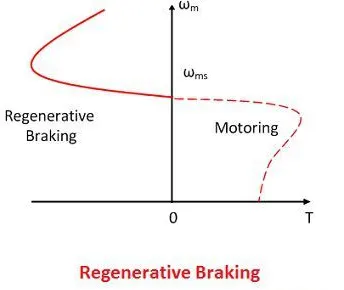
In addition to regenerative brakes, all vehicles are equipped with conventional friction brakes which can be used when rapid deceleration is required. As Regenerative braking is just not enough to stop a vehicle in every situation, especially when driving at higher speeds.During generative braking periodmotor rotates in reverse direction and act as a generator ,it created a back emf in the machine ,The value of back emf become very high when the motor speed in reverse direction become high it reduces the voltage delivered.At the time of starting the motor speed is zero and all electricity created by the motor by tn thhe application of electric power becomes instat torque ,during starting there is no back emf is presented to reducing the torque ,The reason behind this is no matter how much the current loop increases ,proportional to torque by increasing the pulse width modulation duty cycle of the power stage,the voltage developed by the motor is too close to backemf value and current cant incrases.So the peak acceleration torque is greater than the peak decceleration torque,ie ev motorcan’t develop braking torque at high speed similar to starting.
B)
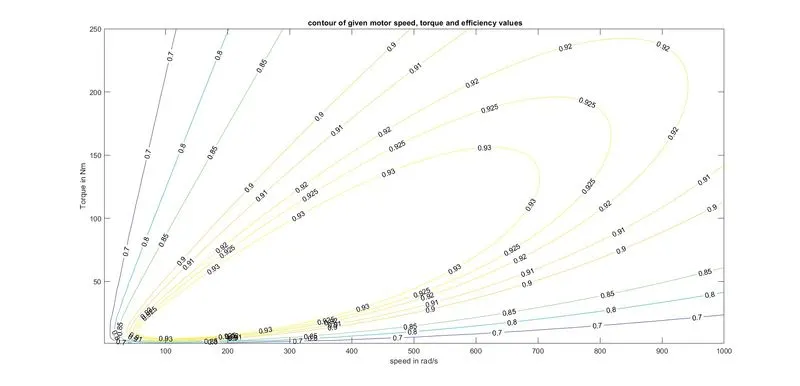
3.Make a MATLAB program which plots contour of given motor speed, torque and efficiency values. Attach the code as a .m file attach a screenshot of all the plots.
Ans:
we know there is several losses take place in motor ,are copper loss ,iron loss,windage loss
T=torque in Nm and w is speed in rad/s
copper loss=kc*T^2
iron loss=ki*w
windage loss=Kw*w^2
constant loss=C,we can find it by experiment
output=torque*speed in rad/s
input=output+losses
efficiency=output/input
Then we can write the program as
clc;
clear all;
x=linspace(1,1000);          %speed  in rad/s
y=linspace(1,250);           %torque in Nm
kc=0.2;                      %constant of copper loss
ki=0.008;                    %constant of iron loss
kw=0.00001;                  %constant of windage loss
ConL=20;                     %constant motor loss value
[X,Y]=meshgrid(x,y);
Outputpower=(X.*Y);          %power=torque*speed
B=(Y.^2)*kc;                 %copper loss
C=X*ki;                      %iron loss
D=(X.^3)*kw;                 %windage loss
Inputpower=Outputpower+B+C+D+ConL;    %calculating input power
Z=Outputpower./Inputpower;            %calculating efficiency
V=[0.70,0.80,0.85,0.90,0.91,0.92,0.925,0.93];
box off
grid off
[a,b]=contour(X,Y,Z,V);        %ploting contour
xlabel('speed in rad/s');      %giving x axis variable name
ylabel('Torque in Nm');        % giving y axis variable name
clabel(a,b);                   %giving contour plot values
title(' contour of given motor speed, torque and efficiency values')
Output:we plots contour of given motor speed, torque and efficiency values and plot is shown below