Week-11 Challenge: Braking
Question:1
Aim: For a defined driving cycle, To calculate the energy required for braking
Answer:
Drive cycle:
The drive is defined as the series of the data points representing the speed of a vechicle vs time ,here mainly the driving cycle is produced by the different countries to know the performance of the vehicles in different ways.
Example:
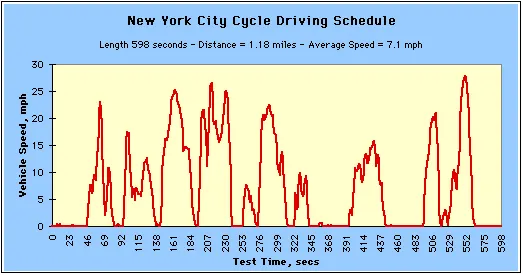
The above figure shows the example of the New york city cycle driving
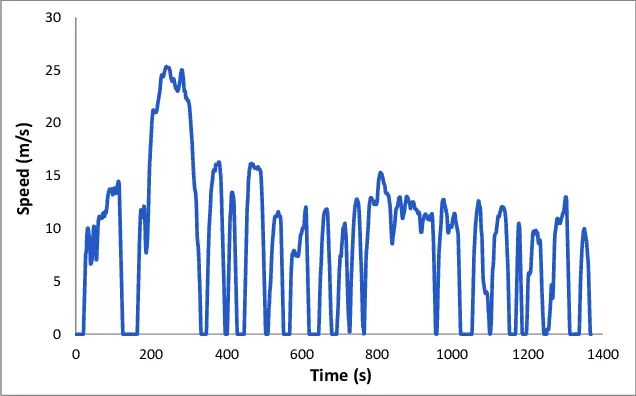
Here we are using the knetic energy formula to calculate the results
E=1/2mv^2
were m is the mass and v is the velocity
In case if the speed decreased from intial velocity Vi to final velocity Vf the required formula is given by:
E= 1/2m(Vi^2-Vf^2)
were vi = intial velocity and Vf = final velocity
so here we assuming the mass m = 2500kg and intial velocity will be =120 and final velocity = 0
0.5*2500*120
= 150000
The energy required for braking is 150000

Question:2
Aim: To know why electric motor can’t develop braking torque at high speed similar to starting? How electric and mechanical brakes are coordinated?
Answer:
Mainly here the braking is process of reducing the speed of an induction motor in the braking the motor work as generator by developing the negative torque which opposes the motion of a motor so the braking of an motor is mainly classified innto three types they are
1) Regenrative braking
2) Plugging or reverse voltage braking
3)Dynamic Braking
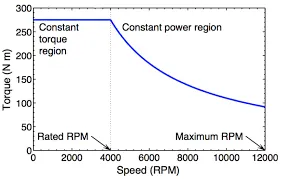
The eletric motor cannot develop braking torque at high speed simmilar to starting because the Braking torque is applied in opposite direction to the rotation.But we can use a mechanical brake to profuce the braking torque.
In this situation it does not occur at the starting of an acceleration because most of the torque is used in to increase the kinetic energy of the load ,but here when the speed is already high and there is no any load is applied so it is not possible to increase the torque.
Necessity of braking :
If you are moving in a vehicle the most important safety system is braking it is the ability to stop or slow down or stop accidents that occurs commnly.so braking is necessary to stop the running motor at instant.
Types of braking systems :
1) Series braking :
It is a braking control strategy based upon the hybrid power mainly a regenerative brsking system which restores the kinetic energy and potential energy to a battery or in any other forms od the power durimg the braking in a special sysytem for electric and hybrid electric vehicles.
2) Prallel braking:
This are already used in EVS and HEVs the variation of this strategy estabilish the regeneration some of the vehicle kinetic energy during the braking activity
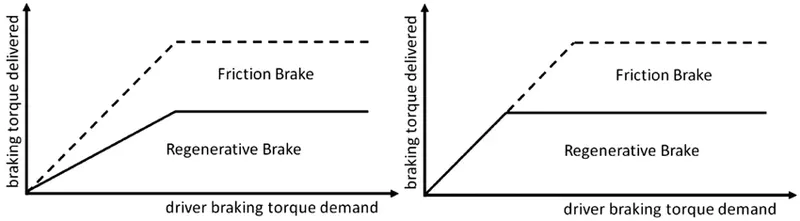
How electric and mechanical brakes are coordinated
- Mainly in the electric motor the braking system is divided into two stages i.e 1) electrical braking aslo called as rengerative braking,2) mechanical braking are aslo called as the hydraulic system
- Here the braking division must be in the uniform so that the regnerative braking power requriment is more then the capacity of the motor
- so in this case we must need to apply the mechanical braking as well as so this combined braking is used practically.
- Here mechincal and rengeratvie braking had combined response so by this reason the braking forces are combined and this process is called as the brake control strategies.
- The two brake control may be in series if we apply mechincal braking and regenrative braking one by one.
- here we can apply only any one of the braking at a time
- But in parallel we apply the two brakes at same time .
- It is the combination of the hydraulic brakr mechincal brake ,regenrative brake
- In this parallel we use regenrative braking at low speeds and at higher and starting we use combined both the brakes.
Question:3:
Aim:To Make a MATLAB program which plots contour of given motor speed, torque and efficiency values. Attach the code as a .m file attach a screenshot of all the plots.
Program:
clc
w = linspace(0,1500);
T = linspace(0,300);
% motor constants
Kc = 0.6; % for copper loss
Ki = 0.010; % for iron loss
Kw = 0.00005; % for windage loss
conL = 25; % for constant motor losses
% making mesh
[X,Y] = meshgrid(w,T);
Outputpower = (X.*Y); % Torque*speed = power
B = (Y.^2)*Kc; % copper loss
C = (X.^3)*Kw; % winding loss
D = X*Ki; % iron loss
Inputpower = Outputpower+B+C+D+conL;
Z = Outputpower./Inputpower;
% set the efficiencies for which the contours will be plotted
V = [0.72 , 0.76 , 0.81 , 0.84 , 0.86 , 0.88 , 0.90 , 0.10];
box off
grid off
contour(X,Y,Z,V) ;
colorbar
xlabel('speed(rad/s)')
ylabel('Torque(N.m)')
hold on
V = [6000,10000];
contour(X,Y,Outputpower,V);
output results:
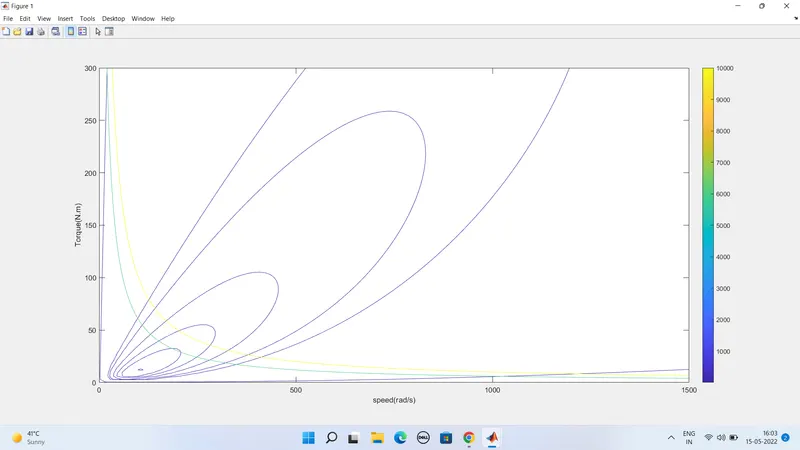
In the above figure the colourbars shows the efficiency values
Conclusion:
we have succesfully complted the given tasks
In case 1: we have calcutaled the energy required for braking.
In case 2: we have studied why electric motor can’t develop braking torque at high speed similar to starting and also How electric and mechanical brakes are coordinated
In case 3: we have made a MATLAB program which plots contour of given motor speed, torque and efficiency values. and also Attached the code as a .m file attach a screenshot of all the plots