Week-11 Challenge: Braking
- For a defined driving cycle, calculate the energy required for braking. A; As we know that the energy can never be created or niether destroyed with the today's development
we have been able to utilize the energy which is been wasted at the time of braking. The kinetic energy which assist the vehicle to
move also gets dissipated while the braking is done. Though it depends on multiple parameters on how efficient the braking would be
it can be depended upon.
Number of Brake Pistons
Duration and Degree of Brake Pedal been Pressed Road Condition
Temprature
Brake Pad and Disc Condition
Mass of the Vehicle
Still with a basic operation where the vehicle in motion and the brakes are applied the same efficiency. given equations.
BE=1/2mv^2 BE = braking energy
m = mass of the vehicle
v = velocity
.In this manner the same calculation is been carried out for calculating the brake efficiency that would be required at the peak point. It
bieng a drive cycle with speed variations the braking power required would vary but still the highest braking power required is
mentioned below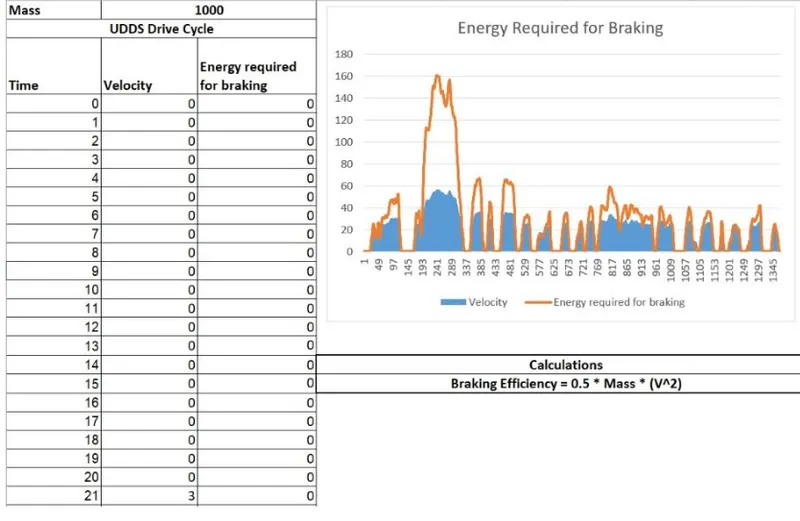 2. Why electric motor can’t develop braking torque at high speed similar to starting? How electric and mechanical brakes are coordinated A; When the motor is at rest and it has to operate from standstill position to the reach the moderate speed the higher torque is required
to bring the motor in operation. Whereas when the vehicle is already at high speed the capping or the limit is reached by the motor
operation and thus any further higher torque could not be obtained while braking. The braking operation happens in the motion
which is been distributed as per proportion in the BRAKE ENERGY and the REGENERATIVE BRAKING. In Mechanical braking which we usually see and experience in all vehicles the brake pedal in the vehicle cabin helps us to engage or
disengage the brakes. Currently the braking technology have done wonders by inventing life saving braking technologies such as
ABS, EBD, BA and mny others. All these technologies play vital role in stopping the vehicle and coming back to rest from a high speed.
In all these vehicles when the driver applies the brakes the brake peds come closer to the disc connected with the driving disc. The
brake pads usually help in efficient braking There are two generic methods by which the vehicle could be braked in the ELECTRIC BRAKES.
Series - The Regenerative Braking or the Mechanical Braking noth are applied one after another.
Parallel - The Regenerative Braking or the Mechnical Braking both are applied Parallely.
.When the brake pedal is pressed the hydraulic fluid reaches the brake piston and created the braking pressure on the wheels and the
same kinetic energy is been used by the Regenerative Braking for generating more power using the Bi-directional motor which
operates as a generator while braking.
An example of the proposition of Regenerative Braking and the Mechanical Braking
NISSAN LEAD - EDIB (ELECTRONIC DRIVEN INTELLEGENT BRAKING)
.EDIB (Electric Driven Intelligent Brake) controls the regenerative brake and friction brake to support both of these requirements.
Further, it also controls the reactive force from the pedal in order to unify the feeling when stepping down on the pedal and the sense
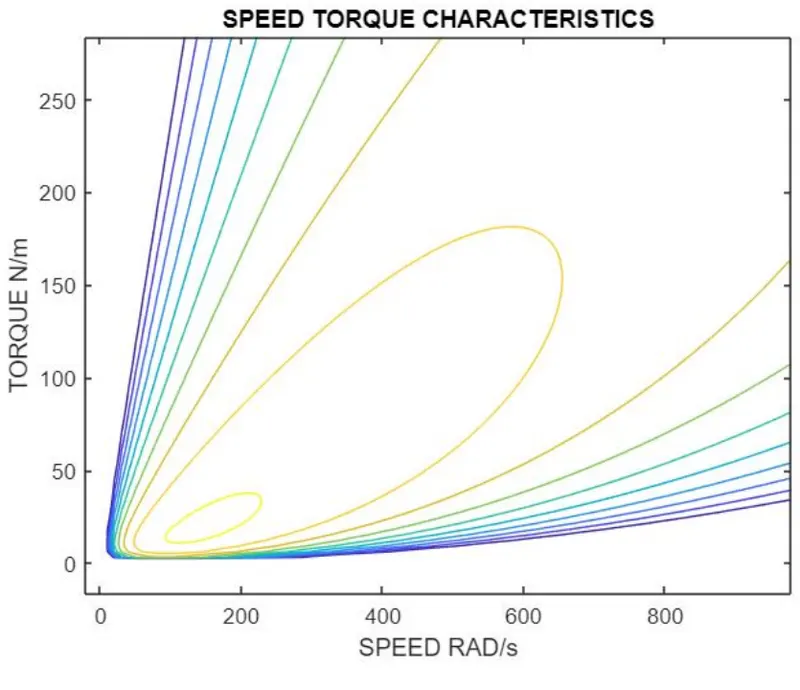
of deceleration. 3. Make a MATLAB program which plots contour of given motor speed, torque and efficiency values. Attach the code as a .m file attach a screenshot of all the plots A. As we Know contour is a graphical technique of representing 3-dimensional surface. The same is mentioned below for the given
details % A MATLAB PROGRAMM FOR PLOTTING CONTOUR PLOT OF MOTOR SPEED, TORQUE
clear all
close all
clc
% SPEED ARRAY
w = linspace(0,1000)
% TORQUE ARRAY
T = linspace(0,300)
% LOSS COEFFICIENTS
kc = 0.18; % COPPER LOSSES
ki = 0.006; % IRON LOSSES
kw = 0.000015; % WINDAGE LOSSES
% MESHGRID
[X,Y] = meshgrid(w,T)
copper_loss = (Y.^2)*kc
iron_loss = X*ki
wiindage_loss = (X.^3)*kw
cons = 20
o_p = X.*Y
input_power = (copper_loss)+(iron_loss)+(wiindage_loss)+(o_p)+cons
Eff = (o_p)./(input_power)
n = linspace(0.7,0.95,10)
box off
grid off
contour(X,Y,Eff,n)
title('SPEED TORQUE CHARACTERISTICS')
xlabel('SPEED RAD/s')
ylabel('TORQUE N/m') OUTPUT ;