Week-11 Challenge: Braking
1) For a defined driving cycle, calculate the energy required for braking.
-When it comes to vehicles safety, braking performance is one of the most important aspects. The function of the braking system of a vehicle is to bring it to rest from speed, within a spesific time or distance when ever desired by the drive in safety conditions. This is achiefed by applying engine brakes and mechanical brakes for ICE vehicles or by applying Regerative braking and mechanical braking system in EV and HEV. However this all depends on the amount of enery required by the vehicle to come to rest or slow down in a given distance and speed. In some case just one type of braking will be required (Just engine braking for ICE) or (just regenerative braking for EV and HEV) because the energy required and the braking distance is sufficient enough but when the ernegy required is high and the braking distance is to small then both braking system will be used to deccelerate the vehicle (engine brakes and mechanical brakes for ICE) or (regenerative braking and mechanicla brakes for EV and HEV).
The same amout of energy required for accelerating from 0 to X speed is the same amount of enery used to brake from X speed to 0. However not all of these enery can be regenerated in electric vehicle cause some of it will be lost in heat and depeneding on the inverty circuit just a part of these enerygy will be recoverd. Below is the calculation of the amout of enery required to brake a vehicle in de drive cycle below.
E = 0.5*m*(Vi-Vf)^2
where Vi = initial velocity and Vf = final velocity.
for decceleration to take place Vf has to smaller than Vi
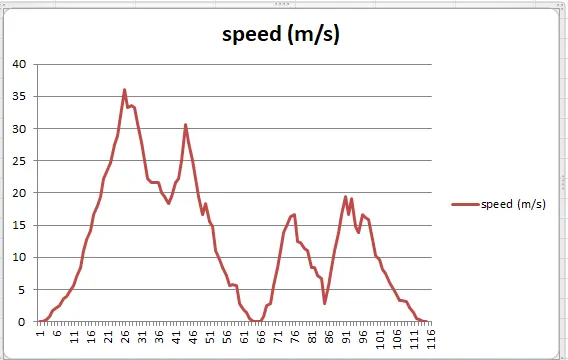
*To calculate the energy required for braking by defined driving cycle, a drive cycle was created in excel as shown below.
*The enrgy required at each speed to slow down the vehicle is as shown below on the D row.

*The drive cycle plot is show below
2) Why electric motor can’t develop braking torque at high speed similar to starting? How electric and mechanical brakes are coordinated?
-Brake torque is the force applied at the brake wheel to stop the motion of the moving vehicle. The force exerted by the caliper, multiplied by the effective radius of the system equals the brake torque. Increasing either the force applied by the caliper, or the effective radius results in increased brake torque.
-At above base speed the torgue value is compromised and the in regenerative braking the motor is opperating in field weakening region hence the braking torgue will be lower.
How electric and mechanical brakes are coordinated?
Brakes in general is a mechanical device from a moving system which absorbs energy and inhibits motion. It is used for reducing the speed of a wheel or axle. It works by means of friction. In Ev and HEV we have 2 main braking systems Mechanical or friction brakes and Regenerative Brakes. Both of this braking systems serve the purpose of slowing down or completly stopping the vehicle in a desireable time and in save contitions.
-Friction braking can quickly slow down or stop the vehicle in comparison to regenerative braking but no energy is gained in the proces while regenerative braking could convert the kinetic and potential energy of the moving vehicle and store them in battery.
-The electric motor in your HEV or EV runs in two directions, one to drive the wheels and move the car, and the other to recharge the battery. When you lift your foot off the accelerator pedal and onto the brake, the motor swaps directions and starts to put energy back into the battery.
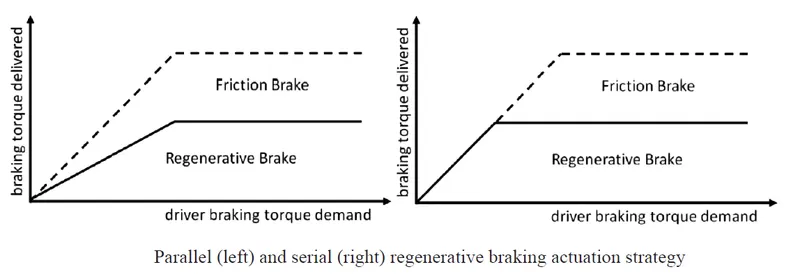
*When the driver places his foot on the brakes to slow down the vehicle at the same time motor swaps direction and opperates as a generator. The proces of slowing down the vehicle has been approched in two different was by car manufactures. Serial and Parallel application of mechanical and regenerative brakes.
Serial Regenerative braking:
Serial regenerative braking is based on a combination of friction braking system with a regenerative braking system that transfers energy to the electric motors and batteries under an integrated control strategy. The overall design is to estimate the deceleration required by the driver and distribute the required braking force between the regenerative braking system and the mechanical braking system.
Parallel Regenerative braking:
Parallel braking system is based on a combination of friction braking system and the regenerative braking system, operated in tandem without an integrated control. Both braking system do not opprerate at the same time. The regenerative torque is determined by considering the motor capacity, battery state of charge SOC, and vehicle velocity. The regenerative braking force is calculated from the brake control unit by comparing the demanded brake torque and the motor torque available.
Electric Driven Intelligent Brakes (EDIB):
In the Electric Driven Intelligent Braking System, the braking force is provided with the help of a ECU controlled motor and ball screw arrangement. This means that no direct load on the engine while applying brakes. This means that a motor operated the brake for providing the braking energy. A more controlled and uniform braking force is applied since its ECU controlled, this helps to recover braking losses when a regenerative braking system is used.
3) Make a MATLAB program which plots contour of given motor speed, torque and efficiency values. Attach the code as a .m file attach a screenshot of all the plots.
- A Motor has various type of losses when its on. This losses include include
* Copper Losses: Copper loss refers to loss occurring due to the electrical resistance of current flowing through a winding. Copper losses are due to the resistance of the wire in the primary and secondary windings and the current flowing through them.
-These losses can be reduced by using wire with large cross-sectional area in the manufacturing of the coils. The rotor copper loss is calculated by subtracting the stator copper loss from the total measured loss or the rotor I2R loss.
-Copper loss is considered as as.kc-T^2 where kc is brushes resistance constance.
Copper losses = as.kc.T^2
* Iron Losses: this are simple magnectic losses. It is denoted as k .w , where k factor is based on the magnectic fiel effect. hence different speed produce different back emf which affecst the iron loss.
iron loss = ki.w
* Windage Losses: Windage is the name usually given to air resistance inside rotating electrical machines like generator or motors. Windage losses also occur in machines such as turbines and gearboxes.When the shaft rotates, it displaces air. This incurs an expenditure of energy which is called windage loss. it represents a loss of power., it is based on motor size and shape.
Windage losses = kw.w^3
-Hence total losses = kc.T^2 + ki.w + kw.w^3 + C where C is loss constant
clear all;
close all;
clc
% plot of motor speed , torgue and efficiency
Speed = linspace(1,1000); %motor speed
Torgue = linspace(1,250); %motor Torgue
%Motor constant
Kc = 0.2; %copper loss
Ki = 0.008; %iron loss
Kw = 0.00001; %windage loss
C = 20; %constant motor loss
%meshing
[S,T]=meshgrid(Speed,Torgue);
OutPower = (S.*T); %Calculating power
%Motor Losses calculations
Cu = (T.^2)*Kc; %Copper losses
Fe = S*Ki; %iron losses
W = (S.^3)*Kw; %windage losses
Inpower = OutPower+Cu+Fe+W+C;
Efficiency = OutPower./Inpower;
%Efficiency is use to plot Contour
V = [0.70,0.74,0.79,0.80,0.85,0.90,0.91,0.92,0.93];
contour(S,T,Efficiency,V)
xlabel('Speed(rad/s)')
ylabel('Torgue(Nm)')
title('Motor Speed-Torgue Efficiency Caracteristics')
hold on
contour(S,T,OutPower,V)
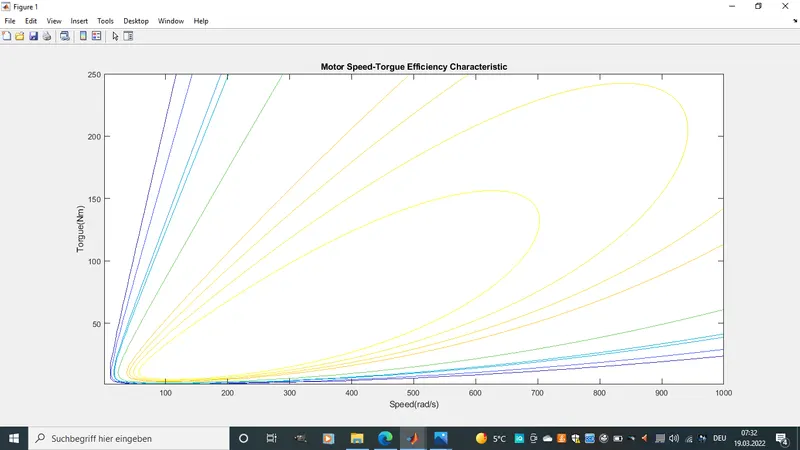
*The Efficiency is higher at the center (The smaller circle) compared to the outermost circles. As the circle moves outer we experience lesser or reduction in efficiency. Efficiency decreases with increase in motor torgue speed charactheristics.