Week-11 Challenge: Braking
Q.1. For a defined driving cycle, calculate the energy required for braking.
Ans : Here we have taken some random values for drive cycle
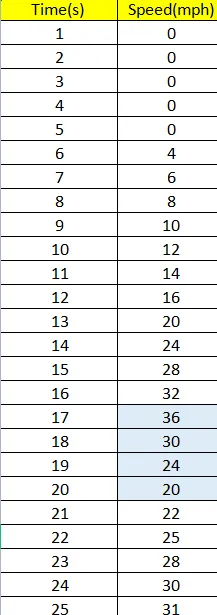
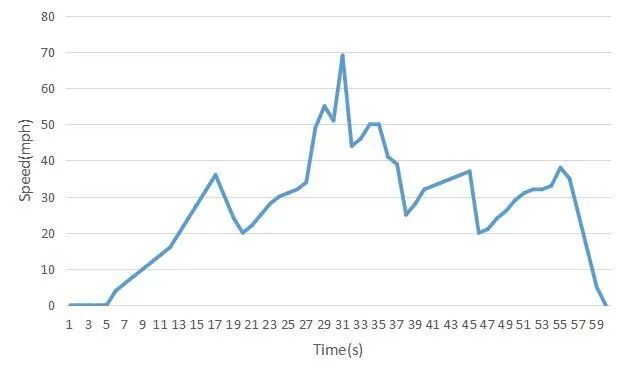
The Excel file attached below and with this data we have plotted a grapg between time and speed(mph). The speed mph converted into mps for calculation
Calculations

where,
Mass = 1000Kg (assume)
6 decelerations were made during this drive cycle, so 6 braking energy is to be calculated and sum it up to get total braking energy for 60sec duration.
- 36 to 20mph = 16.09 to 8.94mps = 1/2 * 1000 * ( 16.09 - 8.94 )^2 = 25.56KJ
- 55 to 51mph = 24.58 to 22.79mps = 1/2 * 1000 * ( 24.58 - 22.79 )^2 = 1.60KJ
- 69 to 44mph = 30.84 to 19.66mps = 1/2 * 1000 * ( 30.84 - 19.66 )^2 = 62.49KJ
- 50 to 25mph = 22.35 to 11.17mps = 1/2 * 1000 * ( 22.35 - 11.17)^2 = 124.99KJ
- 37 to 20mph = 16.54 to 8.94mps = 1/2 * 1000 * ( 16.54 - 8.94 )^2 = 28.88KJ
- 38 to 00mph = 16.98 to 0mps = 1/2 * 1000 * ( 16.98 - 0 )^2 = 144.16KJ
Total Braking Energy = 25.56 + 1.60 + 62.49 + 124.99 + 28.88 + 144.16
Total Braking Energy = 387.68KJ
Q.2. Why electric motor can’t develop braking torque at high speed similar to starting? How electric and mechanical brakes are coordinated?
Ans :
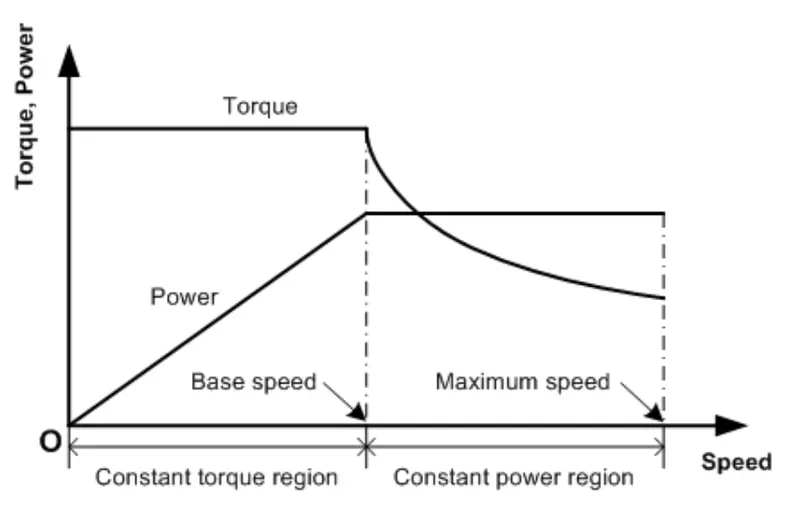
From torque- speed characteristics when we accelerating the vehicle, speed is low so ultimately we get the high torque (constant torque region) but in case of decelerating we are already at high speed so when speed is high we are in the constant power region where torque developed is usually low as compared to constant torque region. also at the time of motor starting, motor draws high cureent due to transient. as torque propotional to square of current, therefor torque value is high at this moment so that's why electric motor can’t develop braking torque at high speed similar to starting.
There are two types are breaking control strategies which are
- Series Breaking :- In this breaking both breaks are not applied simultaneously instead one break is applied after another. so at a time, only one break is in actual functioning Regenerative breaking or Friction break.
- Parallel Breaking :- In this breaking strategies both the breaks can be simultaneously applied.
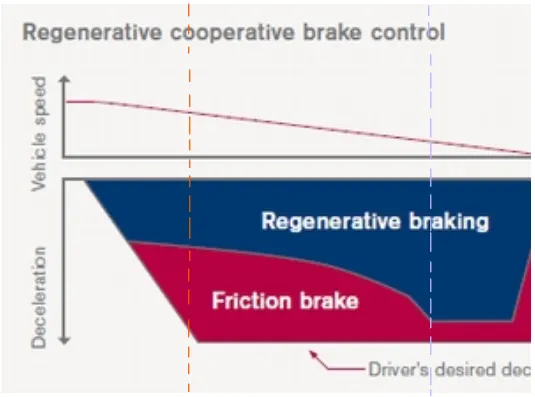
From above graph we can clearly say that when the speed is high(orange line in above fig) then friction break(mechanical break) is used and when the speed becomes low(purple line in above fig) then the regenerative breaking more used. So we can say that in the low-speed breaking we can maximum apply regenerative break and charge our battery in an efficient manner.
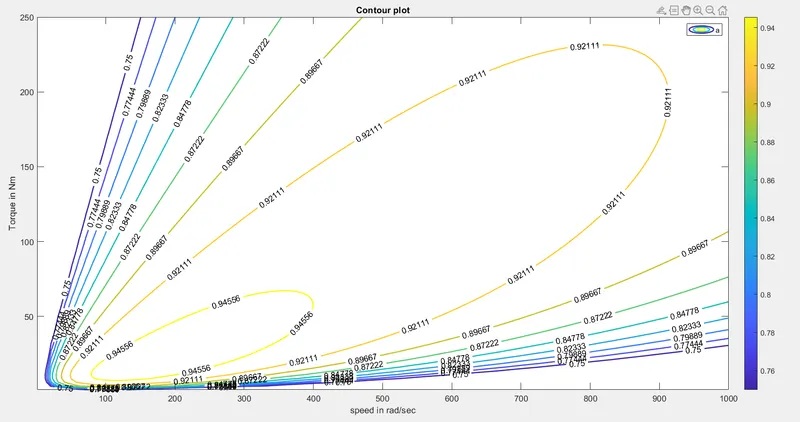
Q.3 Make a MATLAB program which plots contour of given motor speed, torque and efficiency values. Attach the code as a .m file attach a screenshot of all the plots.
Ans :
Given data - Kc (Copper loss) =0.2 , Kw (windage loss)=0.00001 ,Ki (Iron loss)= 0.08, Constant motor loss = 20
clc
clear all
speed = linspace(1,1000);
torque = linspace(1,250);
%given data
kc = 0.2; %const for copper loss
ki = 0.008; %const for iron loss
kw = 0.00001; %const for windage loss
con= 20; %constant loss of motor
%making mesh
[P, Q] = meshgrid(speed,torque);
%for output power
out_power = P.*Q; %outputpower = speed * torque
%for input power
a = (Q.^2)*kc; %coppper loss
b = (P)*ki; %iron loss
c = (P.^3)*kw; %windage loss
in_power = a + b + c + con +out_power;
%to find out efficiency
efficiency = (out_power./in_power);
%contour will be ploted for this 10 points
v = linspace(0.75,0.97,10);
%plotting countour
box on
grid on
contour(P,Q,efficiency,v,"linewidth",1.5,'ShowText','on');
colorbar
xlabel("speed in rad/sec");
ylabel("Torque in Nm");
title("Contour plot");
legend('a','b','c','d')
Result