Week-11 Challenge: Braking
Week-11 Challenge: Braking
- For a defined driving cycle, calculate the energy required for braking.
- Why electric motor can’t develop braking torque at high speed similar to starting? How electric and mechanical brakes are coordinated?
- Make a MATLAB program which plots contour of given motor speed, torque and efficiency values. Attach the code as a .m file attach a screenshot of all the plots.
Study 1:
For a defined driving cycle, calculate the energy required for braking.
explanation:
Code:
clear all
close all
clc

x = linspace(1,1000);
y = linspace(1,250);

%% declaring constants
Kc = 0.2;%cuppor loss cinst
Ki = 0.008;%iron loss const
Kw = 0.00001;%windage loss const
Const = 20;

%% creating meshgrid
[X,Y] = meshgrid(x,y);
outputpower = (X.*Y)

%% finding losses
B = (Y.^2)*Kc;
C = X*Ki;
D = (X.^3)*Kw;
Inputpower = outputpower + B + C + D + Const;
Z = outputpower./Inputpower;
V = [0.75,0.8,0.85,0.9,0.92,0.98];

%% creating countour
box off
grid off
contour (X,Y,Z,V);
xlabel('speed/rad.s^-^1');
ylabel('torque/N.m');
Plots:
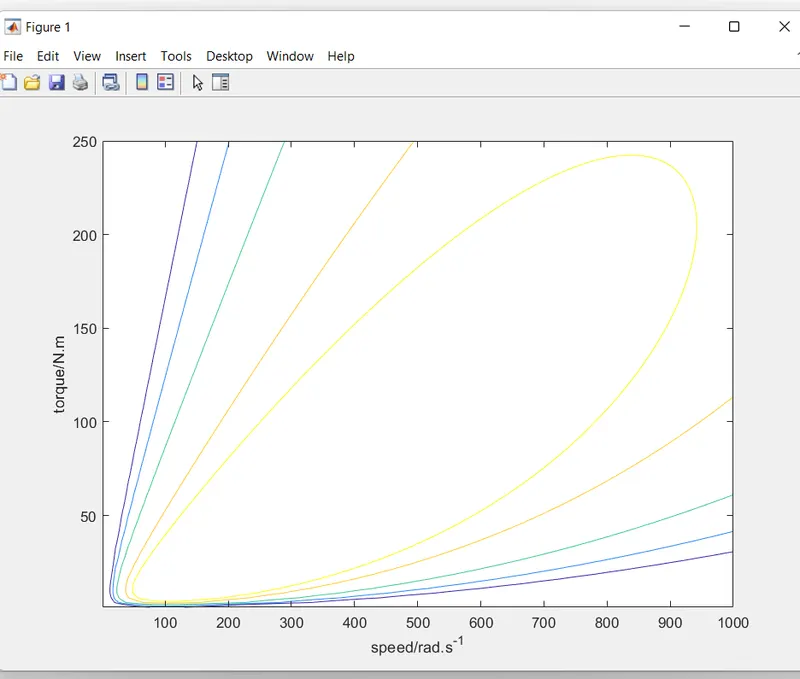
in the above plot the countour has three dimentions,
1.Speed
2.Torque
3.Efficiency
The circles represent the efficiencies and the inner most circle has more efficiency
Study 2:
Why electric motor can’t develop braking torque at high speed similar to starting? How electric and mechanical brakes are coordinated?
Explanation:
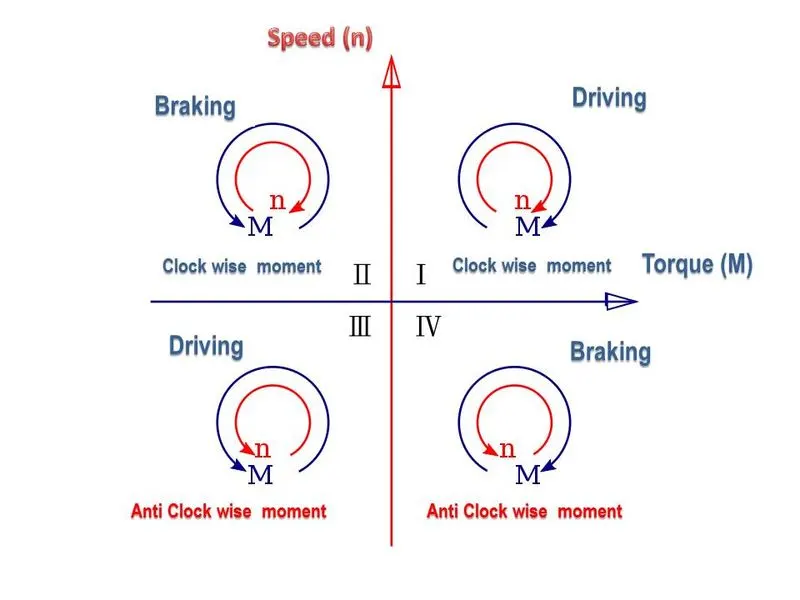
for an electric motor, While accelerating it is in the first co-ordinate where there is a constant torque region and constant power region. for in the case of acceleration it has low speed and high torque when it reaches critical speed or crosses base speed it is constant power region or field weaking region.
In case of Decceleration the motor has the mirror image of quadrant one here the motor has constant power region and later constant torque region.When motor enters here it enters into constant power region, as the motor has high speed it has low torque.So an electric motor doesnt have same torque as starting while breaking.
Electric and mechanical brakes are co-ordinated in two ways,
1.Series
2.Parallel
1.Series Method:
Here the electric and mechanical brakes are used one after the other.
Paralled Method:
Here both electric and mechanical brakes are applied at once.
Study 3:
For a defined driving cycle, calculate the energy required for braking.
Explanation:
clear all
close all
clc

m = 1000 % declaring mass
%% importing Drivecycle
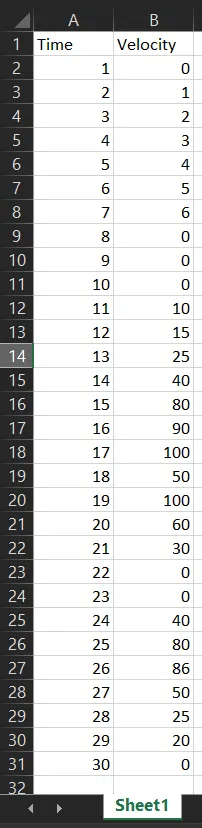
Dc = xlsread('Drivecycle');

%% extracting data
t = Dc( : , 1);
vel = Dc( : ,2);

%% For loop
for i = 1:(length(vel)-1)
    if  vel(i+1)<vel(i)
        be(i) = 0.5*m*((vel(i))^2 - (vel(i+1))^2);
    end
end
 obe = sum(be) %over all breaking
 Obe_kwh = obe / 3600000 %in kilo watt hrs
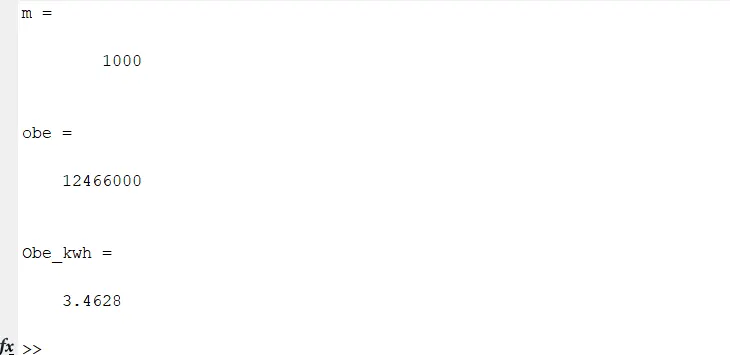
Overall Brake energy for 1000Kg mass car with above driving cycle is given below