Week-11 Challenge: Braking
- For a defined driving cycle, calculate the energy required for braking
Breaking is a procedure to reduce the speed of the vehicle or brnging vehicle to ret position. Breaks are used to increase the frictional resistance, therefore the speed of the wheels will reduce. The breaks will absorbs both kinetic and potential energy and heat is dissapated at the time of braking.
There are two types of breaking one is foot brak and second one is hand break. foot brak is used normally, but during emergency time we will use hand break. When the vehile is moving there will be a kinetic energy stored in the vehicle and this kinetic energy will dssipate as heat during the breaks.
The kinetic energy of the vehicle during the break is given by
`K.E. = frac{1}{2}(frac{W}{g})(U^2 - V^2)`
Which results
`K.E. = (frac{1}{2})M(U^2 - V^2)`
Where
M is vehicle mass
U is initial velocity in m/s
V is final velocity in m/s
g is acceleration due to gravity m/s2
clear all
close all
clc

mass = 1000 ;
drivecycle = xlsread('drivecycle.xlsx');
t = drivecycle(:,1);
v = drivecycle(:,2);
for i = 1:(length(drivecycle)-1)

    if v(i)>v(i+1)
        be(i) = 0.5*mass*(v(i) - v(i+1))^2;
    end
end
fprintf('total break energy is %d',sum(be))
fprintf('average brak energy is %d',mean(be))

figure(1)
subplot(2,1,1)
plot(t,v,'linewidth',2,'color','g')
grid on
xlabel('time in sec')
ylabel('velocity in m/s')
title('Drivecycle')
subplot(2,1,2)
plot(be,'linewidth',2,'color','r')
grid on
xlabel('time in sec')
ylabel('Break Energy')
above code helps to find break energy applied to vehicle
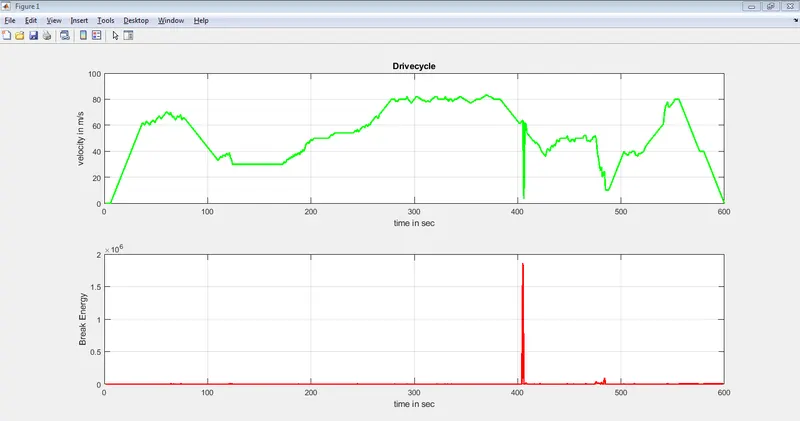
Figure 1
Figure 1 shows the velocity applied to the vehicle and break energy exposed from the vehicle
2. Why electric motor can’t develop braking torque at high speed similar to starting? How electric and mechanical brakes are coordinated?
At starting time motor requirs large current to produce high torqu, because torque is proportional to square of the current. When the vehicle is already at high speed is reached and thus higher torque could not be obtain while breaking.
In vehicles when the driver applies the break , the break peds come closer to the disc connected with the driving disc. inorder to reduce the speed of the vehicle or bring vehicle to rest position both electrical and mechanical breaing is required
There are two types of breaking, one is series and another one is parallel breaking.
If breakings are applied one after another, then it is series breaking. If the two breakings are applied at a same time, then it is parallel breaking.
3. Make a MATLAB program which plots contour of given motor speed, torque and efficiency values. Attach the code as a .m file attach a screenshot of all the plots.
% program for plotting counter plot of motor apeed and torque

clear all
close all
clc

w = linspace(0,1000); %speed array

T = linspace(0,300);  %Torque array


kc = 0.19;  %copper loss
ki = 0.005; %iron loss
kw = 0.00011;  %windge losses

[X,Y] = meshgrid(w,T);
copperloss = (Y.^2)*kc;
ironloss = X*ki;
windageloss = (X.^3)*kw;
constant = 20;

outputpower = X.*Y;  %out put power
inputpower = (copperloss)+(ironloss)+(windageloss)+outputpower+constant; %input power
efficient = outputpower./inputpower; %efficiency calculation
n = linspace(0.7,0.95,10);
box off
grid off
contour(X,Y,efficient,n)
title('Speet Torque characteristics')
xlabel('Speed in rad/sec')
ylabel('Torque in N/M')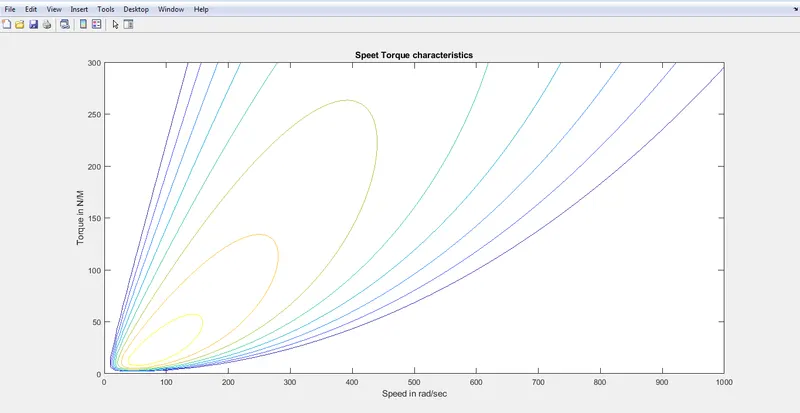
Figure 2
Figure 2 shows the contour plot of motor
From the above contour we can say that torque speed values are inversely proportional to efficiency. As torque speed value increases, efficiency value decreases.
We conclude that, for a low speed values and low torque values, the efficiency of motor is high.