Week-11 Challenge: Braking
1. For a defined driving cycle, calculate the energy required for braking.
A. Driving Cycle: The driven cycle is defined by the excel calulation and the driving cycle. The electric vehicle is accelerate to increase the speed and it deaccelerate the speed in a sipulated time for braking or to stop the vehicle from x speed in kmphr to 0 speed in kmhr. For this the electric vehicle requires some amount of energy to operate the brakes. As we calculated the required power for acceleration of vehicle. The same excel sheet i am taking here. but the speed taken here is 100kmphr for (0 to X KMPH) and the time is 10 sec as said in the tutorial.
From the excel calculation of the power required for the acceleration is nearly 58 KW. According to the formula of kineticenegry E=1/2*M*(Vf-Vi)
where Energy in joules or Kilo joules or Kwh
M= mass of the vehicle
Vf=Final Velocity =0
Vi=Initial Velocity= 100 kmph
here the mass of the vehicle 1000kg .
The 0.16kwh of energy is required for the power of 58kw for 10sec to becomes 0 from 100kmph.
The braking power is required same amount of power required for both the conditions (Acceleration and decceleration).
2.Why electric motor can’t develop braking torque at high speed similar to starting? How electric and mechanical brakes are coordinated?
A. Electric motor can’t develop braking torque at high speed similar to starting
The above graph is showing the speed-torque characteristics of a motor. It is clearly shows that the first graph that till the motor reaches the critical speed it has constant torque and once it reaches the critical speed, the curve is having a down slope which is a constant power region.
And this graph denotes the accelerating operation of the motor. For the deceleration or braking operation of motor,this graph is mirrored down which will be having the speed is Positive and torque is negative.
We can say that the electric vehicle can achieve 0-100 kmph in 10 sec. Acceleration operation goes this way, with low speed and high torque constant torque region is achieved which has accelerating power and by reaching the critical speed it shifts to constant power region and thus it easy for an EV to reach 0-100kmph.
As said that the braking operation graph will be mirrored image of above of plot. So we cannot say that the motor producing 7 N-m torque for acceleration can also produce -7N-mmfor braking . Because we are operating in the field weaking region and operation above the base speed. Thus the peak acceleration torque is greater than the peak deceleration torque. Thus for acceleration it has high torque with low speed and for deceleration it has low torque for high speed.
The braking torque of an electric vehicle is not as high as accelerating torque.
Factors limiting the braking power generated during regenerative braking.
Braking power is not only limited by the motor power rating.But by the charging power limit of the battery pack.This limit depends on the battery type (chemical composition) and changes with temperature.
The kinetic energy of a slowly moving car is low enough that very little energy is put back in to the battery as the car comes to a stop.Infact the last little bit of slowing the vehicle down generates such a small amount of energy that it does not even cover the fixed losses in the inverter and motor.
Regenerative braking is necessarily limited when the batteries are fully charged.Because the additional charge from regenerative braking would cause the voltage of a full battery to raise above a safe level, the motor controller will limit regenerative torque in this case.
Electric and mechanical brakes are coordinated:
The brake control strategies are two types series and parallel
Series: In this control strategy the brakes are applied by one after the other means mechanical or regenerative . Either one brake strategy at a time or regenerative braking or mechanical braking at a time.
Parallel: In this control strategy we will apply the brakes at a time or simultaneously.
Electric Driven Intelligent brake
And Nissan has developed a practical brake strategy called Electric Driven Intelligent Brake (EDIB) developed by Nissan leaf.
Technology Functionality:
After stepping on the brake pedal, the system produces natural and adequate braking force that corresponds to the operation. The amount of energy regeneration also needs to be increased as much as possible. EDIB( ELECTRIC DRIVEN INTELLIGENT BRAKE) controls the regenerative brake and friction brake to support both of these requirements. Further it also controls the reactive force from the pedal in order to unify the feeling when stepping down on the pedal and then sense of deceleration.
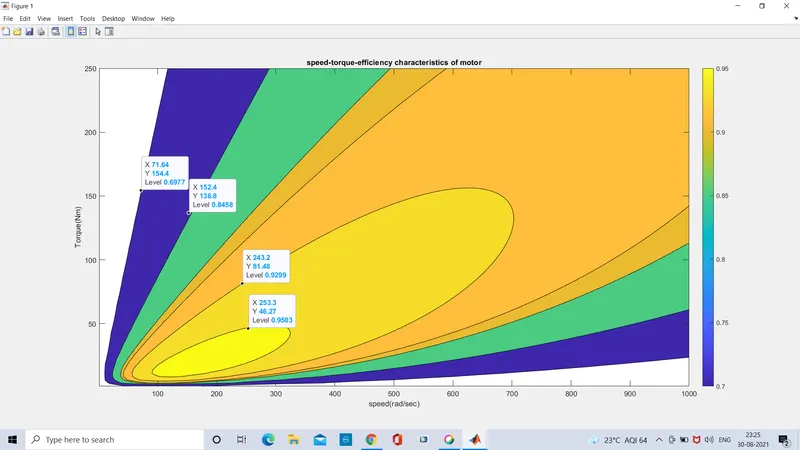
3.Make a MATLAB program which plots contour of given motor speed, torque and efficiency values. Attach the code as a .m file attach a screenshot of all the plots.
A. Click on the matlab - click on the editor window- write the matlab program for the contour.
X=linspace(1,1000);% speed in rad/sec%
Y=linspace(1,250);%Torque in N-m%
%Motor loss constants %
Kc=0.2;%copper loss constant%
Ki=0.008;%Iron loss constant%
Kw=0.00001;%windage loss constant%
Constant_loss=20;% constant motor loss%
[X,Y]= meshgrid(X,Y);%converting to 2D%
Output_power=(X.*Y);% Power =Torque*speed
B=(Y.^2)*Kc;%copper loss%
c=(X.*Ki);%Iron loss%
D=(X.^3)*Kw;%windage loss
Input_power=Output_power+B+c+D+Constant_loss;
Efficiency=Output_power./Input_power;%efficiency of the motor%
V=[0.7,0.85,0.9,0.91,0.93,0.95];%efficiencies to be plotted%
box off
grid off
contourf(X,Y,Efficiency,V);
contourcbar
title('speed-torque-efficiency characteristics of motor')
xlabel('speed(rad/sec)');
ylabel('Torque(Nm)');
After wirting this program-create the path directory - click on the run icon.
The result of the contour plot as shown below .