Week-11 Challenge: Braking
Q1.
Cycle used is WorldWide harmonized light vehicle test.
https://docs.google.com/spreadsheets/d/15GQ6E61ClZdhwamQWd0exKsb7dlC-KuHxsLW1yuR5ss/edit?usp=sharing
Q2.
Electric motor can't develop braking torque at high speed similar to starting, because Braking torque is applied in the opposite direction of the rotation. We can use a mechanical brake to produce a braking torque.
Mechanical with electric brakes
In practical case the combination of these two is applied. So usually it is combined response of Mechanical brake and Regenerative brake.
The reason for how these brake force are combined, that particular phenomena is called Brake Control Strategies. There are two Brake Control Strategies, which are
Series - In case of Series we apply Mechanical brake and Regenerative electric brake one after another. We can apply only one brake strategy at a time either apply Regenerative or apply Mechanical brake.
The Series Brake Control Strategy has further classification, that is based on whether we want comfort of driver or Brake behaviour compared to energy efficiency.
Parallel - In case of Parallel we apply both brakes simultaneously. This Particular Parallel braking is going to happen both at a time. Electric Driven Intelligent Brake (EDIB) is a combination of Hydraulic brake or Mechanical brake along with a Regenerative brake. It is a Parallel braking technique. The Control criteria such that at low speed use regenerative braking higher and at high speed or during initial braking
period we actually combine the both.
Q3.
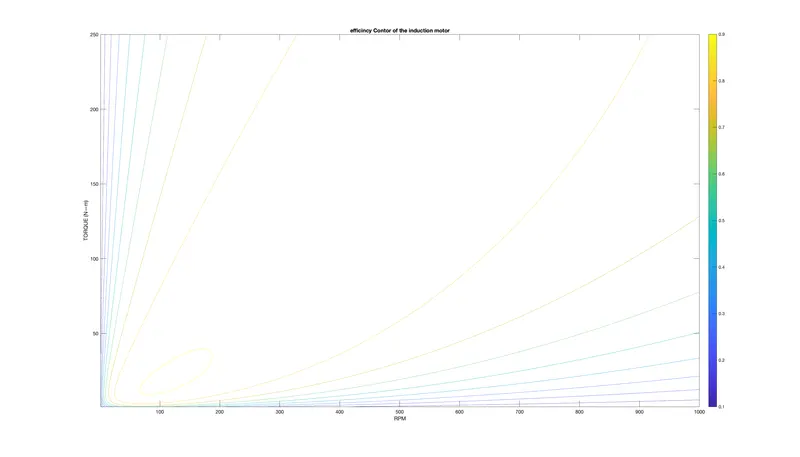
Matlab program for the plots contour of motor speed, torque and efficiency.
Torque=linspace(1,250,250)         %Input Torque
Speed=linspace(1,1000,250);         %Input Speed
[w,T]= meshgrid(Speed,Torque);     %Converting to 2D array

C_k= 0.3;       % Copper loss constact
I_k= 0.009;     % Iron loss Constant
W_k= 0.00005;   % Windage loss constat
C=30;          % constant loss

Power_out= w.*T;
Copper_loss=C_k*(T.^2);
Iron_loss=I_k*w;
Windage_loss=W_k*(w.^3);

Pin=Power_out+Copper_loss+Iron_loss+Windage_loss+C; %Input power
eff=Power_out./Pin;

contour(Speed,Torque,eff)
title('efficincy Contor of the induction motor');
xlabel('RPM');
ylabel('TORQUE (N—m)');
OUTPUT