Week-11 Challenge: Braking
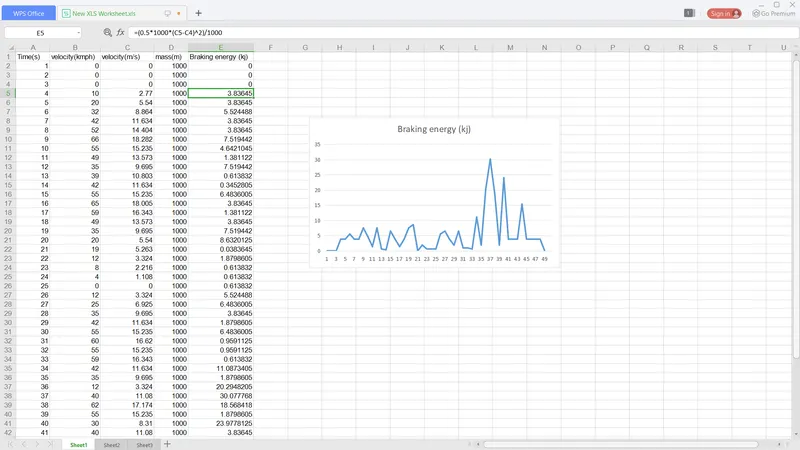
- For a defined driving cycle, calculate the energy required for braking.
- Why electric motor can’t develop braking torque at high speed similar to starting? How electric and mechanical brakes are coordinated?
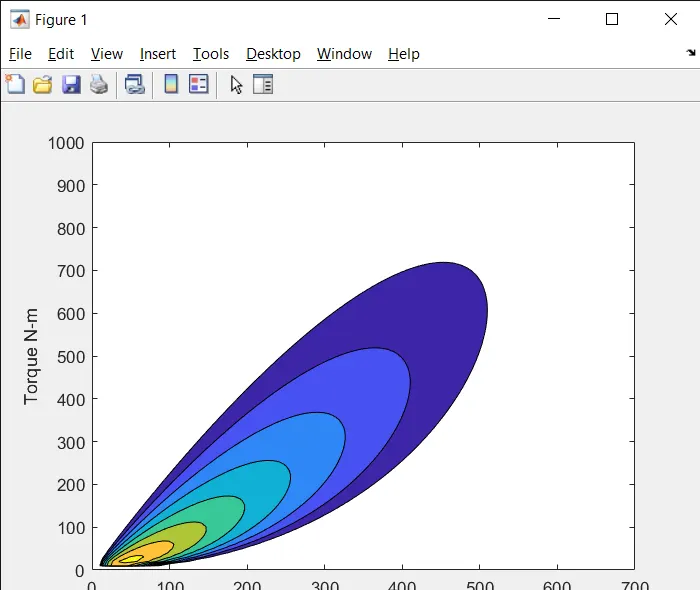
- Make a MATLAB program which plots contour of given motor speed, torque and efficiency values. Attach the code as a .m file attach a screenshot of all the plots.
1.For a defined driving cycle, calculate the energy required for braking.
braking energy =1/2*m*(vf-vi)^2
vf is final velocity
vi is intial velocity
m is mass
2.Why electric motor can’t develop braking torque at high speed similar to starting?
There are two main reasons
1.Due to transients
At starting the motor draws a large current due to Transient
because the torque is proportional to square of current,therefore torque value is also high at this moment.
2.Torque speed characterstic
When the speed increases torque should decrease to maintain power constant at the time of starting speed is very low therefore torque value is very high. at the time of braking speed value is high therefore value will be low so at the time of braking torque value available will be lower.
How electric and mechanical brakes are coordinated?
To stop the vehicle it requires electrical and mechanical brakes
1.series braking
2.parallel braking
1.series braking:in this mechanical and electrical brakings are applied one after other.
parallel braking:in this both braking methods are applied at the same time.
3.MATLAB program which plots contour of given motor speed, torque and efficiency values
clear all
close all
clc
%speed array
W=linspace(0,700);
%torque array
T=linspace(0,1000);
%loss coefficents
kc=0.18;
ki=0.08;
kw=0.0005;
%Mesh grid
[X,Y]=meshgrid(W,T);
copperloss=(Y.^2)*kc;
ironloss=X.*ki;
windageloss=(X.^3)*kw;
constantloss=21;
output_power=X.*Y;
input_power=copperloss+ironloss+windageloss+constantloss+output_power;
efficiency=output_power./input_power;
n=linspace(0.7,0.9,10);
box off;
grid off;
contourf(X,Y,efficiency,n);
xlabel('speed rad/sec');
ylabel('Torque N-m');