Week-11 Challenge: Braking
1] For a defined driving cycle, calculate the energy required for braking.
ANSWER:-
File enclosed is DS.xlsx
Formulas:-
BE=((1/2)m(v^2))
BE=braking energy
m=mass of the vehicle
v=velocity
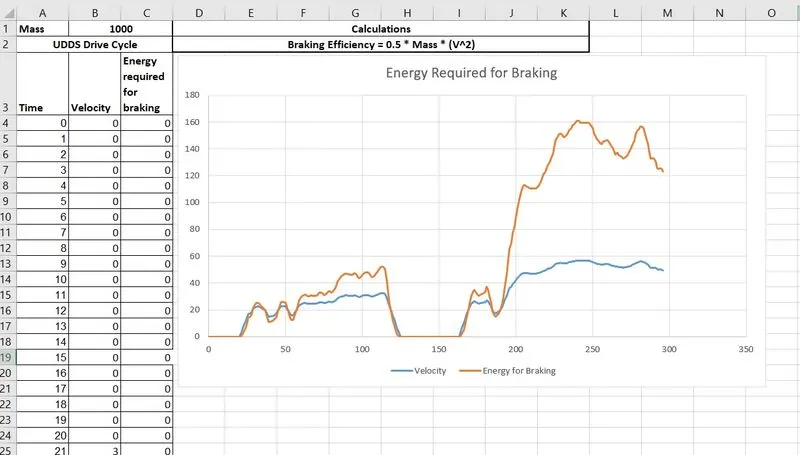
Braking energy required is 160Kj
2] Why electric motor can’t develop braking torque at high speed similar to starting? How electric and mechanical brakes are coordinated?
ANSWER:-
An electric motor produces high torque on starting but cannot generate high braking torque while braking due to the inertia of the vehicle. One way to increase braking torque is by using regenerative braking. Regenerative braking in simple terms is the use of the electric motor to act as a generator to charge the battery while slowing down or going down hill. One of the other problems with regenerative braking is that id the motor can deliver high power but the battery cannot charge as fast then there is less back torque on the motor and in such casses a mechanical brake may be used.
The application of mechanical brakes along with Regenerative braking can be classified into two types. They are series braking and parallel braking. In series braking the regenerative braking is used first and when we require more stopping power then the mechincal brake is used. The pattern is in series. In parallel braking the Regenerative braking and Mechanical brakes are used simultaneously. The energy lost in parallel is more than that of series braking. As mechaincal brakes convert the momentum into heat energy.
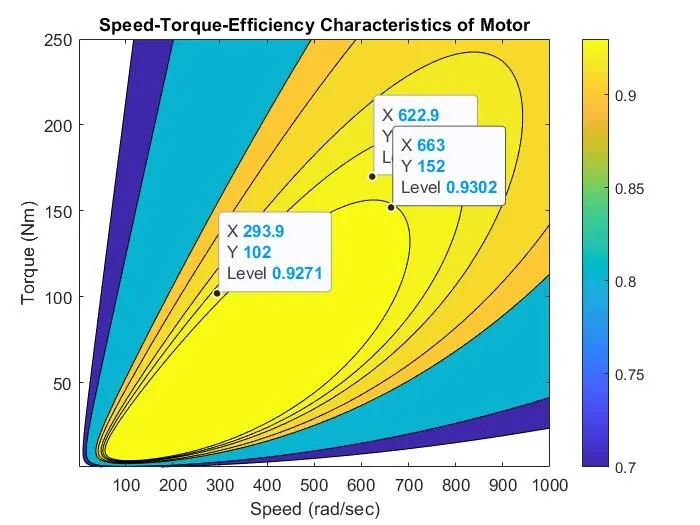
3] Make a MATLAB program which plots contour of given motor speed, torque and efficiency values. Attach the code as a .m file attach a screenshot of all the plots.
ANSWER:-
File Enclosed Q3.m contains matlab program and following is results obtained
And there is maximum efficiency at 93.02% with 663 rad/sec and 157 Nm.