Week-11 Challenge: Braking
AIM:- To Understand the concept of Braking.
Objective:-
1. For a defined driving cycle, calculate the energy required for braking.
2. Why electric motor can't develop braking torque at high speed similar to starting? How electric and mechanical brakes are coordinated?
3. Make a MATLAB program that plots the contour of given motor speed, torque, and efficiency values.
#Oues 1- For a defined driving cycle, calculate the energy required for braking.
Braking:- A brake is one of the most important controls of the vehicle. This is a combination of some interactive parts. It absorbs energy from the moving part and slows down the vehicle with the help of friction. The function of the brake system is to stop the vehicle within the smallest possible distance and hence this is done by converting the kinetic energy of the vehicle into heat energy which is dissipated into the atmosphere.
The brake system in an automobile can be classified as;
• Mechanical Brake
• Disc Brake
• Hydraulic Brake
• Power-assisted Brake
• Air Brake
• Electric
• Hand brake System
The Braking distance increases four times each time the starting speed doubles. This is because the work done in bringing a car to rest means removing all of its kinetic energy. Kinetic energy is the force that keeps the vehicle moving. This energy is provided by the engine in order to accelerate the vehicle from a standstill to the desired speed. Kinetic energy is dissipated as heat by the brakes during the application of breaks.
Work done(Brake Energy) = kinetic energy =1/2 mv^2, Brake Energy = 1/2 mv^2
where, m = Mass of vehicle V = Velocity difference (V_final - V_initial)
I am taking an example to Calculate the Brake Energy:-
I have Created a drive Cycle for 0-120 sec Let's assume the Total weight of the vehicle = 600 kg
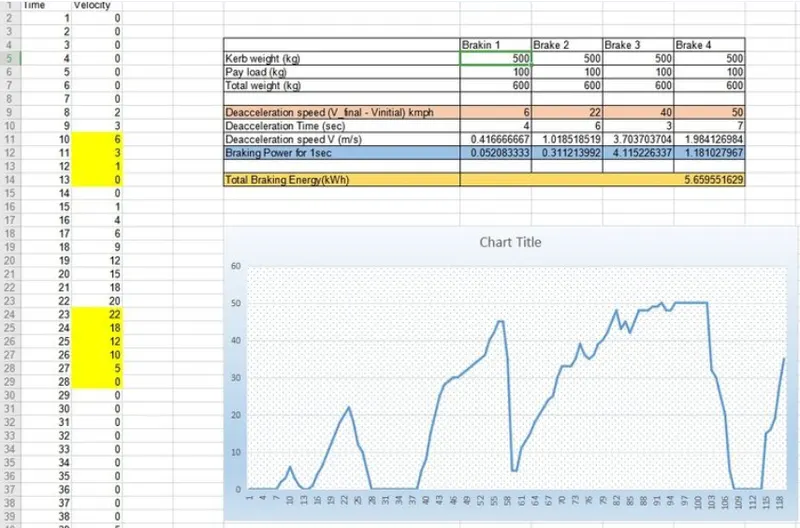
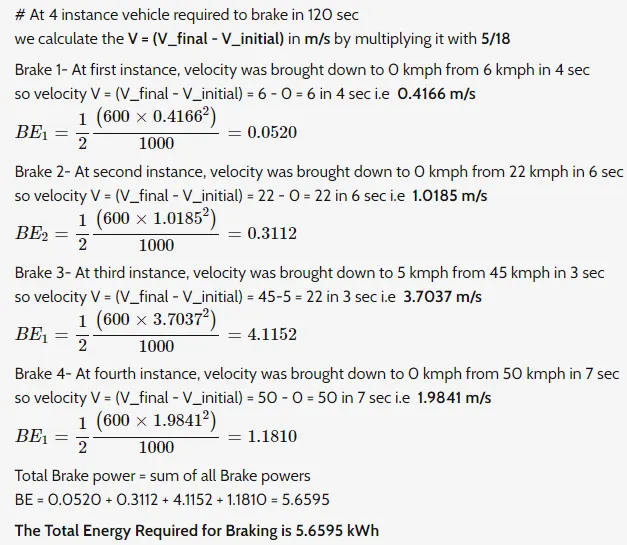
#Ques 2- Why electric motor can't develop braking torque at high speed similar to starting? How electric and mechanical brakes are coordinated? Braking in Vehicle- In-Vehicle, braking is achieved by using a Mechanical brake or Regenerative Brake. - In DC motors when the load on the motor is constant, speed is proportional to supply voltage. And when the supply voltage is constant, speed is inversely proportional to the load on the motor. Motor's torque-speed curve.
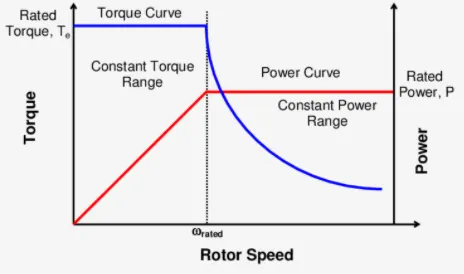
In the constant torque region higher acceleration is possible and then the vehicle reaches the point of constant power. When it comes to braking, where the torque is negative, the braking torque required goes down as the vehicle is in the constant power region lower than the torque which was required during acceleration. So while braking the peak torque is less than the torque required during acceleration. Therefore peak acceleration and peak deceleration torque are not the same.
Braking control-
- Usually, Front-wheel drives have a higher Braking forcer. So it is advisable not to increase the front braking.
- Braking should be distributed in both and rear wheel independently, so as the direction of driving will not be a sacrifice, for the safety purpose.
- Braking is achieved by using a Mechanical brake or Regenerative Brake.
- In practice, if the Regenerative braking power requirement is more than the charging limit of the battery or more than the regenerative capacity of the machine then the combination of both mechanical brake & Regenerative Brake are applicable.
- As the acceleration torque is higher than deceleration torque, only electric braking is not sufficient to stop the vehicle. Also while reducing the speed, the speed is not directly reduced, as a process, the regeneration takes place, where the curve enters into the 2nd quadrant and again enters to 3rd to a reduced speed.
- In practice, the same motor cannot produce the same braking power, which means if the motor accelerates to 100kmph in 10 seconds, it cannot give the equal Torque as acceleration in deacceleration.
Tbraking < TAcceleration
Limitations-
- The battery charge rate is lower as compared to the peak discharge rate.
- Power converter limitations while reverse power flow.
Braking control strategies
-1. Series Braking (one adter another) In the case of the series brake, we apply a Mechanical brake and Regenerative brake in series one after the another i.e applying one brake at a time.
2. Parallel Brake (Both at a time) In the case of the parallel brake, we apply a Mechanical brake and Regenerative brake at a time i.e both brakes are applied at the same time.
Conclusion:-
- Electric and Mechanical brakes are coordinated used in EV & HEV.
- The coordination is made on the requirement, either comfort braking or efficient braking is required. As an example, Nissan Leaf is made with the Regenerative Cooperative Brake Control method which is an intelligent Brake control method developed by the company.
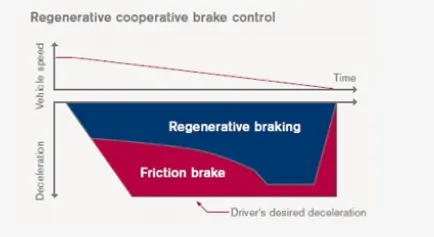
This method is an intelligent automatic control method, designed by Nisan company, in this method when speed is low on Generation braking is done when applied brakes, and when the speed is high to a certain point both mechanical and regenerative braking will work simultaneously.
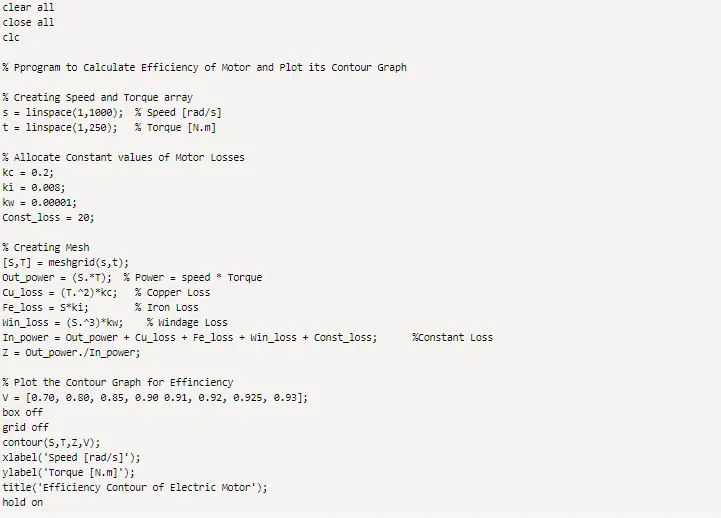
#Ques 3- Make a MATLAB program that plots the contour of given motor speed, torque, and efficiency values.
- In order to plot the Contour Graph for the motor speed, torque, and efficiency values, I have written the code. - While calculating the input, the losses also need to take into consideration
- The losses are iron losses, copper losses, windage losses.
- Copper losses (Cu_loss) = Kc.T^2, where Kc is the constant of copper loss
- Iron losses (Fe_loss) = Ki.w, where Ki is the constant of iron loss, this varies with speed.
- Windage losses (Win_loss)= Kw.W^3, where Kw is the constant of Windage loss, it depends on the size and shape of the motor.
- Constant losses (Const_loss) = 20
- Total losses = Kc.T^2 + Ki.w + Kw.WA3 + 20 - Variable Z is the efficiency points we are giving, Efficiency is the ratio of output power to input power
Matlab program:-
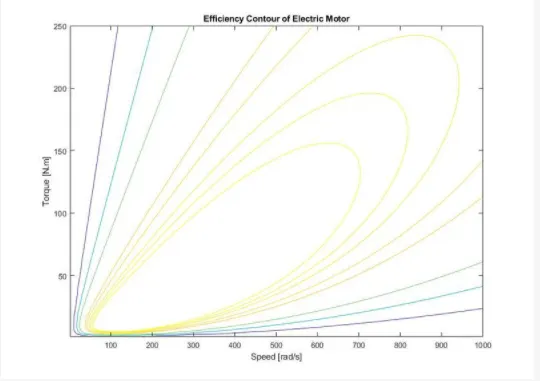
result:-
checking for 5kw and 8kw

result:-
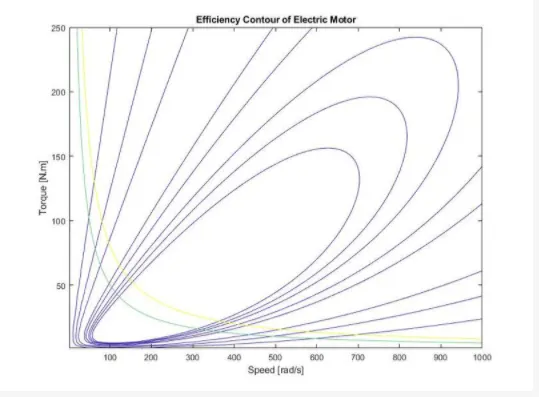
- From the Graph. we can observe the behavior of torque. speed. and efficiency of Electric Motor
- It is shown that the higher efficiency is achieved in the area with a middling speed corresponding to middling torque
- From the above Graph. it is clear that the high efficiency is achieved at low speed and low torque in the speed range of 200 rad/s to 300 rad/s correspondings to torque between 20 N.m to 30 N.m.
Learning Outcome:-
- Calculate the Braking Power for Motor for Defined Drive Cycle.
- Understand why electric motor cant develop braking torque at high speeds.
- Understand the coordination of electric and mechanical brakes.
- Understand the Efficiency of Electric motor using Contour Graph