Week-11 Challenge: Braking
CASE 1:
For a defined driving cycle, calculate the energy required for braking:
BRAKING:
When applying brakes to a car, kinetic energy is converted to heat and then dissipated into the environment via both radiation and convection. But, momentum is transferred to the earth. The act of breaking the car actually applies a spin to the earth in the forward direction of the car's travel.
FORMULA USED TO CALCULATE ENERGY:
`E = 0.5*m*v^2`
m is the mass of the vehicle (m = kerb weight + pay load)
V is the velocity of the vehicle( v = v_f - v_i)
v_f is the final velocity
v_i is the initial velocity
CALCULATION:
https://docs.google.com/spreadsheets/d/125WQFTgd-h8aZigrepz184uVjB-j1J52ZrQaVPe8qTw/edit?usp=sharing

The total braking energy is 198.04 kj.
CASE 2:
Why electric motor can’t develop braking torque at high speed similar to starting? How electric and mechanical brakes are coordinated?
At the initial or starting time the torque generated is high because the vehicle is at rest position it requires a lot amount of torque to move the vehicle at a certain speed whereas at the time of moving the torque generated is less as the car is already moving it does not required a lot of torque to generate a motion thats the reason for electric motor for not developing the braking torque at high speed similar t0 starting.
MECHANICAL BRAKES:
Brakes absorb energy and convert it to heat.Mechanical brakes all act by generating frictional forces as two surfaces rub against each other. The stopping power or capacity of a brake depends largely on the surface area of frictional surfaces as well as on the actuation force applied.Mechanical brakes are assemblies consisting of mechanical elements for the slowing or stopping of shafts in equipment drives. They use levers or linkages to transmit force from one point to another. Braking slows or stops the movement of the coupled shafts.
REGENERATIVE BRAKING:
Regenerative braking is an energy recovery mechanism that slows down a moving vehicle or object by converting its kinetic energy into a form that can be either used immediately or stored until needed.
Methods of braking using the electric brakes:
1. Series braking:
where the mechanical and regenerative braking occurs after one another.
2.Parallel braking:
where the mechanical and regenerative braking occurs at a same time parallely.
This is how the mechanical and electrical brakes coordinate with each other.
CASE 3:
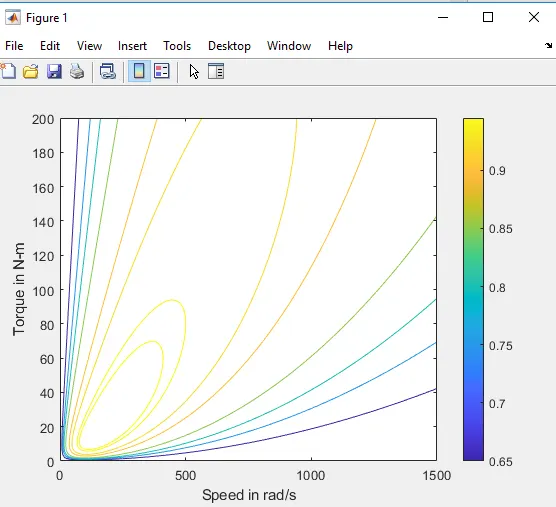
Make a MATLAB program which plots contour of given motor speed, torque and efficiency values.
Matlab code:
clear all
close all
clc

%array of speed, torque values
speed=linspace(0,1500,1501); %in rad/s
torque=linspace(0,200,401); %in Nm

%2D mesh values
[w,T]=meshgrid(speed,torque);

%Output calculation P=T*w
output_power=w.*T;

%Loss constant values
kc=0.2;      %Copper loss constant
ki=0.006;    %Iron loss constant
kw=0.00001;  %Windage loss constant


%Power losses in watts
cul=kc*T.^2;         %Copper loss
ironl=w.*ki;           %Iron loss
windl=w.^3*kw;         %Windage loss
motorl=20;              %Constant motor loss

%Input power calculation
input_power=output_power+cul+ironl+windl+motorl;

%Efficiency calculation
efficiency=output_power./input_power;

%Efficiency values taken for plotting contour
values=[0.65,0.75,0.8,0.85,0.9,0.92,0.94,0.945];

%Plotting contour
contour(w,T,efficiency,values);

xlabel('Speed in rad/s');
ylabel('Torque in N-m');

k = colorbar
Workspace:
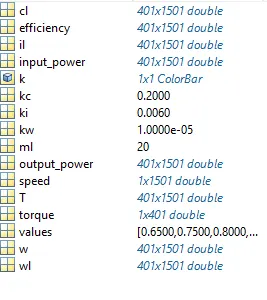
FIGURE PLOT: