Week-6 Challenge: EV Drivetrain
1.TYPES OF POWER CONVERTER CIRCUITS USED IN ELECTRIC AND HYBRID ELECTRIC VEHICLE:
- Rectifier
- Inverter
- Chopper
RECTIFIER:
Rectifier is an electronic circuit which converts the Alternating current (periodically reverses the direction)into direct current(flows in single direction).In a electric and hybrid electric vehicle rectifier is used to convert high frequency A.C to D.C in order to charge the battery of a vehicle.
INVERTER:
Inverter is an electronic circuit which converts the Direct current into Alternating current.In a electric and hybrid electric vehicle Inverter is used to convert D.C to A.C in order to run an induction motor, inverters accelerate or decelerate the vehicle by converting the DC power from the batteries to alternating current (AC) at the frequency required for vehicle speed and other system control to control the electric motor speed, drive torque, and power.
CHOPPER:
Chopper is an electronic circuit which converts fixed D.C input into a variable Direct current output directly,a chopper is an electronic switch that is used to interrupt one signal under the control of another.In a electric and hybrid electric vehicle chopper is used to convert a D.c input of a battery to the required car auxillaries such as speakers ,headlamps, etc.
2.TO FIND THE EV STEADY STATE SPEED IF DUTY CYCLE IS 70% :
GIVEN INPUTS:
Rated Armature voltage= 72 V
Rated armature current= 400 A
Ra= 0.5Ω
KΦ= 0.7 Volt second
Chopper Switching frequency= 400 Hz
duty cycle = 0.7
The vehicle speed-torque characteristics are given by the below equation

According to speed-torque characteristics eqnw.k.t,
`omega=(Vo)/(kpi)-(Ra.T)/(Kpi)`
changing the above equation in form of torque,
`T= (Vo*Kpi)/(Ra)- (omega*(kpi)^2)/(Ra)`
W.k.t,
`Vo = Va *d`
`Vo = 72 * 0.7`
Vo = 50.4 v
substituting the given input value in the torque equation
`T = (50.4 * 0.7)/(0.5) -(omega*(0.7)^2)/(0.5)`
`T = 70.56 - omega0.98`
substituting the torque equations
1. T = 70.56 - omega0.98
2. T = 24.7 + 0.0051omega^2
by equating 1 & 2 we get,
`70.56 - omega0.98 = 24.7 + 0.0051*omega^2`
`0.0051* omega^2 + 0.98 *omega + 24.7 - 70.56 = 0`
`0.0051* omega^2 + 0.98 *omega -45.86 = 0`
by quadratic equation we get
`omega = -231.06&38.09( (rad)/s)`
The value of omega is always positive
omega = 38.09 rad/s
THE STEADY STATE SPEED OF EV IS 38.09 rad/s.
3.WALLY RIPPEL PERSPECTIVE OF BRUSHLESS DC MOTOR AND INDUCTION MOTOR :
BRUSHLESS DC MOTOR:
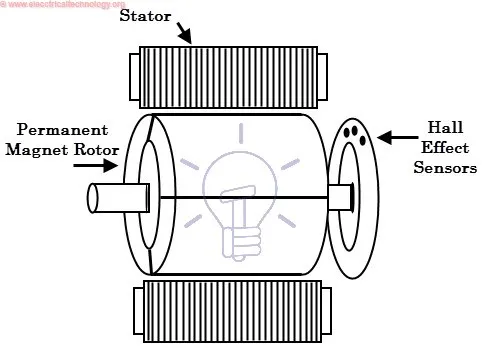
A brushless DC motor is a permanent magnet synchronous electric motor which is driven by direct current electricity and it accomplishes electronically controlled commutation system (it is the process of producing rotational torque in the motor by changing phase currents through it at appropriate times) instead of a mechanically commutation system which is used in brushed dc motor.
In BLDC permanent magnet (or field poles) rotates (rotor)and current carrying conductors are fixed(stator).Transistors are used to correct the rotor position so the armature is in quadrature space within the permanent magnet poles.
Due to the absence of brushes the rotor rotates at higher speed therefore efficiency increases.
ADVANTAGES:
- High efficiency
- less heat dissipation
- lesser weight
- Long life as no inspection and maintenance is required for commutator system
- less noise
- less electro magnetic interference
APPLICATIONS:
- Electric vehicles, hybrid vehicles, and electric bicycles
- Industrial robots,
- CNC machine tools, and simple belt driven systems
- Washing machines, compressors and dryers
- Fans, pumps and blowers
INDUCTION MOTOR:
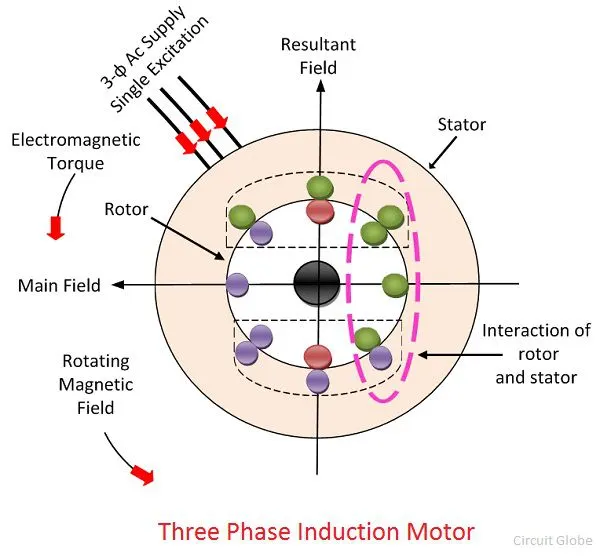
An induction motor or asynchronous motor is an ac electric motor in which the electric current in the rotor needed to produce torque is obtained by eletromagnetic induction from the magnetic field of the stator winding , The motor which works on the principle of electromagnetic induction is known as the induction motor. The electromagnetic induction is the phenomenon in which the electromotive force induces across the electrical conductor when it is placed in a rotating magnetic field.
In induction motor there are no magnets but which there is an steel lamination with buried peripheral conductors.The current is passed in this steel lamination stators which rotates the rotor because of eletromagnetic induction.
ADVANTAGES:
- Simple in construction.
- high efficiency
- Less Maintenance
- less noise
LIMITATIONS:
- An induction motor, unlike a 3 phase induction motor, does not have a self starting torque. Auxiliaries are required to start a single phase motor
- Due to poor starting torque, the motor cannot be used for applications which require high starting torque.
- The change in speed of the motor is very low.
CONCLUSION:
Wally Rippel conclusion is that DC brushless drives will likely continue to dominate in the hybrid and coming plug-in hybrid markets, and that induction drives will likely maintain dominance for the high-performance pure electrics.