Week 11 Car Crash simulation
Objective
To perform a explicit analysis of a car crash simulation followed by a parametric study using 3 different values of thickness for the car body and to find out the total deformation and Equivalent stresses acting on the model.
Procedure
Preprocessing
Firstly, the geometry is imported and checked for any irregularities in the geometry. If not, the spaceclaim is closed and the model scheme is updated.
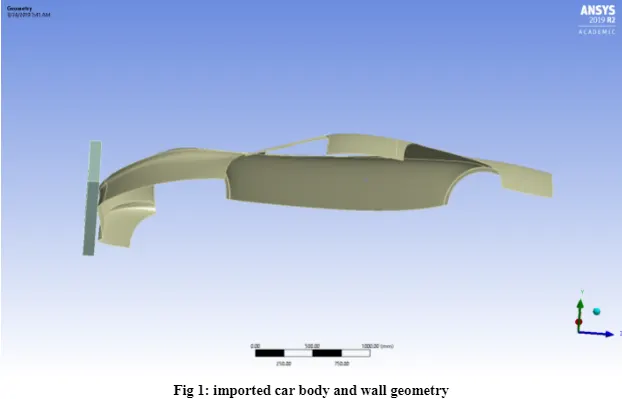
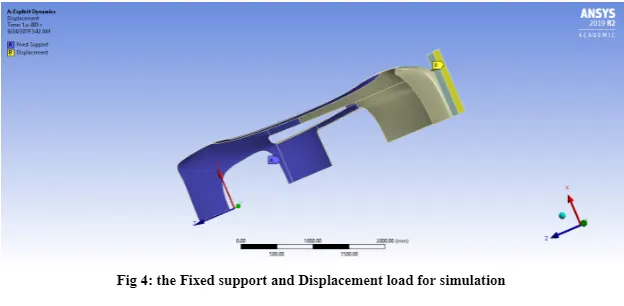
Since there should not be any contacts while performing explicit dynamics, if there are any inbuilt contacts they are deleted. Only the wall and the car body is required for simulation, other components are suppressed. The wall is structural steel material and the car body is stainless steel material. The meshing of the geometry is carried out. The overall element order is given as linear as it reduces the computation time with element size of 400 mm. Here, the wall is selected and tetrahedron elements were applied using the patch conforming option. The car’s rear faces are selected and a face sizing of 175 mm is given.
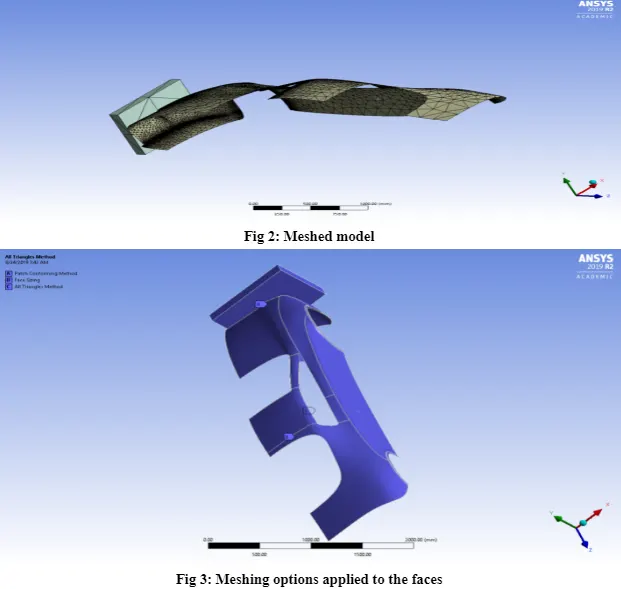
The analysis settings were inputted as given below
Step Controls
Number Of Steps 1
Current Step Number 1
End Time 1.e-003
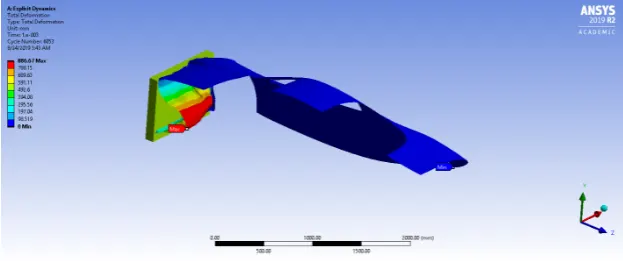
The car body is made fixed by selecting the rear end of the car body and applying a fixed support. A displacement of 500 mm is applied to the wall in the positive Z direction. The inputted load is applied in a single step at an end time of 0.001 sec.
Solution
For an initial car body thickness of 0.3 mm with the given input analysis settings the problem is solved and the results are obtained. After the output results obtained from initial problem setup(thickness 0.3 mm) thickness is taken as the input and the results such as total deformation, equivalent stress and strains were taken as output parameters for carrying out the parameter study. This parameter study is done separately and their results are obtained as sheet file.
Total deformation: 886.67 mm Max
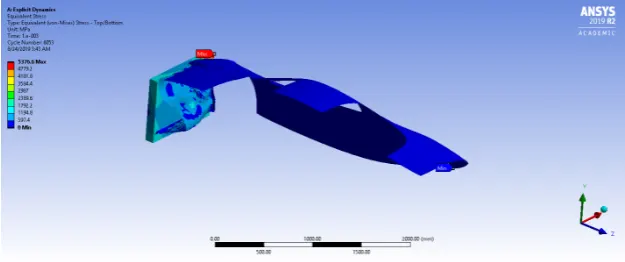
Equivalent stress: 5376.6 MPa Max
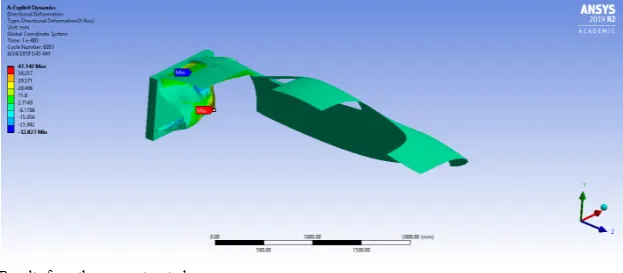
Diretional Deformation: 47.142 mm Max
Results from the parameter study
|
S. No |
Car body Thickness, mm |
Equivalent Stress Maximum, MPa |
Difference |
Total Deformation Maximum, mm |
Directional Deformation Maximum, mm |
|
1 |
0.3 |
5376.611852 |
- |
886.6722951 |
47.14234546 |
|
2 |
0.5 |
5350.244278 |
26.367574 |
885.0718402 |
47.89824784 |
|
3 |
0.7 |
5334.010044 |
42.601808 |
883.6694908 |
47.75559902 |
Conclusion
The simulation was successfully carried out the results were tabulated as above. From the results, it can be concluded that stress is inversely proportional to area and directly proportional to the force acting. The value of stress decreases as the thickness value increases and that difference even though being small, that difference is visible. The same goes for total deformation but the difference between them is small.