Week 11- Broadband Noise modelling over Ahmed body
Objective: The goal is to simulate Broadband Noise across Ahmed's body and depict the drag and lift coefficients.
Introduction :
The sound or noise produced by the aerodynamic forces and motion of turbulent flow in the domain is referred to as aero-acoustics. Car mirrors, wheels, and airplane landing gear are all frequent sources of noise. When an item vibrates, the air pressure varies somewhat. These variations in air pressure move through the air as waves and generate sound. Unwanted or irritating sound is referred to as noise. Sound waves are longitudinal waves that vibrate in the same direction as the wave's propagation. These are waves of pressure.
Need For the study of the Broadband Noise modeling and dynamics of fluid over a Body
Aerodynamic forces and turbulent flow motion create sound/noise, which if not addressed can damage the outer portions of the automobile and cause severe discomfort for the passengers. As a result, acoustic modeling is required to pinpoint the noise-generating sites and make design adjustments.
Depending on the body's speed, form, smoothness of the surface, and velocity, anyone traveling through any sort of fluid encounters varying resistances. Automobiles, airplanes, and other vehicles travel over an ocean of fluid known as air. As a result, there is a reluctance to move. Drag is one of the most significant forms of fluid resistance. A car expends a large amount of energy to overcome these resistances (about 10-15 percent ). Fuel usage will rise as a result of this. In a moving automobile, the lift is similarly created over a person traveling through the air; however, it is an unneeded force that can cause serious accidents if not regulated. The large lift force might cause the Fl vehicle to fly away, necessitating the generation of downforce.
As a result, engineers must investigate the dynamics of fluid surrounding the body and aim to minimize lift and drag forces to the greatest extent possible.
Ahmed's body and its importance.
Ahmed's body is quite helpful in anticipating the most aerodynamic elements that affect the car. In the automobile sector, the Ahmed body is a particularly valuable model for evaluating simulation tools. The Ahmed body form is a straightforward design with car-like proportions. Although we can't estimate the flow separation effects in a reasonable way, this is a bluff body. Drag forces are influenced by a number of parameters, including body viscosity, velocity, and form. Ahmed's body was created in order to examine and conduct tests on the behaviour of air on automobiles. The real-world simulations are carried out on the Ahmed body, which is a car-like duplicate.Because it's tough to simulate real-world vehicles, Ahmed's body is developed in the late 1980s. Acoustic modelling emerged as a result of advancements in CFD. It's a generic automobile model that's used to verify wind tunnel results.
Geometry :
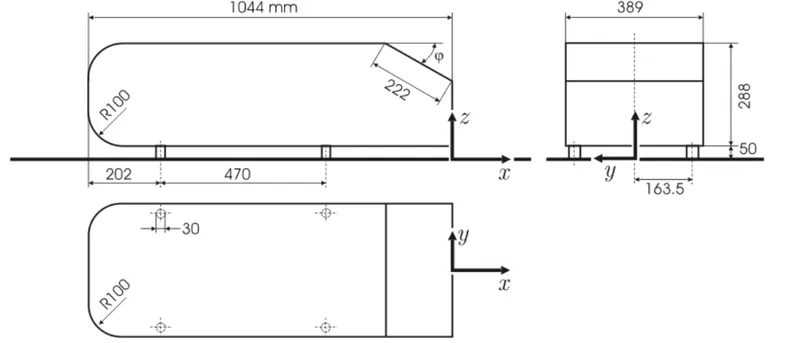
BROADBAND NOISE MODELLING
Noise has no distinguishable tones in many practical applications involving turbulent flows, and sound energy is continually spread across a wide frequency range. In cases where broadband noise is present, statistical turbulence variables easily computed from RAN equations can be used with semi-empirical correlations and Lighthill's acoustic analogy to give light on the source of the broadband noise.
ANSYS FLUENT has many source models that allow you to estimate the local contribution to the overall acoustic power generated by the flow (per unit surface area or volume). The following are some of them:
Proudman's formula
- jet noise source model
- boundary layer noise source model
- source terms in the linearized Euler equations
- source terms in Lilly's equation
Given that one would eventually wish to devise some steps to minimise the noise created by the flow in question, source models may be used to extract relevant diagnostics on the noise source in order to understand which component of the flow is predominantly responsible for noise creation. These source models, however, do not forecast the sound at receivers.
The broadband noise source models, unlike the direct and FW-H integral methods, do not need transient solutions to any governing fluid dynamics equations. The source models only need the mean velocity field, turbulent kinetic energy (k), and dissipation rate, which are all provided by standard RANS models.As a result, using wideband noise source models necessitates the least amount of computing resources.
Ahmed body Dimensions:
H= 0.297m
length of Ahmed body= 3.7H
Height of Ahmed body = H
Width of the Ahmed body = 1.18H
Inclination of the rear = 25 deg
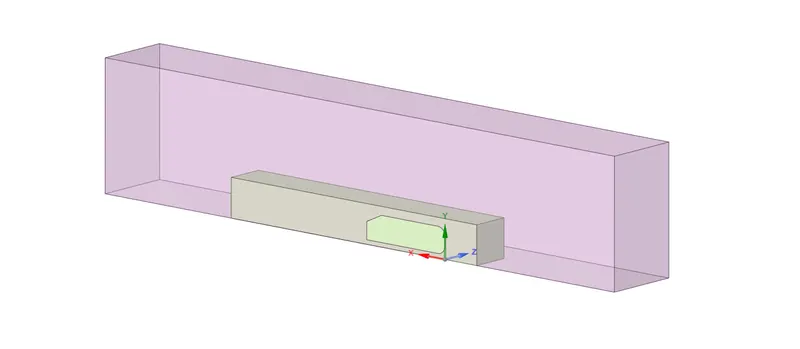
Domain
the rear of the Ahmed body = 5L
Front of the Ahmed body = 3L
height of the Domain = 3L
Width of half the domain = 1.5L
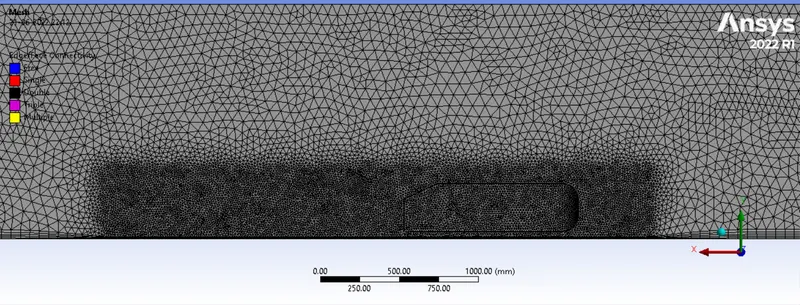
The inner domain is also created (To refine the mesh) with more length at the downstream
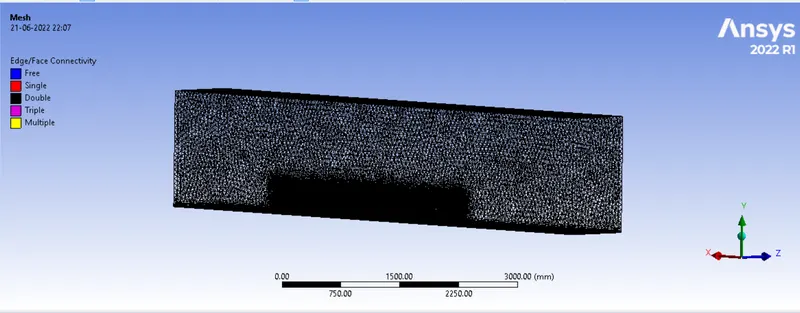
Mesh Parameters:
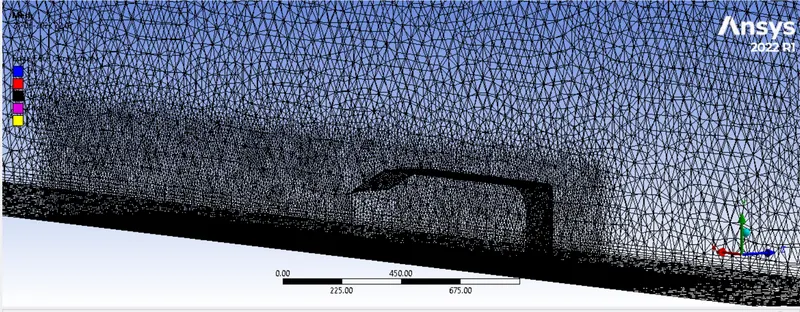
So we have added body sizing and inflation layers to capture the turbulence of flow simulated.
- Mesh Size = 75 mm
- Sizing - Body Sizing
- Mesh size of Ahmed body = 30 mm
- Inflation layer = 28 layers
- Growth rate = 1.2
- Mesh Type - First Layer Thickness
- First Layer Thickness size = 0.01 mm
Fluent set up:
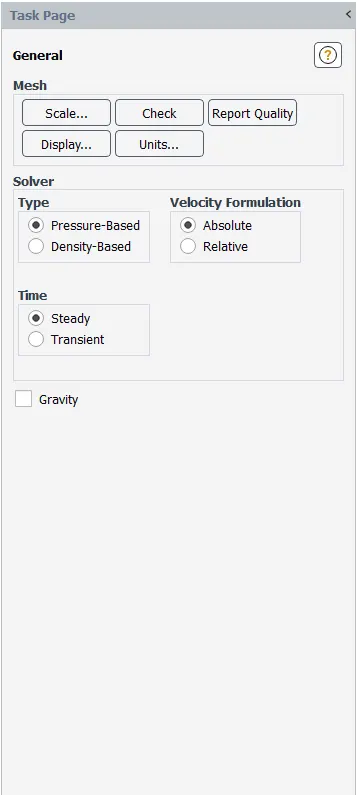
- Solution setup: Due to the low Mach number, a pressure-based solver is employed. The major goal here is to observe how noise develops in the end, hence steady state simulation is used.
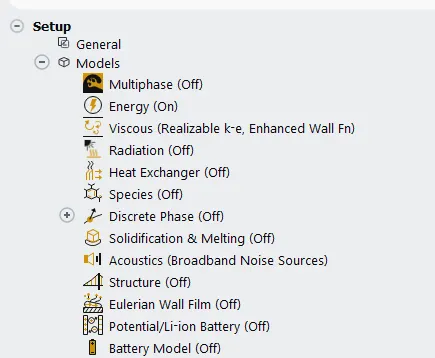
- The power is switched on.
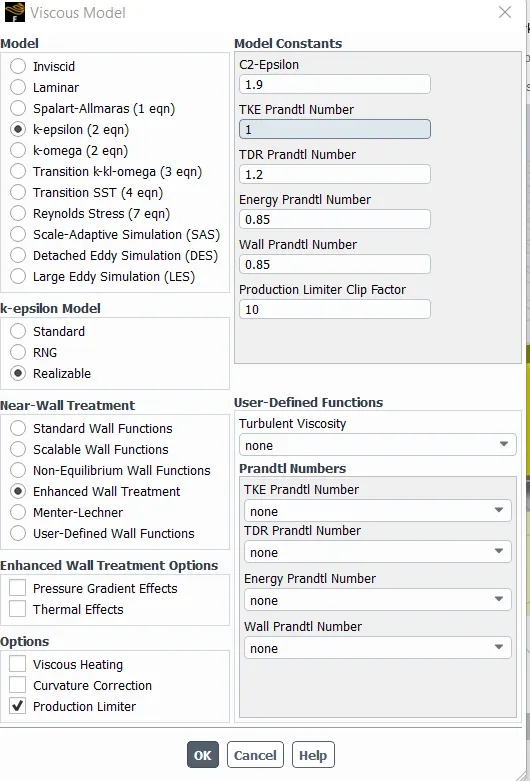
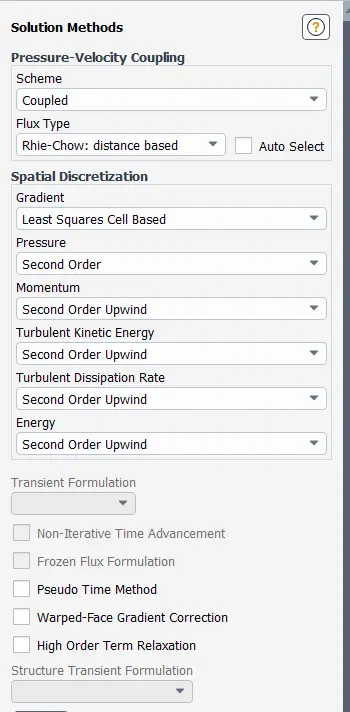
- The K omega st viscous model was chosen as the viscous model. The production limiter has been activated. Any unpredictable convergence issue is taken into account by the production limiter.
- Fluid selection: Air is the fluid. Aluminium is the solid.
- The following are the boundary conditions:
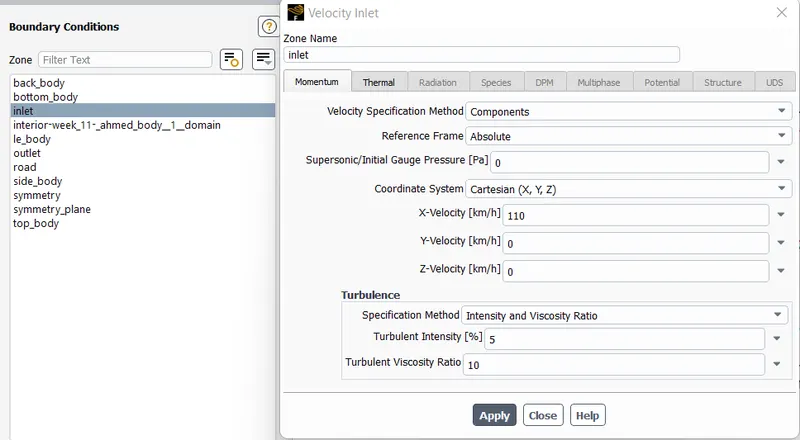
- Inlet: Velocity parameters are entered in component form into the inlet. The inlet velocity's x component is 110 m/s. The rest of the settings are left alone.
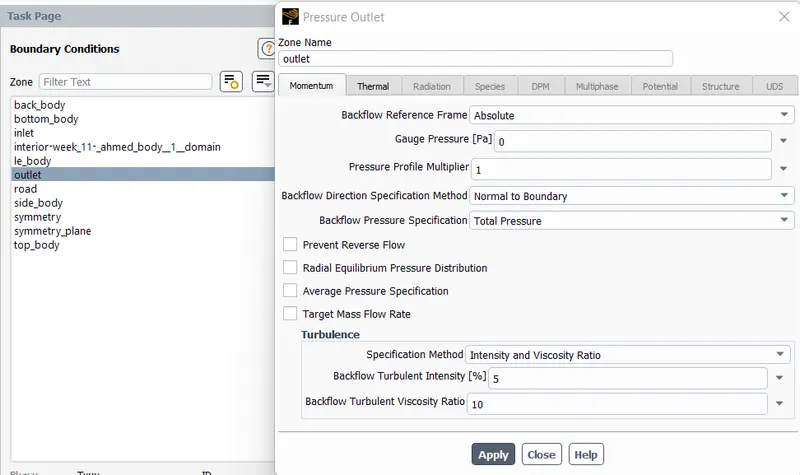
- Outflow: In the outlet, pressure boundary conditions are common.
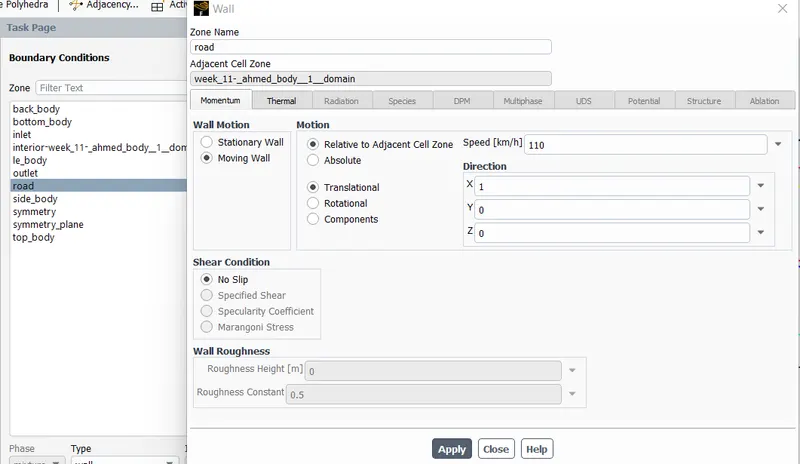
- Road: This is a form of moving wall. The speed of translation in the x direction is 110 m/s, and fluent provides all other boundary conditions by default.
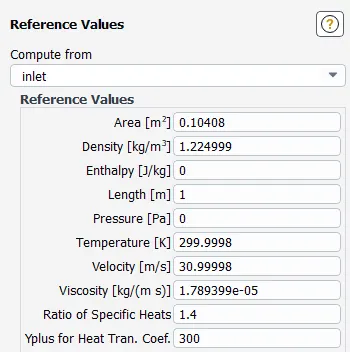
- Reference values: The inlet is used to calculate the reference values. Ahmed's body has a frontal area of 0.10404 m2.
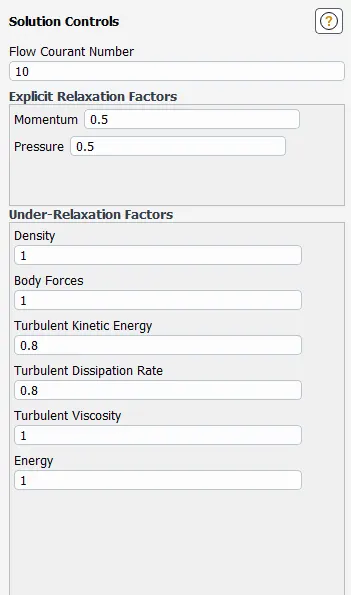
- Controls for the solution: The coupled method has been chosen. The value of the Courant number is set to 10.
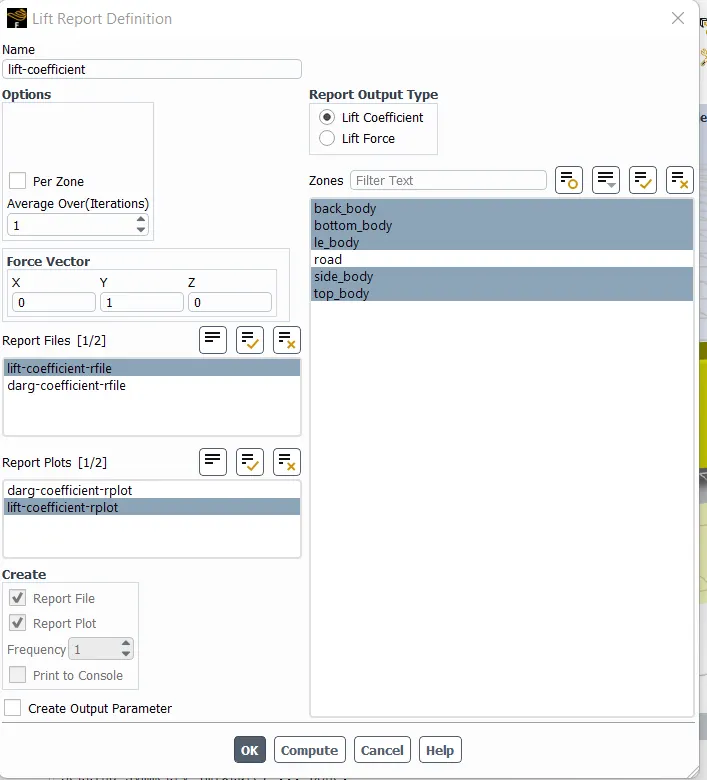
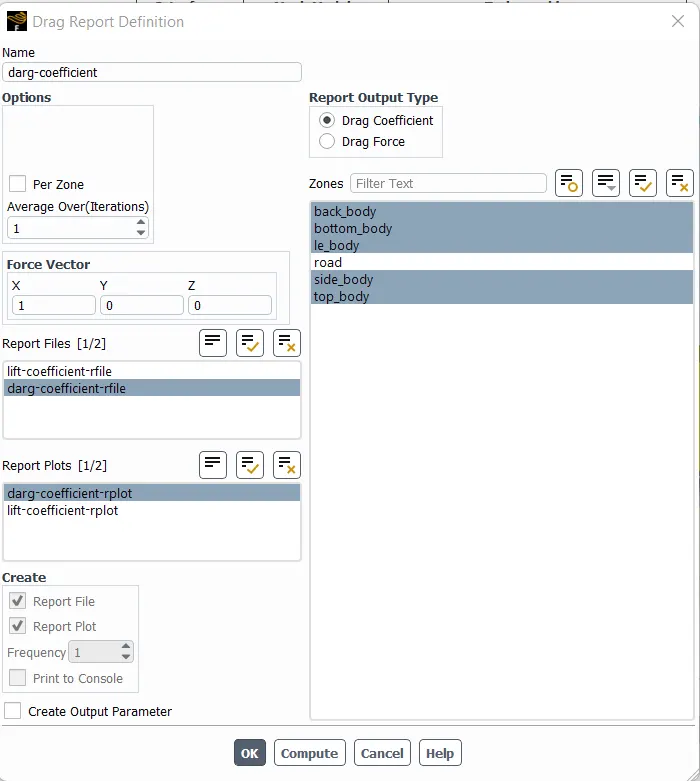
- Report definitions: The drag and lift coefficients are kept track of.
- Convergence criteria: The default convergence criterion is le-03.
- From the intake, standard initialization is chosen. 1000 iterations are specified for the solution.
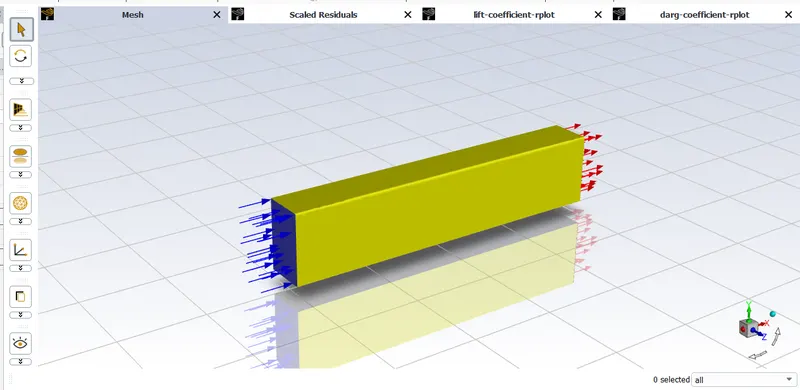
Results :
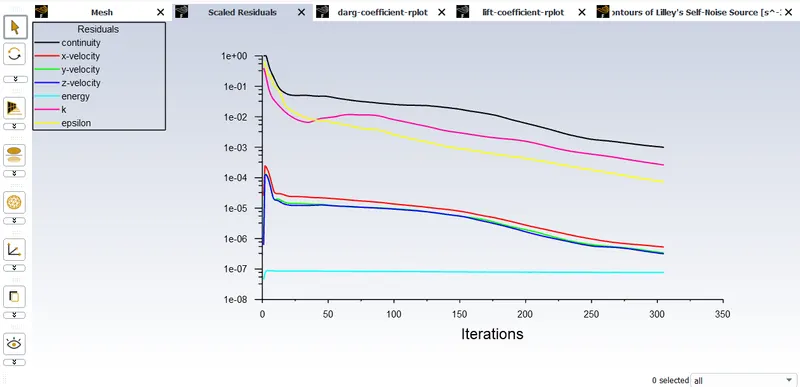
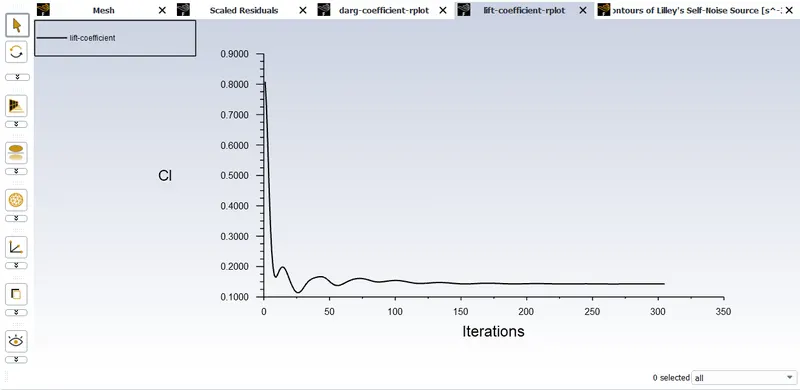
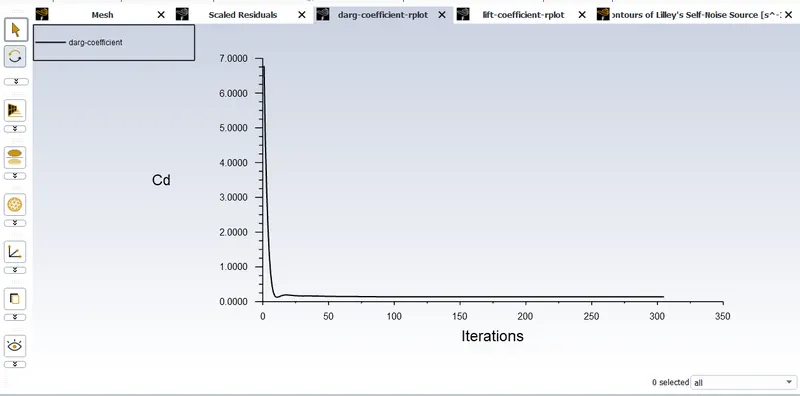
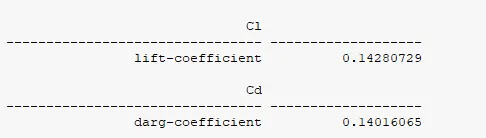
Lift and drag forces are not changing because the solution is getting converged
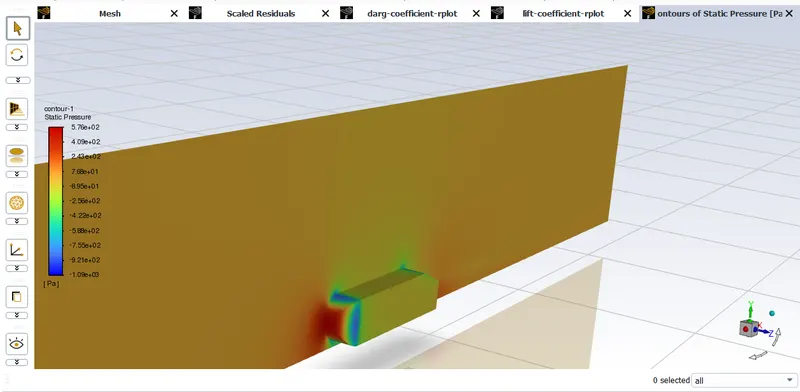
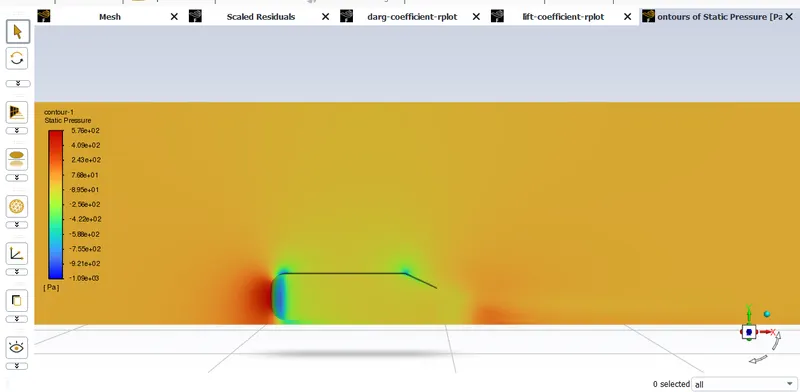
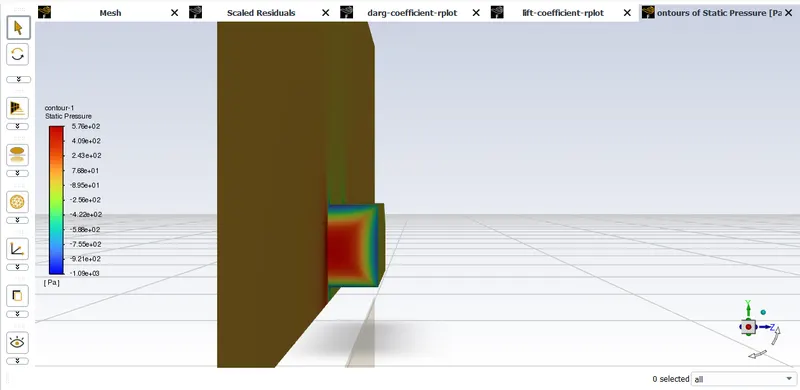
Static Pressure :
Total Pressure :
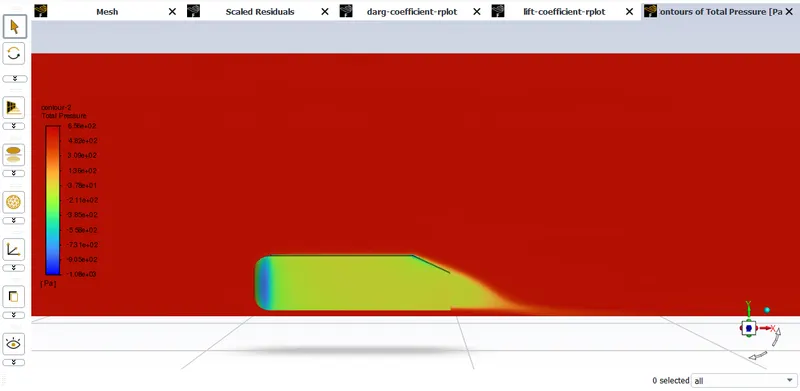
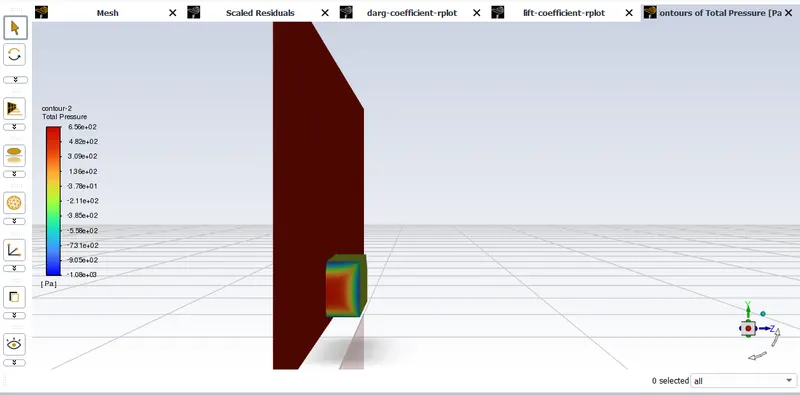
High Pressure is obbserverd at the body in the wake region
Velocity Contour :
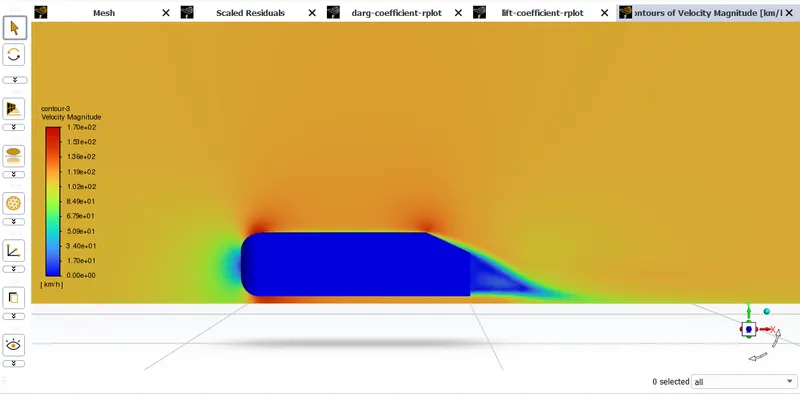
The wake region is creatd behing the body. The velocity on the front of the body is zero. and the velocity on the surface of the body is also zero as per the no slip condition
Acoustics :
Acoustic level decibels :
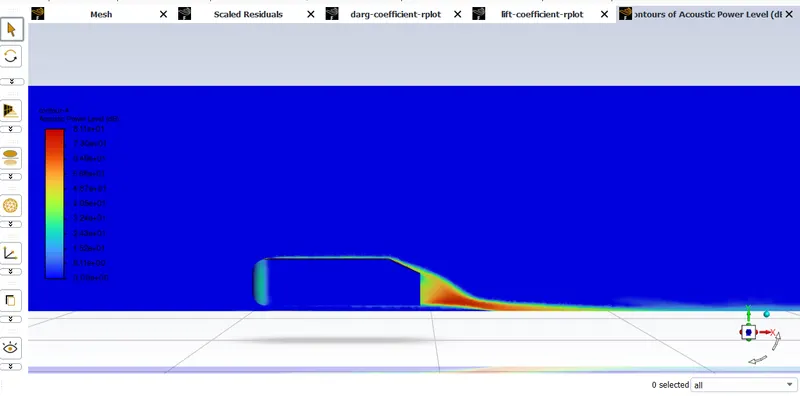
It can be seen that the major part of the contribution to the noise are the boundary layers formation of the wake region as there is more tubulence
Surface Acoustic :
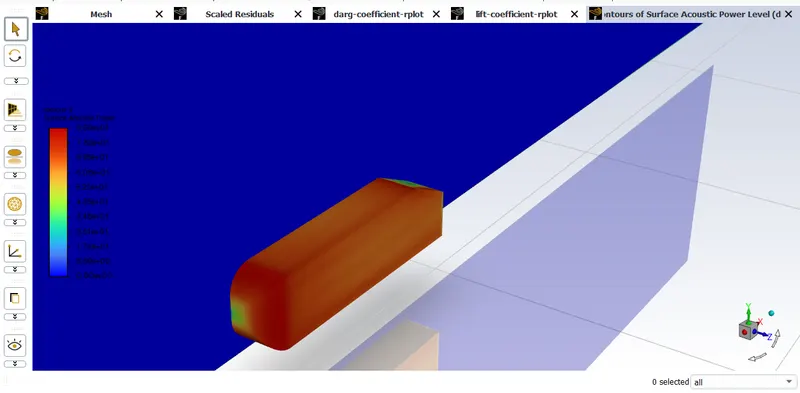
On the surface, the noise generation is due to the edges so any kind of protrusion from the body should be avoided.
Lilley's Shear-Noise Source :
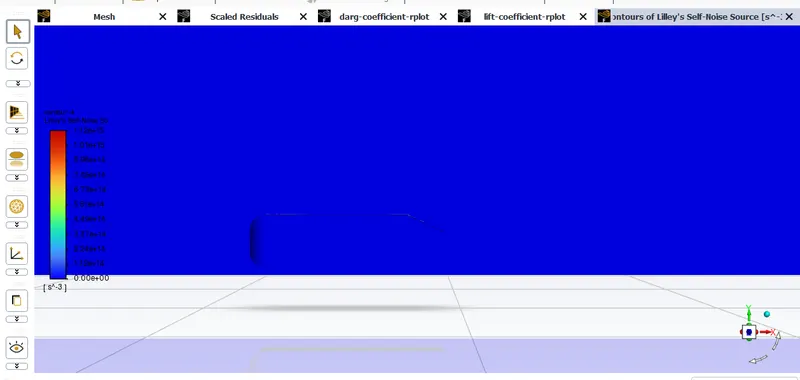
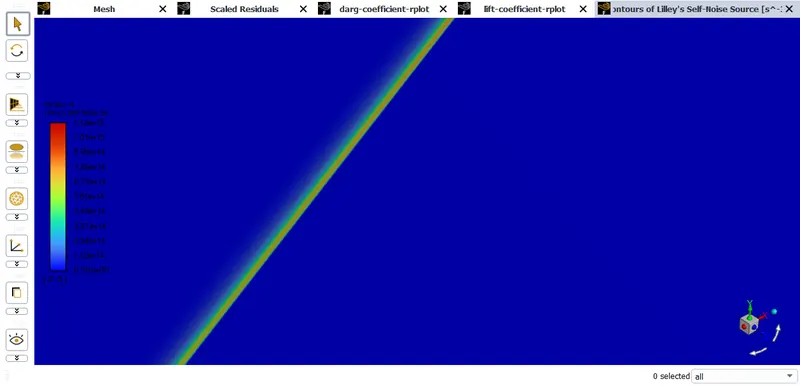
Noise is more where there is a profile change.
Conclusion :
- The wake area and boundary layer creation create the majority of the noise.
- The surface and body should be designed in such a way that the thickness of the boundary layer and the wake zone is reduced. Because removing the border layer fully is difficult. - Sharp alterations in the structure of the profile should be avoided.