Week 11:- 2D Detailing Challenge 2
AIM:
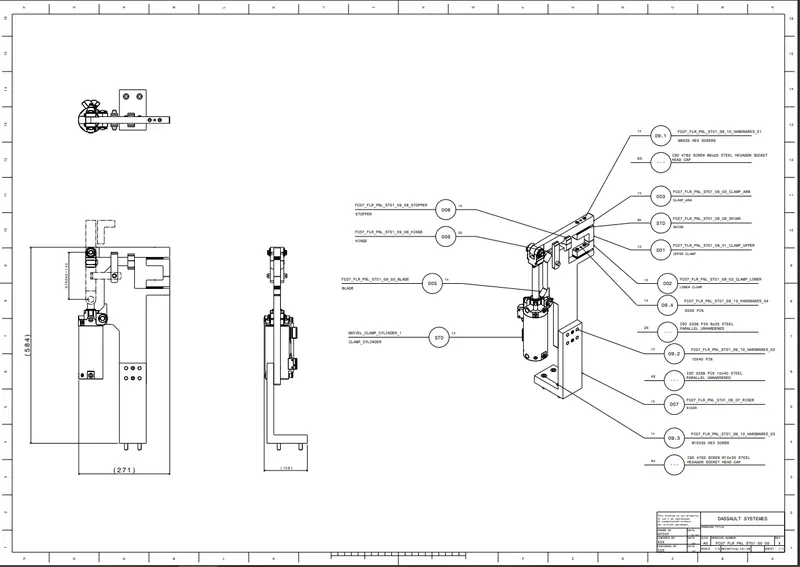
To create clamp and pin unit 2D drawing for the required 3D model and create separate child parts.
SOFTWARE:
CATIA V25
INTRODUCTION:
A Fixture is a device that holds the workpiece or pieces in place while it’s being worked on. It holds it in place by arresting all the degrees of freedom using the 3-2-1 principle. This is necessary to avoid pieces moving while they are being worked on.
The basic principle of fixture design is on how to arrest all the degrees of freedom of the workpiece and also to locate the workpiece in the fixture.
A workpiece free in space can move in an infinite number of directions. For analysis, this motion can be broken down into 12 directional movements or "degrees of freedom". All 12 degrees of freedom must be restricted to ensure proper referencing of a workpiece.
DRAFTING:
Drafting, also spelt draughting, also called engineering drawing, graphical representation of structures, machines, and their component parts that communicates the engineering intent of a technical design to the craftsman or worker who makes the product.
At the design stage, both freehand and mechanical drawings serve the functions of inspiring and guiding the designer and of communicating among the designer, collaborators, production department, and marketing or management personnel. At this stage, exact mechanical drawings can clarify, confirm, or disqualify a scheme that looked promising in a freehand sketch. Actually, both the sketch and the exact mechanical drawing are essential parts of the process of designing, and both belong to the field of drafting. After the basic design has been established, drafting skills aid in the development and transmission of the wealth of data necessary for the production and assembly of the parts. For an automobile, a skyscraper, or a spacecraft, tens of thousands of drawings may be needed to convey all of the requirements of the finished product from the designers to the fabricators.
PIN UNIT:
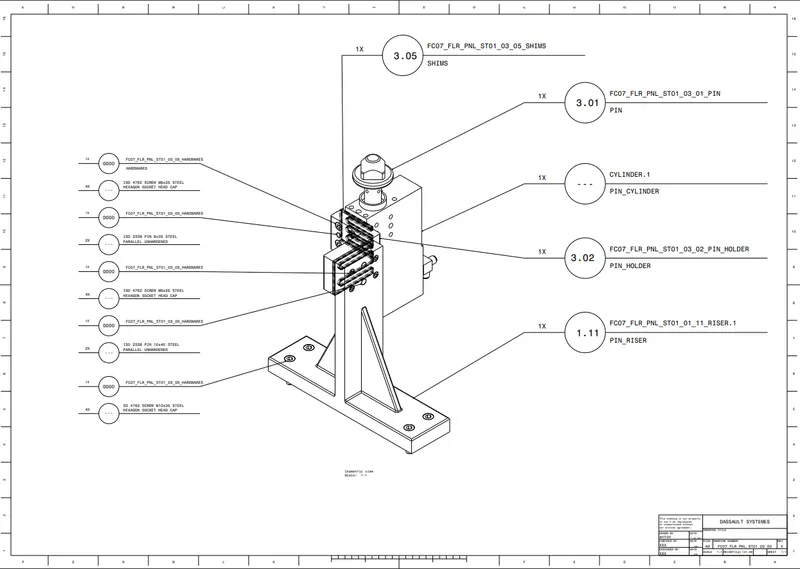
A pin unit is used to locate a component in a fixture, they can be separated based on the ability of motion of the pin as a fixed and retractable pin unit. The pin unit stops the motion of the component along a certain axis.
 +
+
A fixed pin unit consists of a riser, blades, shims, pin retainer and pin.
- Riser: It’s the part used to change the height of the whole unit.
- Blades: These are plates mounted on the riser to which other parts like cylinders, arms etc are mounted.
- Shims: These are parts that are used to compensate for the stack-up tolerances of the mylars. They vary in thickness by 0.1mm, 0.2mm, 0.5mm etc.
- Pin and pin retainer: The pin which is fixed to the pin retainer
The primary purpose of this unit is to locate the panel using the pin. It restricts the degrees of freedom of the panel using the 3-2-1 principle.
CLAMP UNIT:
A clamp unit is used to arrest the motion of the object it is holding. A typical clamp unit has the following parts
- Clamp Cylinder: Clamp cylinder uses compressed air to actuate a piston that produces a force linear on the required part. Pneumatics are preferred so as to reduce noise, cleanliness and reduced requirement of storage space for working fluid (air). The cylinder here has a hinge joint that allows it to swivel. Cylinders are usually bought out parts produced by manufacturers like Tunkers.
- Clamp Arm: The clamp arm moves the clamp finger which is actuated by the cylinder. the clamp arm is hinged this allows the clamp arm to swing along with the clamp finger.
- Clamp Arm: The clamp arm moves the clamp finger which is actuated by the cylinder. the clamp arm is hinged this allows the clamp arm to swing along with the clamp finger.
- Stopper: The stopper restricts the movement of the clamp unit. they are 2 units mounted on the clamp arm and blade respectively and restrict the excessive movement of the clamp.
- Blade: The blade is a made part that is used to position the cylinder, riser, rest and clamp arm hinge.
-
Riser: The riser is a standard part that provides the required height to the unit. It is required to have the required strength to support the unit and component.