Week 10 Thermal Management
AIM : To prepare a report summarizing thermal management techniques for electric car battery pack.
SOLUTION :
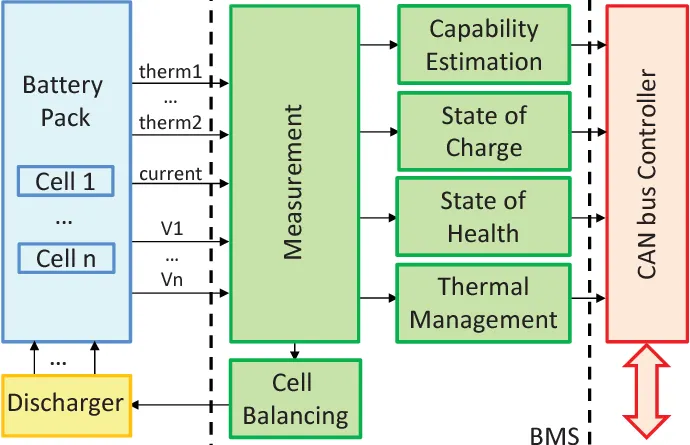
Battery management system is an electronic system which safegaurds rechargeable battery by making it operate within the given operating range like preventing it from over charging, maintaining a proper discharge ,State of charge with respect to other cells and temperature.
Reasons for change in temperature of a battery :
All batteries depend for their action on an electrochemical process whether charging or discharging and we know that these chemical reactions are in some way dependent on temperature.
Nominal battery performance is usually specified for working temperatures somewhere in the + 20°C to +30°C range however the actual performance can deviate substantially from this if the battery is operated at higher or lower temperatures.
The operation of any battery generates heat due to the I2R losses as current flows through the internal resistance of the battery whether it is being charged or discharged. This is known as Joule heating
In addition to Joule heating the chemical reactions which take place in the cells may be exothermic, adding to the heat generated or they may be endothermic, absorbing heat during the process of the chemical action. Overheating is therefore more likely to be a problem with exothermic reactions in which the chemical reaction reinforces the heat generated by the current flow rather than with endothermic reactions where the chemical action counteracts it. In secondary batteries, because the chemical reactions are reversible, chemistries which are exothermic during charging will be endothermic during discharging and vice versa. So there's no escaping the problem. In most situations the Joule heating will exceed the endothermic cooling effect so precautions still need to be taken.
The thermal condition of the battery is also dependent on its environment. If its temperature is above the ambient temperature it will lose heat through conduction, convection and radiation. If the ambient temperature is higher, the battery will gain heat from its surroundings.
How change in temperature above or below operating range affects battery :
- The active chemicals expand causing the cell to swell
- Mechanical distortion of the cell components may result in short circuits or open circuits
- Irreversible chemical reactions can occur which cause a permanent reduction in the active chemicals and hence the capacity of the cell
- Prolonged operation at high temperature can cause cracking in plastic parts of the cell
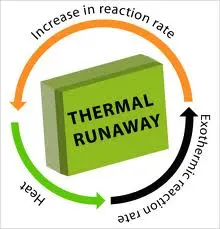
- The temperature rise causes the chemical reaction to speed up increasing the temperature even more and could lead to thermal runaway
- Gases may be given off
- Pressure builds up inside the cell
- The cell may eventually rupture or explode
- Toxic or inflammable chemicals may be released
Thermal Battery management system :
This helps to increase lifetime of battery by regulating temperature level and distribution. The batteries can be cooled by using coolants like air or liquids.
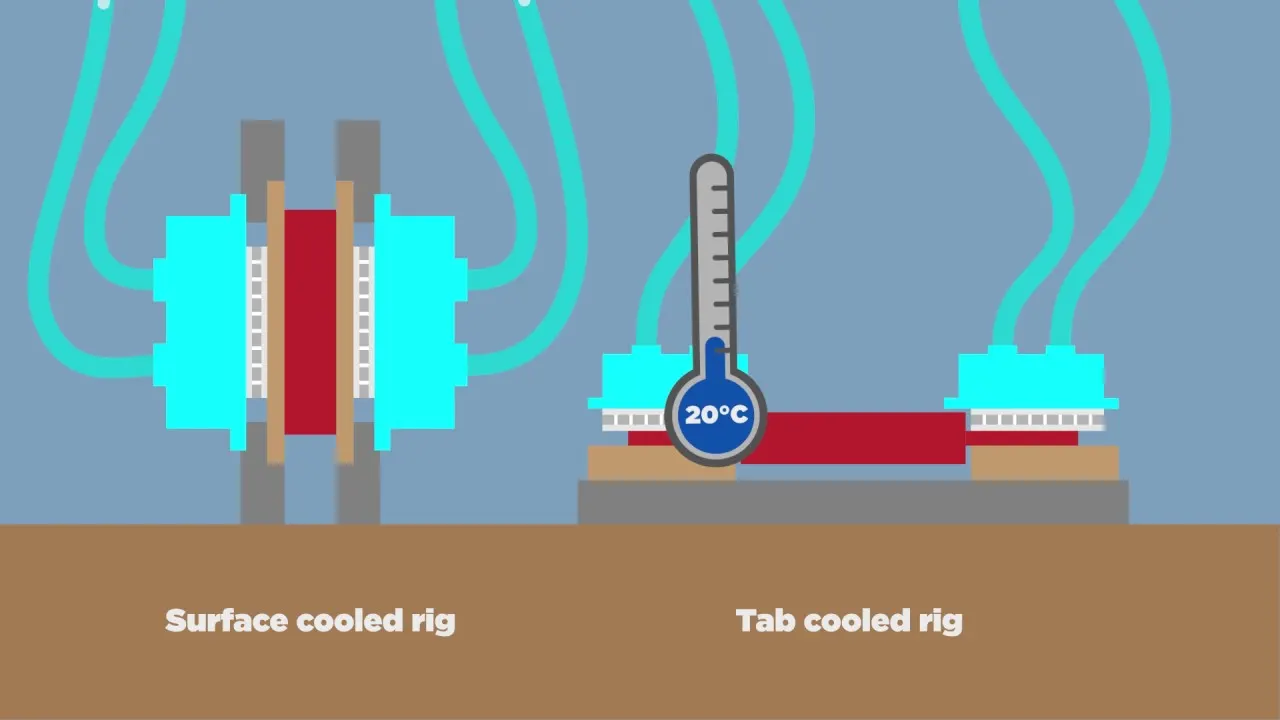
Surface cooling :
Air cooling system :
In the air cooling system, the battery is cooled by an airflow sweeping the battery pack. The air typically comes from outside, but also from the cabin and additional AC units in systems that are more complex. The advantage of this method is its simple nature, where no insulation between the air and the battery is needed or which allows less maintenance and lighter components.
Liquid cooling system :
In the liquid cooled systems, components which contain a coolant are located in between cells or modules. The heat is then transported to a heat sink, placed away from the battery pack. The heat sink can be a simple radiator or a more complex system dissipating the heat into a refrigerant circuit. Usually, both are used in combination, where switching is done depending on various parameters.
The above approaches are called active, because they use external components such as pumps and fans which use additional battery power.
Tab cooling :
Tab cooling is best achieved by a water-based coolant or an organic refrigerant circulated through a cold plate system built into the battery pack by a pump.
The coolant can be used to remove heat from the pack and to also provide heating of the pack for fast charging at low temperatures.
Example : BMW i3 and the Chevy Bolt use a bottom cooling plate in its battery with the cooling medium being a refrigerant for the BMW and water-glycol for the Chevy. Fitting the cooling plate to the bottom of the pack is not necessarily for directional cooling, however, it is more likely to be linked to simple construction and failure mode analysis of leaks within the pack itself. Although the BMW does use top-mounted terminal tabs; this will be directional cooling in the correct direction but at the opposite end to the hot spot in the cell. The Chevy has side-mounted tabs meaning the cooling base plate is potentially drawing heat from the wrong edge of the cell.